IN Brief:
- Expert manufactures central impression and stack flexographic presses at its Italian operations near Verona.
- The acquisition expands BW Converting's equipment portfolio across different production widths, substrates, and printing configurations.
- Expert gains access to BW Converting's international sales, technical service, and spare parts network.
BW Converting has acquired Italian flexographic printing press manufacturer Expert Srl, expanding its equipment portfolio for flexible packaging production and strengthening its engineering presence in Europe. The acquisition adds central impression and stack press technologies for converters working with paper, polymer films, and laminated materials.
Expert was established in 2004 in San Martino Buon Albergo, near Verona, and develops printing and converting equipment for a range of industrial applications. Its press portfolio spans different production widths, print repeat lengths, colour configurations, and operating speeds, enabling converters to select equipment according to their production volumes and material requirements.
The acquisition brings Expert’s press design and engineering capabilities into BW Converting’s print and packaging business. The Italian manufacturer will also gain access to the group’s international sales, service, and spare parts infrastructure, extending the resources available to support existing machinery installations and reach additional markets.
Flexographic printing is used extensively in food packaging manufacture, applying graphics, branding, and product information to continuously fed materials before they undergo further conversion. Printed rolls may subsequently be laminated, slit, converted into pouches, or transferred directly to food manufacturing facilities for use on automated packaging lines.
The printing process uses flexible plates containing raised image areas, with an anilox roller metering the ink transferred to each plate. The volume of ink carried by the roller’s engraved cells, together with the ink’s physical properties, influences the resulting colour density and consistency. Multiple printing stations apply separate colours as the packaging material passes through the machine.
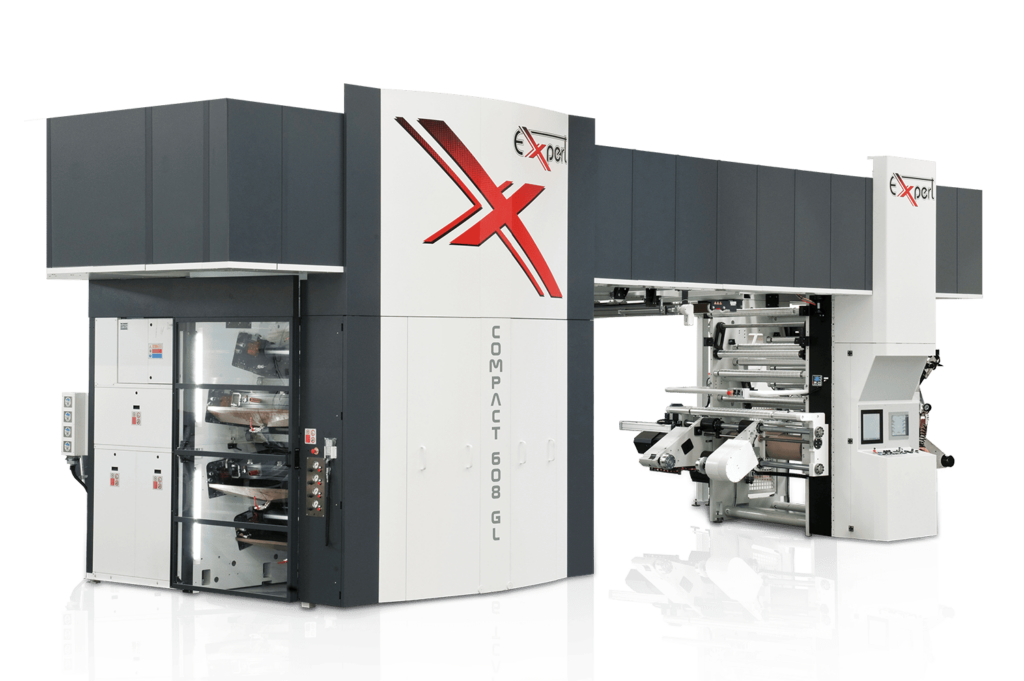
Expert’s central impression presses arrange these stations around a common supporting cylinder, keeping the substrate supported as successive colours are applied. This configuration helps maintain registration when printing polymer films that may otherwise stretch or distort under variations in web tension.
Its Compact central impression press accommodates printing widths from 600mm to 1,000mm, with six, eight, or ten colour configurations and maximum printing speeds of 300 metres per minute. The machine also supports print repeat lengths of up to 750mm, establishing the range of design dimensions that can be accommodated within its specified configuration.
Stack presses arrange printing stations independently, typically in a vertical configuration. Their material paths can provide greater flexibility for applications requiring printing on both sides of a substrate, or for integration with other converting processes, depending on the equipment configuration.
Expert’s Sprint stack press supports widths of up to 1,600mm and repeat lengths of up to 1,250mm, with maximum printing speeds of 350 metres per minute. The machine is available with several printing station configurations, ranging from single-colour operation to eight colours.
The difference between the two platforms illustrates the importance of selecting printing machinery according to the characteristics of the finished packaging. A press designed for demanding registration requirements on flexible films may serve a different production portfolio from equipment configured for wider substrates or longer print repeat lengths.
Changing packaging material specifications introduces additional variables into the printing process. Recyclable flexible packaging structures may use different combinations of polymers from established laminates, altering the material’s stiffness, thermal response, and dimensional stability as it passes through printing and drying equipment.
These changes can affect the tension needed to transport the web consistently between printing stations. Excessive tension may stretch a film and alter print registration, while insufficient tension can allow creasing or irregular movement. Converters must also account for the compatibility of printing inks with the substrate and any subsequent lamination, coating, or sealing processes.
Expert has previously extended its engineering activities into coating and lacquering applications involving paper, films, and aluminium foil. These operations allow different surface properties to be introduced during material conversion, broadening the range of packaging applications that can be supported by an individual manufacturing system.
The economics of shorter packaging runs also influence the specification of flexographic equipment. Preparing a press for a new design requires adjustments to plates, inks, registration, and operating parameters before saleable material can be produced. Material consumed during setup contributes to manufacturing waste, while the associated downtime reduces the capacity available for production.
Reliable access to technical support becomes increasingly important as printing and converting equipment incorporates more sophisticated control systems and automated adjustment functions. A press’s operating availability depends partly on the ability to diagnose faults, obtain replacement components, and restore acceptable printing performance following an interruption.
Expert’s integration into BW Converting’s international support network will extend the service infrastructure available to its customers. The transaction value and any plans for additional manufacturing investment have not been disclosed. Its immediate effect is to expand the range of press architectures, production widths, and material applications available through BW Converting’s flexible packaging equipment business.