IN Brief:
- The Hygienic Oil family spans SCARA, articulated and palletising robot formats.
- NSF H1 food-grade lubricants address incidental lubricant contact risks, not all hygiene requirements.
- Automha is presenting four-direction shuttles, pallet storage systems and warehouse software.
Comau has introduced a Hygienic Oil family of industrial robots for food handling and processing, presenting the range at Cibus Tec 2026 in Parma alongside warehouse automation technology from Automha. The company says the new robots use NSF H1 food-grade lubricants and are intended to reduce the need for protective robot covers in suitable applications. The launch extends its existing offer across production and product handling while the wider group presents integrated pallet storage, picking and logistics systems.
The Hygienic Oil range spans several robot types and payload capabilities, including Rebel SCARA machines, Racer and NJ articulated robots and palletising models. Comau identifies pick-and-place, portioning, processing and handling as potential applications in food factories, including zones where food may be exposed. One exhibit is the four-axis S-18-1.7 HO robot, designed for food handling duties. These configurations address different motion and load requirements; a compact high-speed transfer application has little in common with moving loaded pallets at the end of a line.
The defining lubrication specification is important but limited. NSF H1 is a registration category for lubricants permitted for incidental food contact during processing; it does not authorise deliberate addition of lubricant to food. An H1 lubricant specification does not certify the robot as a whole for direct food contact or establish that its construction meets all the cleaning requirements of a particular food processing area. A food plant assessing the system must still consider structural design, crevices, washdown suitability, seal integrity, materials, surface finish and the cleaning chemicals used within a particular production zone.
Comau says the H1-lubricated range is designed to limit contamination risk without the protective covers sometimes fitted over robots in food applications. Removing a cover could simplify access and eliminate certain cover-related cleaning tasks, but suitability will depend on the environment and intended product contact. High-moisture or aggressive washdown areas may impose additional constraints on electrical enclosures and moving joints. A supplier’s lubrication strategy is therefore one part of an equipment hygienic design assessment, not a substitute for plant hazard analysis or cleaning validation.
Comau separately describes parts of its existing robot range as FCM-certified and MOCA-compliant, providing a complementary food-contact materials offer. The scope of food-contact materials compliance differs from lubricant registration, and neither should be used as a blanket certification claim for a complete integrated line. Integrators need to identify which specific equipment and components fall within each approval and what operating conditions are covered. End-effectors, tooling, conveyors and guarding may come from other suppliers, making system-level assessment essential before a cell is commissioned.
The exhibition includes a Racer-5 SE food-handling cell developed with Progea Leonardo and Camozzi, alongside a packaged-product pick-and-place application using Comau’s MyCo collaborative robot developed with Innovision. These demonstrations show different positions for robotics within a food production line. Handling an unpackaged portion can introduce more stringent hygiene obligations than transferring already sealed products, while collaborative applications require a risk assessment of human contact, speed and protective measures regardless of the robot’s marketing designation.
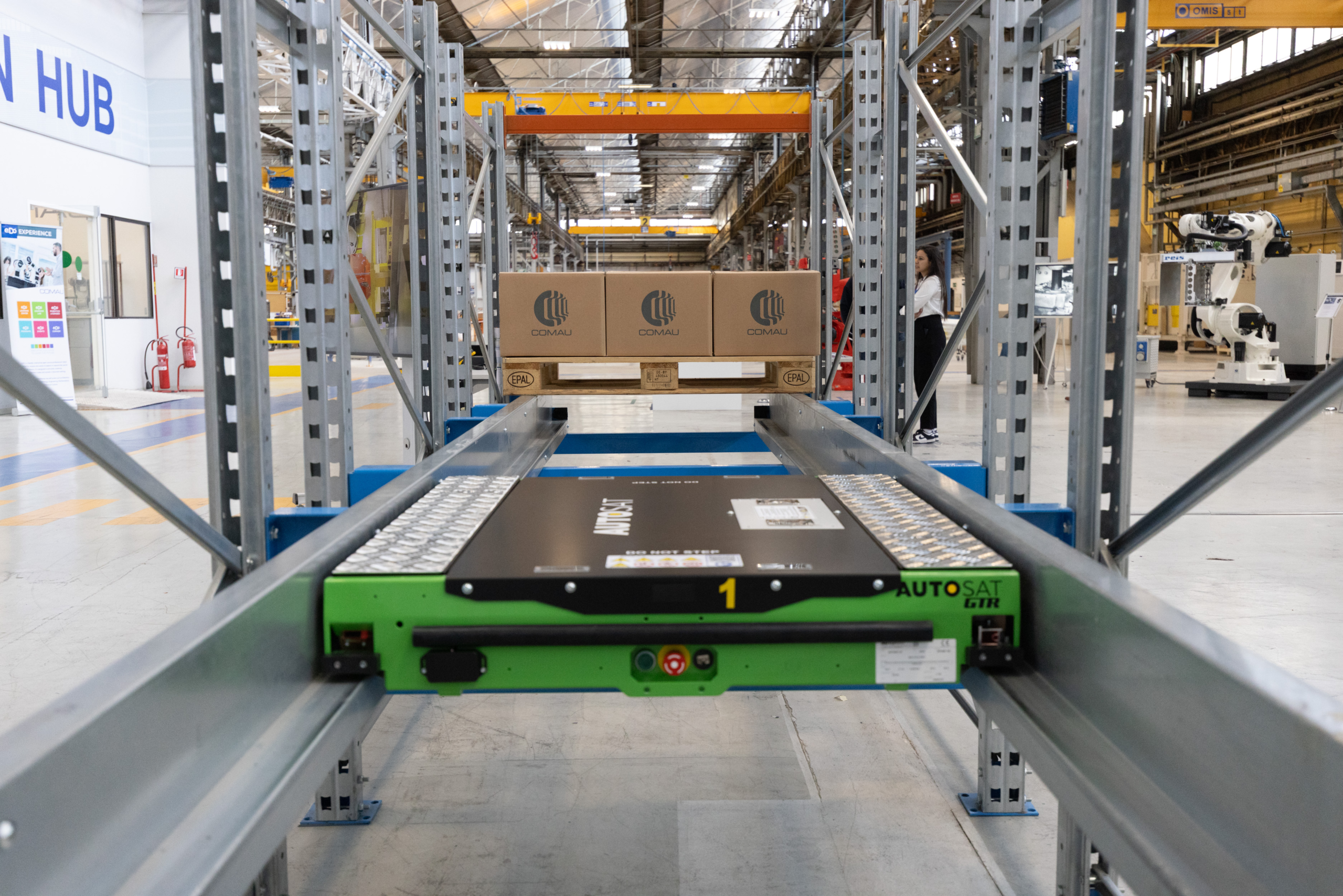
Automha is presenting its Quaterways multidirectional shuttle, which can travel through rack aisles in four directions, and the AutosatGTR system for multi-depth pallet storage. The Quaterways platform operates with Automha Warehouse Management System software, linking storage and retrieval tasks to inventory instructions. Automated storage can increase density and reduce manual movement when layouts, throughput and pallet characteristics support it. An actual food warehouse installation would still need to demonstrate the specified temperature range, stock rotation rules, traceability integration and pallet movement rate; the exhibition announcement does not document a particular operating deployment.
The partners, also referring to Invent’s software expertise, are positioning a combined service across material receipt, processing, handling, packing, storage and dispatch. Such breadth can simplify contractual integration, but it does not eliminate the engineering boundaries between food-contact equipment, controls and warehouse systems. Data handovers, interfaces, hygiene zones and mechanical availability still determine whether separate technologies function together as a complete installation.
Commissioning a mixed production-and-storage automation system also requires an agreed approach to fault recovery. A stoppage at a robotic pick-and-place cell can change the flow reaching downstream packers, while warehouse systems depend on accurate unit and pallet identification. Integration work must specify safe restart procedures, inspection of held products and the reconciliation of traceability records after disturbances, not simply the nominal rate of each robot or shuttle.
Francesco Allegra, Automha’s Chief Executive and Comau’s Chief Operational Performance Officer, said growing demand was encouraging investment in combined robotics and intralogistics capabilities. Cibus Tec runs in Parma from 27 to 30 October 2026. The confirmed product launch is Comau’s Hygienic Oil family, while the Automha machines are being exhibited as part of an integrated offer; the release names no new food-factory customer orders arising from the event.