IN Brief:
- The Department for Business and Trade has published a Supply Chain Centre mission statement and 14-point action plan.
- The centre will focus on future risk, essential inputs, domestic capacity, global partnerships, disruption response, and business support.
- Food manufacturers are exposed through ingredients, packaging, fertiliser, machinery, energy-linked inputs, and logistics resilience.
The Department for Business and Trade has set out a Supply Chain Centre mission statement and 14-point action plan designed to strengthen UK resilience around critical inputs and long-term business growth.
The centre has been created in response to a more volatile global operating environment shaped by geopolitical fragmentation, climate impacts, technological change, and recurring disruption to international trade. Its mission is to act as a central hub for supply-chain intelligence and policy inside government.
The plan sets out six main objectives: anticipating future supply-chain risks, identifying essential inputs, building domestic capacity, diversifying global partnerships, managing disruption, and supporting businesses. The government has also identified broad categories of growth-driving inputs, including fertilisers, electronic components, engines and motors, heavy industrial machinery, inorganic chemicals, laboratory reagents, metals, batteries, and specialised vehicles.
Food processing depends on many of those inputs indirectly as well as directly. Agricultural production relies on fertilisers, crop protection, fuel, machinery, and spare parts. Factories rely on packaging materials, hygiene chemicals, cold-chain equipment, process machinery, electronic components, energy, transport capacity, and digital systems. Disruption in any of those areas can affect continuity, cost, quality, and customer service.
Fertilisers are a clear example. Fertiliser price and availability affect farm production costs, crop yields, and ultimately the price and supply of ingredients. Packaging materials create another exposure. Paperboard, polymers, aluminium, glass, labels, coatings, inks, and closures all depend on global material and energy markets.
Machinery and electronic components are equally important because a food factory can be constrained by a single unavailable part as much as by a missing ingredient. Sensors, motors, drives, valves, pumps, seals, controls, and automated handling systems all depend on supply chains that may sit several tiers away from a food manufacturer’s usual procurement view.
The Supply Chain Centre is expected to use policy and analytical expertise, including the Global Supply Chains Intelligence Programme, to combine government and industry data. That approach is intended to reveal risks linked to products, suppliers, and geographies before disruption becomes acute.
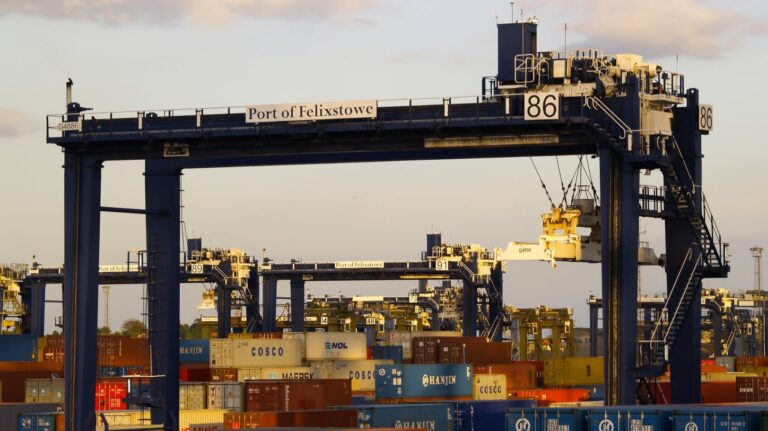
Freight resilience remains a closely connected issue. UK transport networks support food, fuel, medicines, construction materials, and emergency response, and cuts or bottlenecks in those networks quickly become wider supply-chain problems. The DBT action plan sits in the same policy territory, with resilience depending on the physical and informational systems that keep goods, inputs, and equipment moving.
The practical question is whether the centre can turn intelligence into useful action. Companies already monitor supplier risk, but many do not have full visibility beyond tier one. Food production networks often depend on upstream chemicals, additives, processing aids, farm inputs, packaging intermediates, logistics capacity, and equipment suppliers that are not visible in day-to-day procurement dashboards.
Better government-industry data sharing could help identify systemic risks, particularly where multiple manufacturers depend on the same input, origin, route, or supplier region. It could also support targeted action during disruption, such as prioritising critical imports, diversifying supplier markets, or coordinating responses across departments.
The centre’s value will depend on speed and specificity. Broad resilience language has limited value when businesses need immediate clarity on ports, customs, product categories, supplier countries, energy exposure, or regulatory changes. Food manufacturers operate on tight production schedules and retail service levels, so resilience support has to be practical enough to influence sourcing, inventory, logistics, and investment decisions.
The plan reflects a wider shift in industrial policy. Supply chains are no longer being treated only as commercial arrangements between companies. They are becoming part of national economic security, especially where disruption affects food, energy, health, defence, and key manufacturing sectors. Food factories need inputs, people, equipment, packaging, transport, energy, and data; the Supply Chain Centre gives government a framework for understanding those dependencies before disruption reaches the production line.