IN Brief:
- Den Berk Délice has placed a Packaging Automation REV6 top sealer into production at its Belgian operation.
- The system adds higher speed, revised software, easier operation, and faster tooling changes.
- The investment supports growing use of lighter mono material trays across tomatoes and snack vegetables.
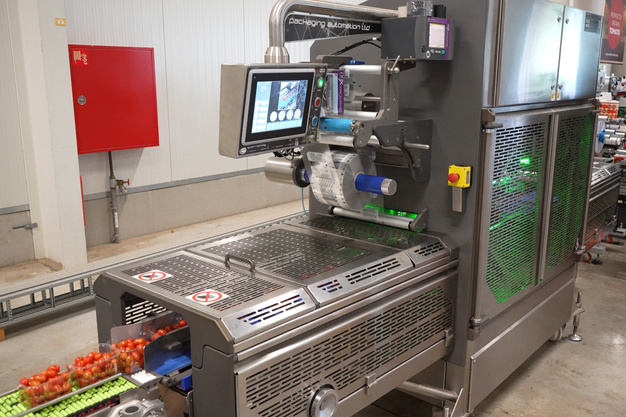
Den Berk Délice has installed a Packaging Automation REV6 top sealer at its Belgian tomato packing operation, increasing line speed and changeover flexibility as the producer expands its use of lighter mono material packs.
Supplied and installed by Het Packhuys, the machine entered production in April 2026 and is being used for cherry tomatoes and snack vegetables. Den Berk now operates six top sealers across its sites, including equipment at its Moroccan production operation, following a relationship with the supplier of approximately four years.
The REV6 introduces higher throughput, revised software, easier operation, and faster tooling changes than the previous machine generation. Existing lidding films can continue to run on the system, allowing the equipment upgrade to proceed without an immediate wholesale conversion of packaging materials.
Top sealing replaces a separate clip on lid or overwrap with film sealed directly to a tray rim. The format can reduce packaging weight and pack height while preserving product visibility, tamper evidence, and containment through packing, palletisation, transport, and retail handling.
Fresh produce places variable demands on a sealing process because tomatoes differ in size, shape, temperature, surface moisture, and fill pattern. Trays can also distort during denesting, filling, conveying, and sealing, while fruit or debris trapped on the flange may weaken seal integrity or contaminate tooling.
Stable output consequently depends on more than headline cycle speed. Tray presentation, film tracking, sealing pressure, dwell time, temperature, cut accuracy, reject control, and downstream handling determine how many saleable packs leave the line during a complete shift.
Where a faster sealer is introduced, upstream and downstream operations must keep pace. Denesting, product filling, inspection, labelling, checkweighing, case packing, and palletising each need sufficient capacity and controlled accumulation if the additional speed is to produce more finished cases rather than longer queues between machines.
Lighter packs require tighter control
Industrial dry fibre forming trials undertaken by Fiberdom and Kiefel have shown a comparable interaction between material reduction and production engineering, with forming speed, sealing, barrier performance, tooling, and downstream compatibility all needing to work within the same process window.
Mono material design can simplify collection and recycling by reducing combinations of polymers or separate components, although it does not remove the engineering work required on the packing line. A lighter tray may have less stiffness, different denesting behaviour, and greater sensitivity to heat, compression, or guide pressure.
Film and tray must form a reliable seal across routine variation rather than only under ideal validation conditions. Changes between material batches, ambient temperature, pack contamination, equipment cleanliness, and product temperature can narrow the operating window and create intermittent leaks that are difficult to identify during short checks.
Faster tooling changes are particularly useful in produce packing, where schedules respond to crop availability, retailer orders, promotions, and daily quality. A line may move repeatedly between pack sizes, tray colours, fill weights, and customer specifications, making changeover loss a significant part of overall capacity.
Mechanical replacement is only one stage of a format change. Operators may also need to load a recipe, adjust guides, thread film, confirm sealing temperatures and pressures, verify print or label data, run integrity tests, check weights, and obtain quality approval before full speed production resumes.
Updated software can reduce start up waste when recipes are controlled and access rights prevent unapproved changes. Stored parameters improve repeatability between shifts, but they cannot compensate for altered tray stiffness, film behaviour, moisture on the flange, damaged tooling, or residue on sealing surfaces.
Het Packhuys and its J-TS operation can connect top sealers with case packing, palletising, tray denesting, conveyors, labelling, barcode detection, checkweighing, and metal detection. Broader integration becomes more valuable as packers remove manual transfers and balance the complete line around higher sealing capacity.
Increasing speed at one stage can expose constraints elsewhere, particularly where produce is still placed manually or inspected by operators. Poorly designed accumulation may allow packs to collide, fruit to bruise, trays to deform, or lidding film to lift before the seal has fully cooled.
Agricultural variability also limits how rigidly automation can be configured. Vision systems, adjustable guides, gentle handling, and well planned reject routes help accommodate natural variation without turning every unusually sized tomato or distorted tray into a stoppage.
Den Berk’s investment brings additional capacity while its packaging specifications continue to evolve. The REV6 will need to maintain seal integrity, product condition, and repeatable changeovers as thinner materials, shorter campaigns, and a wider mix of pack formats place greater demands on operators and controls.