IN Brief:
- Green Power Systems has supplied 50 generator sets powered by FPT Cursor 13 engines for a major Algerian dairy project.
- The equipment will support central pivot irrigation in Adrar province, where dairy feed production faces extreme heat conditions.
- The project connects dairy processing capacity with power resilience, irrigation, food security, and agricultural infrastructure.
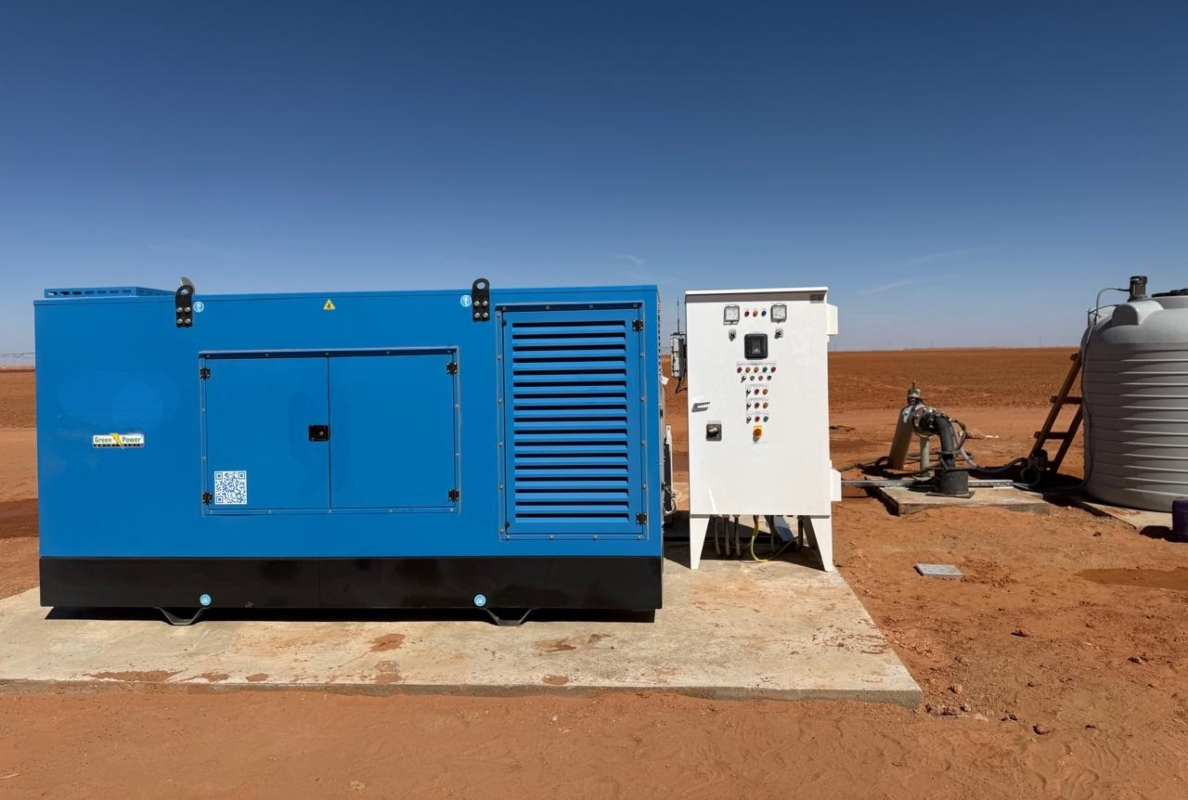
FPT Industrial engines are powering 50 generator sets supplied by Green Power Systems for a major dairy and powdered milk project in Algeria’s Adrar province.
The GP330 S/I-A generator sets are equipped with FPT Cursor 13 engines, each providing up to 330 kVA. The equipment will support round-the-clock irrigation systems in a Saharan region where temperatures can exceed 40°C for more than 130 days a year.
The agro-industrial facility is scheduled to start production in late 2027. Once fully operational, it is expected to produce up to 100,000 tonnes of powdered milk per year, covering about half of Algeria’s domestic requirement. The project is also expected to create around 5,000 local jobs.
The generator sets will support central pivot irrigation, a system in which equipment rotates around a central point and applies water through sprinklers. The method is suited to large areas of arid land because it can reduce labour intensity and improve water-use efficiency compared with less controlled irrigation methods.
Large dairy projects depend on power continuity long before milk reaches the processing plant. Feed production, irrigation, livestock management, milking, cooling, evaporation, drying, and packing all rely on stable energy and water systems. In high-heat regions, interruption in one part of that chain can rapidly affect animal performance, raw milk availability, and downstream processing.
The European supply element is clear even though the production site is outside Europe. FPT Industrial, Bimotor, Avoni Industrial, and Green Power Systems are supporting an integrated project in which engines and generator sets form part of the dairy production platform. In that setting, power generation is not a peripheral utility. It determines whether feed crops can be grown reliably enough to support a large herd.
Milk powder is strategically important because it can be stored, transported, and used across consumer, foodservice, and manufacturing channels. Countries with high import exposure are vulnerable to global price volatility, currency movement, freight disruption, and export controls in supplier markets. Domestic capacity can reduce part of that exposure, but only when farming, feed, water, power, processing, and logistics are developed together.
The feed challenge is central to the Algerian project. Large dairy operations cannot be planned as processing facilities alone. Milk output depends on animal nutrition, water supply, climate management, herd health, and farm infrastructure. Where heat and water stress are structural conditions, irrigation and power reliability become part of the production specification.
European dairy investment is also moving toward more infrastructure-heavy production, including higher-value ingredients and specialised processing. Recent expansion in Dutch whey protein capacity shows the same capital-intensive direction from a different part of the dairy chain, with process capability, energy use, and product performance tied closely together.
Milk powder production brings its own process constraints. Raw milk supply, evaporation, drying, energy efficiency, powder quality, microbiological control, storage, and packaging integrity all have to align. Upstream instability in feed or milk quality can affect downstream yield and consistency, particularly in plants built for high annual volumes.
The Adrar project sits at the junction of agricultural engineering and dairy processing. Generator sets are not the finished product, but they are an enabling technology for the system that makes production possible. In extreme conditions, infrastructure resilience shapes the viability of the whole manufacturing chain.
Central pivot irrigation also illustrates how food processing investment increasingly reaches back into primary production. A milk powder plant cannot operate at target capacity if feed supply is erratic, water delivery is unreliable, or power systems fail under heat stress. The factory and the farm have to be engineered as one connected system.
FPT’s role in the project underlines a wider change in dairy capacity planning. Processing assets are still essential, but they no longer define the whole investment. Water, power, feed, automation, heat resilience, and service continuity now carry equal weight in large-scale dairy projects, especially in regions aiming to build domestic food-security capacity.