IN Brief:
- GEA has invested €4m in a new Application and Technology Center for New Food and Biotechnology in Sarstedt, Germany.
- The centre supports pilot-scale work across precision fermentation, cell cultivation, separation, filtration, and hygienic process design.
- The investment reflects rising demand for industrial scale-up infrastructure between laboratory development and full food production.
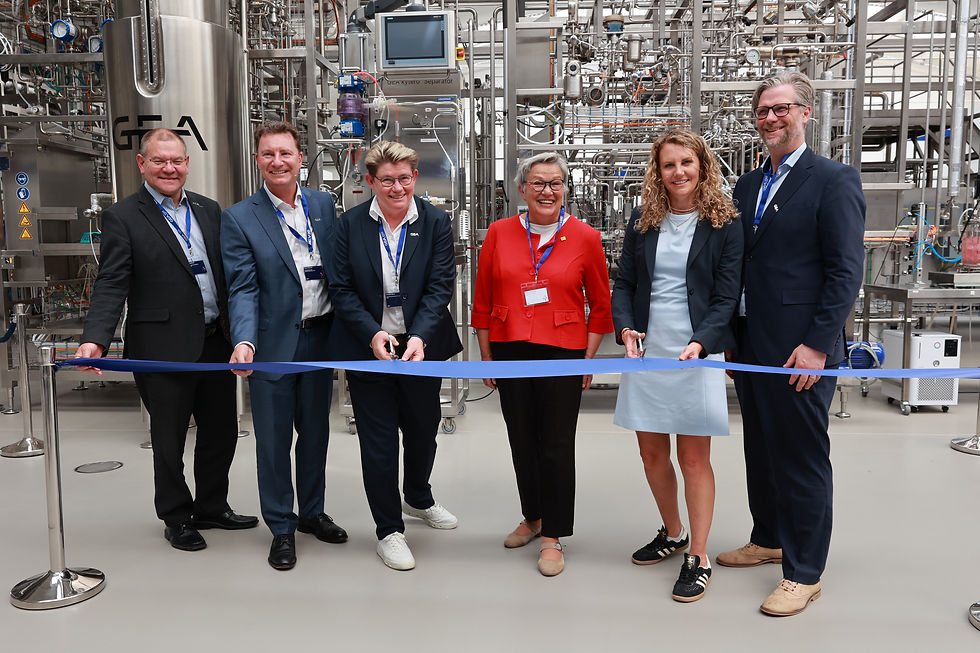
GEA has opened a €4m Application and Technology Center for New Food and Biotechnology in Sarstedt, Germany, expanding its pilot-scale support for companies developing fermentation, cell cultivation, and other biomanufacturing processes.
The centre has moved from Hildesheim to the Sarstedt site of GEA Liquid Technologies GmbH, where the company has converted and fitted out an existing facility. Around 240 employees are now based at the engineering site, bringing the application centre closer to wider process engineering, automation, and liquid technology expertise.
Designed to help food and biotech developers move processes from laboratory work into practical pilot operation, the facility covers upstream and downstream processing, including bioreactors, media preparation, hygienic design, separation, filtration, and automation. That combination is particularly relevant to precision fermentation, cell cultivation, and new food applications where product quality depends on tight control of biology, process conditions, and downstream recovery.
Food biotech has attracted substantial investment and scientific attention, yet commercial progress still depends on whether laboratory results can be translated into stable, repeatable, and economically viable production. Pilot infrastructure sits in the difficult middle ground between benchtop proof and capital-heavy industrial plant design. It allows developers to test process feasibility, contamination control, yield, energy use, cleaning regimes, and product recovery before committing to larger assets.
GEA’s investment lands at a practical point in the market. Companies working on alternative proteins, fermentation-derived ingredients, dairy alternatives, cultivated-cell systems, and functional biomaterials are under pressure to show that their processes can move beyond demonstration batches. Scaling up is rarely a simple matter of using larger vessels, since mixing, oxygen transfer, heat removal, shear stress, cleaning, sterilisation, separation efficiency, and batch-to-batch consistency all change as volume increases.
By giving customers access to process engineering before full plant specification, the Sarstedt centre can shape equipment selection, process integration, utility demand, and automation strategy at an earlier stage. It can also expose weaknesses before they become expensive: a filtration step that works in a lab can become a throughput constraint at pilot scale, while a fermentation profile that looks attractive in small batches may become less stable once aeration, cooling, and media handling change.
Across food processing, equipment suppliers are moving closer to product development rather than waiting until recipes and process routes are fixed. The same operational pressure is visible in Bühler’s chocolate and bakery processing launches, where efficiency, format flexibility, and production reliability are being pushed into machinery development. GEA’s Sarstedt centre sits in a different category, but it follows the same direction: industrial food innovation increasingly depends on equipment, process validation, and application support working together.
Capital scrutiny is also changing how new food production systems are assessed. Developers must compete with established food manufacturing on cost, reliability, hygiene, throughput, and quality control. Investors and customers increasingly expect evidence that a process can scale with acceptable operating costs and manageable technical risk. Pilot centres cannot remove that risk entirely, but they can reduce the number of unknowns before industrial investment is committed.
Germany and the wider European food manufacturing base already have strong research capability in fermentation and biotechnology, but the bottleneck often sits at industrialisation. Facilities that link biology, process design, automation, and hygienic engineering are becoming essential if new food technologies are to move from specialist pilots into mainstream manufacturing supply chains.
The next test will be how quickly pilot work at Sarstedt translates into commercial plants. Precision fermentation and cell cultivation still face cost, regulatory, energy, and market hurdles, but the sector is moving into a more disciplined phase. Laboratory promise is no longer enough. Processes will need to show that food safety, downstream recovery, utility demand, and production economics can hold together beyond the pilot run.