IN Brief:
- A 3mm hexagonal aperture provides 7.80mm² of open area compared with 7.07mm² from a 3mm circular hole.
- Gericke's flour trial recorded 19,338kg/h with the hexagonal screen against 16,567kg/h conventionally.
- The replacement screen increases usable open area without requiring a larger centrifugal sifter.
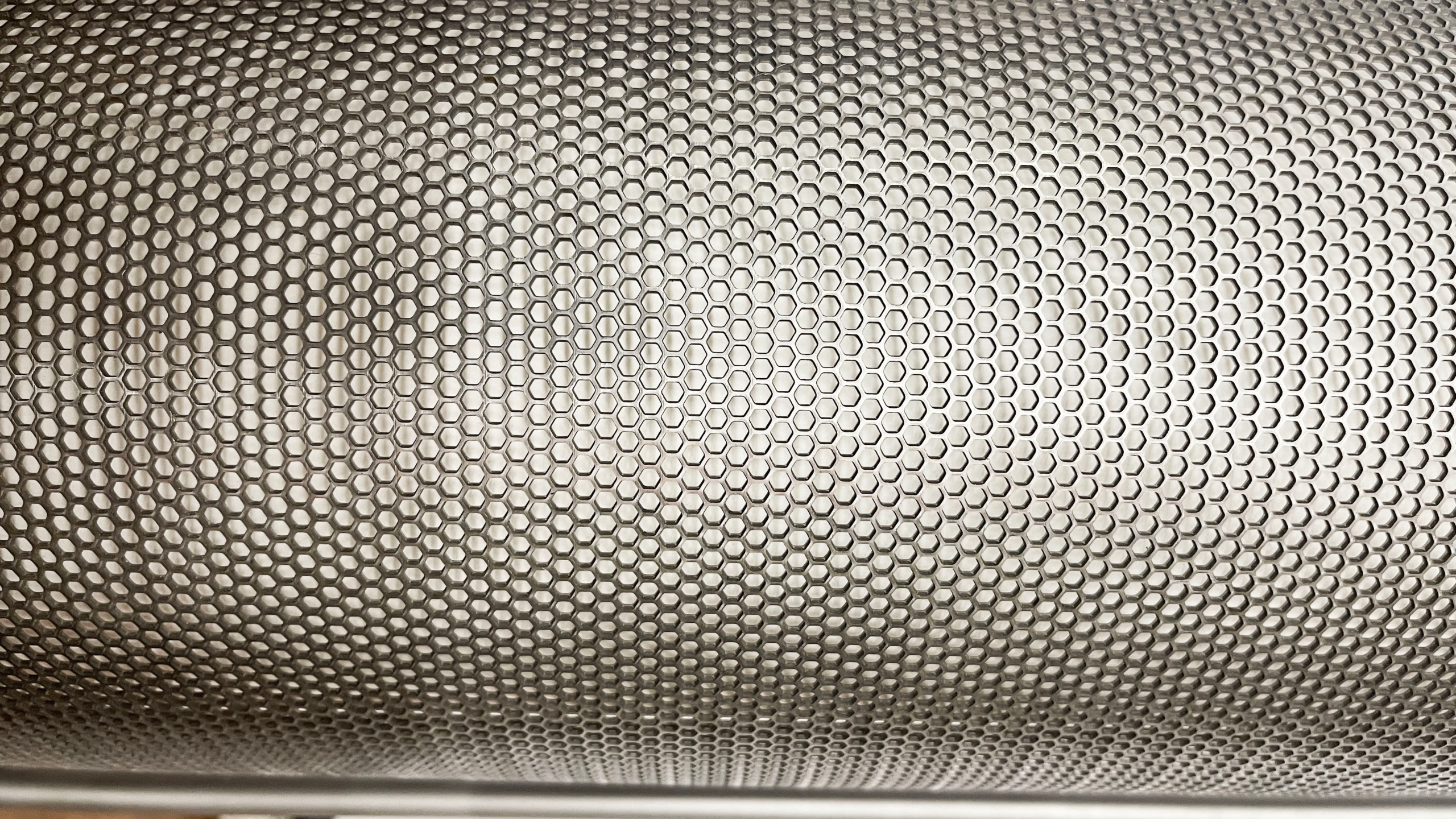
Gericke has developed a perforated screen for centrifugal sifters that replaces conventional circular holes with hexagonal apertures, increasing usable screening area without enlarging the machine or changing the nominal aperture dimension.
Gericke Group has introduced the plate as a direct replacement for conventional perforated screens, targeting powder-processing applications in which the available screen area contributes to a throughput constraint. Flour, bakery ingredients, starches, sugars, powdered mixes, and other dry food materials are among the applications where centrifugal sifting is routinely used.
For a nominal aperture size of 3mm, measured across the flats of the hexagon, Gericke gives an open area of 7.80mm² for each hexagonal hole. A conventional circular aperture with a 3mm diameter provides 7.07mm², producing a 10.3% increase in open area at the individual aperture.
The geometry matters because a perforated plate divides its surface between material that product can pass through and metal that it cannot. Increasing the proportion occupied by apertures gives the powder more available passage area while retaining the same nominal opening size used for particle separation.
Gericke tested the design with plain white flour on a GS4-722 centrifugal sifter fitted with a 3mm screen. The conventional circular-hole plate recorded an average throughput of 16,567kg/h, while the hexagonal screen reached 19,338kg/h under what the company describes as identical operating conditions.
Those two published figures equate to an increase of approximately 16.7%. Gericke’s announcement separately describes the throughput gain as 14%, so the raw kilogram-per-hour measurements provide the clearer basis for reporting the trial rather than silently repeating an inconsistent percentage calculation.
The measured increase is also greater than the 10.3% change in aperture area, illustrating why screen performance cannot be predicted from geometry alone. Powder flow through a centrifugal sifter is influenced by feed rate, rotor action, material loading, particle-size distribution, moisture, bulk density, cohesiveness, and the behaviour of the product against the screen surface.
Flour is a useful production example because sifting often sits between bulk handling and higher-value process stages. It may be used to remove foreign material or oversize particles, break up agglomerates, condition powders before mixing, or protect equipment further along the line.
A sifter that has become the capacity limit can restrict the rest of the process even if mixers, conveyors, and packing machines are technically capable of higher rates. Plants normally have several ways to respond, including installing a larger machine, adding equipment in parallel, changing the screen, modifying product feed, or accepting a lower line rate.
A replacement perforated plate is less disruptive than most of those options. If a plant can increase available screen area within the existing equipment envelope, it avoids some of the floor-space, controls, access, cleaning, installation, and capital requirements associated with an additional machine.
The upgrade still has to be assessed against the actual product. Powders differ considerably in flow behaviour, fat content, electrostatic properties, particle shape, and their tendency to blind or coat a screen. The result obtained with plain white flour should not therefore be treated as a universal throughput increase for every dry ingredient.
Product quality remains another limit. Higher capacity has little value if the separation performance changes. Gericke’s comparison keeps the nominal opening dimension at 3mm, pursuing the capacity improvement through the shape and packing of the apertures rather than enlarging the specified screen size.
The company also suggests that lower flow resistance could reduce operating energy consumption, although the published flour trial does not include power-consumption measurements. Quantifying an energy benefit would require motor-load or electrical data alongside throughput, particularly if manufacturers wanted to compare performance on the basis of energy consumed per tonne of product.
Cleaning and hygiene will matter equally in food applications. Perforated screens are regular inspection and maintenance points, and any alternative design has to fit the plant’s established removal, cleaning, inspection, and reinstallation procedures without introducing difficult product-retention areas.
None of those requirements changes the appeal of the underlying approach. Process improvement often concentrates on replacing complete machines, but existing equipment can remain mechanically sound while one component defines the available capacity.
Here the modification is unusually modest: the machine remains the same size, the nominal aperture remains 3mm, and the principal change is the geometry of the holes in the screen. Plants already operating close to a sifter’s capacity have a clear reason to test whether the same principle transfers to their own powders before committing to more substantial equipment.