IN Brief:
- Gericke says a flour mill has recovered more than 100 tonnes of product a year after redesigning its sifting process.
- The revised arrangement returns suitable oversize material to the process and adds magnets and accessible inspection chambers.
- The supplier reports a yield improvement exceeding 2% and says the installation is configured for applicable ATEX requirements.
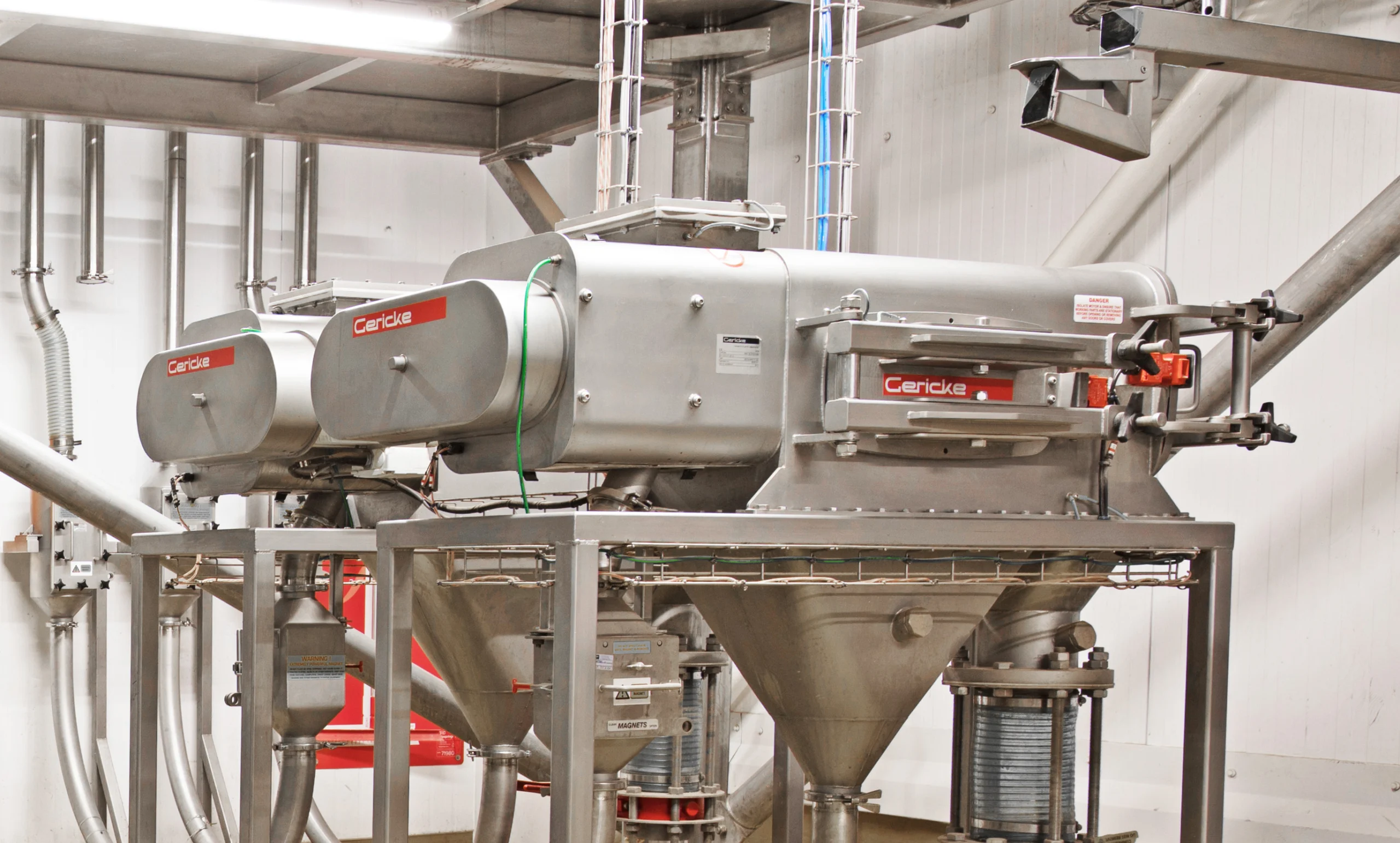
Gericke says a redesign of an industrial flour mill’s sifting system has reduced product losses by more than 100 tonnes a year, after its UK engineering team introduced centrifugal separation, recovery of suitable rejected material, and additional foreign-body inspection.
The customer, which has not been named, previously operated a series of sifters that removed oversize material from its flour streams. The retained fraction was discarded, creating cumulative losses across the milling operation. Gericke reports that the quantity eventually amounted to approximately a truckload each month.
Following an engineering assessment, the supplier proposed a simpler process in which retained material could be directed back into production instead of automatically leaving the system as waste. A centrifugal sifter became part of the revised configuration, alongside magnetic inspection and access points intended to assist maintenance and contamination investigations.
Sifting is used at several stages of flour and ingredient processing to control particle size and prevent unwanted material from entering downstream machinery or finished products. Its purpose varies with the location in the process: a screen may remove foreign bodies, separate an oversize fraction, or condition powder before blending and packing.
A centrifugal sifter feeds material into a cylindrical screen, where rotating components move the powder across the screening surface. Particles small enough to pass through the openings become the accepted fraction, while material retained by the screen is discharged separately. The machine can be installed in a gravity-fed process or within a broader bulk material handling arrangement.
Screen aperture, feed rate, powder properties, and the amount of material already loading the screen determine how consistently the machine performs. Flour can contain agglomerates as well as particles that genuinely fall outside the required size range, and the two need not have the same value or handling requirements.
A recirculation circuit can recover suitable material that would otherwise have been discarded, but its design depends on establishing which retained particles may safely return to the process. It cannot assume that everything rejected by the screen is fit for reuse. Foreign objects and contaminated material still require removal rather than another pass through the production line.
Gericke’s project therefore incorporated magnets with inspection chambers to identify and retain suitable ferrous contaminants. The supplier says the arrangement is intended to help operators investigate where foreign material originates, rather than simply removing it without further examination.
Magnetic inspection is specific to materials attracted by the installed magnets. It does not detect every non-metallic foreign body and cannot replace a full food safety control programme. The point at which recovered flour returns to the line must also be assessed for traceability and compatibility with the product specification.
According to Gericke, the redesigned process allowed the mill to use a finer screening arrangement while increasing production efficiency. That combination would be difficult to achieve simply by reducing screen openings in an otherwise unchanged process, because finer separation can also restrict the effective throughput of the equipment.
The reported outcome reflects the interaction between screening capacity and material recovery. A system that retains a greater proportion of oversize material may still improve yield if the retained fraction is handled appropriately and recoverable product is no longer lost. The supplier has not provided a breakdown separating the effects of the new sifter from those of recirculation or changes elsewhere in the process.
Gericke attributes an increase of more than 2% in production yield to the installation, alongside annual flour savings exceeding 100 tonnes. These are supplier-reported results: the customer has not been identified and independently audited production records have not been published.
Neither the number of production lines nor the mill’s annual tonnage has been disclosed. Those figures are necessary to calculate the loss reduction as a proportion of total output or to compare the result against another plant. A reported absolute saving cannot establish the same commercial return for mills operating at different production rates.
The release also describes small amounts of flour rejected during individual batches, but provides no consistent batch count or operating data that would connect those measurements to the annual total. The more substantial outcome is the stated year-on-year recovery, although its calculation method remains unavailable.
Handling flour introduces dust explosion hazards as well as conventional contamination and hygiene concerns. Combustible flour dust suspended in air can form an explosive atmosphere under suitable conditions, making containment, potential ignition sources, inspection access, and the classification of hazardous areas important elements of system design.
Gericke says the installation has been configured to meet applicable ATEX requirements and is ready for audit inspection. The company has not supplied the area’s hazard classification, relevant equipment category, or certification records for the complete site. Its statement therefore establishes the supplier’s intended compliance status, not an independent approval of the entire mill.
Inspection chambers were also redesigned to improve access and ergonomics during routine checks. The ability to examine screens, magnets, and collection points without difficult dismantling can support consistent inspection practices, although the actual maintenance time saved has not been quantified.
The project is distinct from Gericke’s previously introduced hexagonal sifter screen, which changed the shape of perforations to increase open screening area. That earlier development concerned component geometry and measured throughput under test conditions; the present case study concerns the recovery of flour in an installed customer process.
Gericke describes the revised configuration as repeatable at other milling facilities, but performance will depend on each site’s original reject rate, screen requirements, material properties, and allowable recirculation routes. Product recovered at one plant cannot be assumed suitable for another without examining the cause of rejection.
The mill’s reported improvement illustrates the value of assessing the complete handling route around a sifter rather than treating the screen as an isolated machine. Confirmation of the annual savings, operating costs, and investment payback would require customer production data that Gericke has not released.