By Kati Hope, Global Key Account Manager, Mettler-Toledo
IN Brief:
- For food manufacturers, inspection technology choice is driven by application, packaging, contaminant risk, and line position rather than a simple metal-versus-x-ray decision.
- Metal detection suits many dry, gravity-fed, and non-foil applications, while x-ray adds dense non-metal detection plus checks on fill level, integrity, and missing product.
- Where risk, footprint, and productivity demand wider coverage, manufacturers may need both systems, or an integrated combination unit, across multiple CCPs.
For food, pharmaceutical, chemical and other manufacturers, the roles of metal detection and x-ray inspection systems are essential. They inspect products for foreign bodies, protect brands, profits and productivity by automatically removing non-conforming products from production, and help manufacturers to comply easily with industry requirements. When making the right inspection technology choice for a business, production line requirements and application characteristics should be considered.
Initially, the decision might seem straightforward: opt for a metal detection system to detect metal contaminants and choose an x-ray inspection system for detecting both metal and non-metal contaminants.
While this view isn’t totally unfounded – especially regarding the efficacy of metal detection systems in identifying metal, such as aluminium and wire – it oversimplifies a multifaceted decision-making process. Consider a scenario where metal contaminants need identification, but the product is packaged in aluminium foil. A metal detection system deems the foil itself a detectable contaminant, rendering it impractical. In contrast, an x-ray system penetrates the foil, providing a clearer view of contaminants within. In contrast, if you are inspecting free-falling products, metal detection would be your only option. Gravity Fall metal detection systems are designed specifically to inspect free-flowing materials at vertical transfer points. As the products move by gravity through an enclosed chute, they pass through the detector aperture. Any contaminated product is instantly rejected and removed from the production process.
The technology choice extends beyond contaminant types, delving into where in the production process the product requires inspection. For instance, a metal detection system might be optimal when raw products require scrutiny before the addition of valuable ingredients. Conversely, during end-of-line inspection, where both packaging integrity checks and contaminant detection are imperative, x-ray technology may be the more suitable choice.
Consequently, manufacturers face a crucial decision when equipping their production lines – opting for metal detection, x-ray technology or a strategic combination of both.
The differences in how metal detection and x-ray inspection technologies operate underscore the importance for manufacturers to understand these distinctions and their implications for optimal performance in various product inspection applications. Crucially, the keyword here is “application”: the product’s nature, the fill process (for example Vertical Form Fill Seal (VFFS)), potential contaminant types and factors like the physical packaging must be integral considerations in choosing the right physical contaminant detection technology. Financial constraints, spatial limitations and the spectrum of additional quality control checks should also be factored into the decision-making process.
Metal Detection Unwrapped
Metal detection systems can identify a range of metals, both magnetic and non-magnetic including all ferrous, non-ferrous, stainless steel and aluminium. How do they do it? Well, it’s all about coils carrying an electrical current, which create a balanced electromagnetic field. When a product with a metal contaminant moves through, it disrupts this magnetic dance, and clever electronic circuitry and software algorithms interpret this disturbance.
Picture this: a well-crafted metal detector in the food industry spotting a pinhead in a loaf of bread or its pharmaceutical counterpart detecting metal contaminants less than 0.3 mm in diameter. Impressive, right? To perform these tasks, the detector’s construction must be solid and stable. Even the tiniest vibrations could lead to the rejection of perfectly good products. Operating in a factory environment, these detectors need to dodge airborne electrical noise like pros.
Now let’s talk about “product effect.” Metal detection excels when it comes to dry products – moisture-free means the product is non-conductive, minimising the phenomenon that is “product effect.” But, when you add moisture or salt into the mix, things get interesting. Products with high moisture content emit conductive signals (the “product effect”) as they pass through the metal detector, causing a disturbance in the detection field.
Managing product effect is crucial—it’s the difference between accurate detection and false alarms. Moisture, salt content, temperature, format, consistency, size, shape and orientation on the production line can all play a role. The solution? A high-quality metal detection system armed with multi-simultaneous frequency operation and smart software algorithms. This powerhouse combo optimises performance, slashes false reject rates and helps the system have the right sensitivity to pick up signals from even the tiniest metal contaminants, no matter the application. It’s main job? A laser focus on brand protection.
Metal detection isn’t picky about packaging either. From loose, unpackaged goods to liquids, pastes, slurries, bulk powders or free-flowing solids in gravity-fall conditions, these detectors keep a keen eye out. Tall containers like bottles, jars and composite containers also get the once-over, though inspection happens before any metal cap or closure is applied.
Packaging-wise, metal detection systems can perform well with metallised film packaging, depending on the film thickness. But, and it’s a big but, if you’re dealing with aluminium foil packaging—say, foil wraps or product trays—the standard balanced coil metal detectors simply will not detect metal contaminants.
X-ray Inspection Uncovered
Step forward x-ray inspection —a smart solution which excels at detecting a wide range of contaminants like metal, glass, stone, calcified bone and high-density plastics and rubber. These systems don’t just stop at contaminant detection; they perform additional quality checks on food and pharmaceutical products. Think measuring mass, counting components, identifying missing or broken products, monitoring fill levels, detecting sealed-in products and even giving damaged products and packaging a once-over.
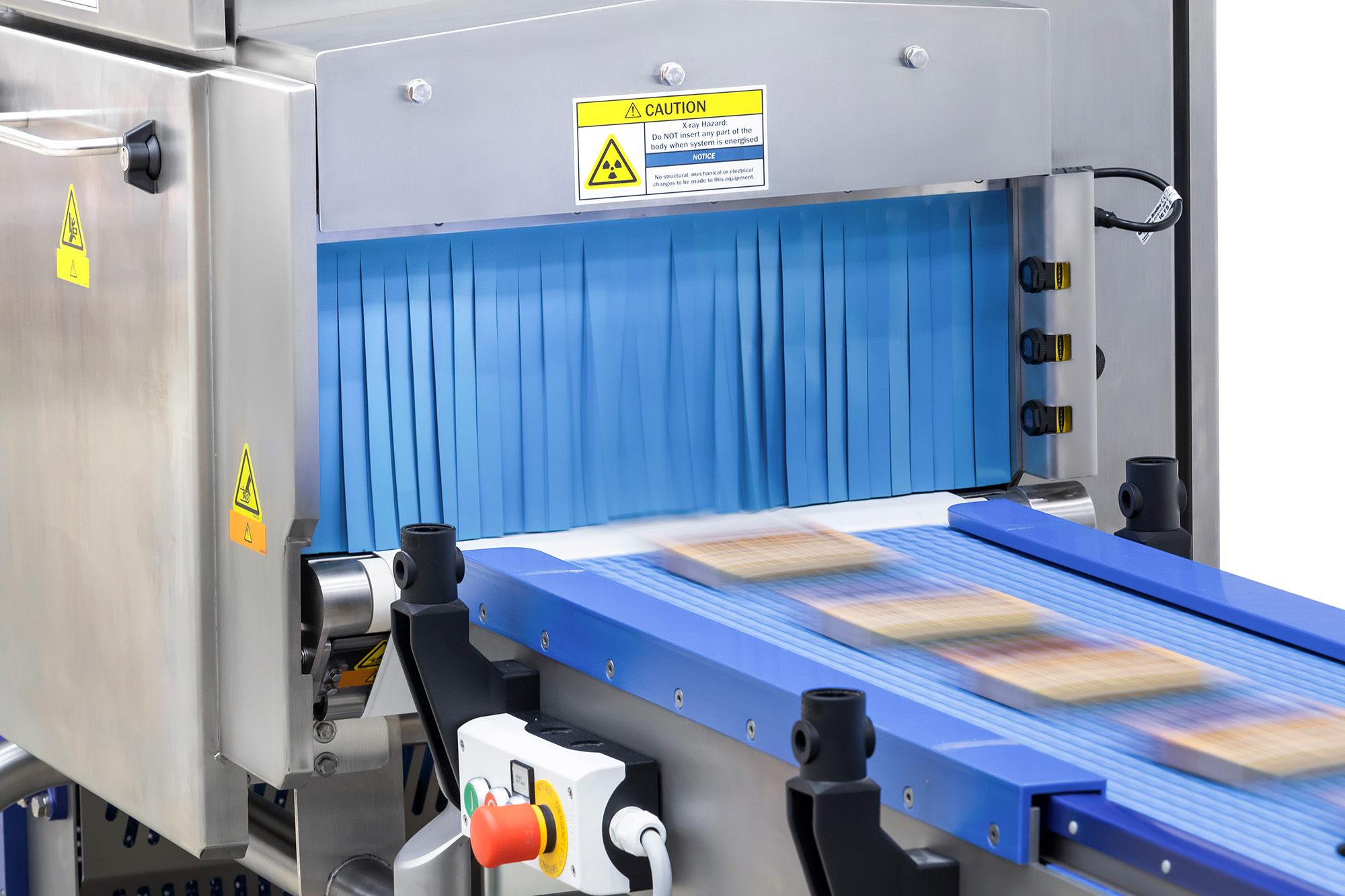
The magic begins with an x-ray beam, cutting through the product and onto a detector. As the beam encounters the product and any contaminants, their density plays a starring role. Since contaminants are usually denser than the product, they absorb more x-ray energy. The result? An image showing this absorption difference, compared to a predetermined acceptance standard. Based on this visual verdict, the product gets the green light or gets rejected by an automatic reject system, swiftly removing the culprit from the production line.
Now, let’s talk limitations. X-ray can spot dense contaminants, but it struggles with low-density, like insects, wood and low-density plastics. Yet, these systems are versatile, inspecting pumped products (slurries, fluids, semi-solids), bulk goods, loose items, jars, bottles, cans and even products wrapped in foil or metallised film.
Making the Right Choice
So, what is the right answer for you – metal detection or x-ray inspection? Both have their strengths and limitations. To navigate this choice, manufacturers must establish a Hazard Analysis and Critical Control Points (HACCP) framework. This framework is a systematic approach designed to help manufacturers identify and control potential hazards throughout the production process.
Critical Control Points (CCPs) help tackle the identified risks. Depending on what type of contaminants pose the biggest risk the manufacturer might choose either a metal detection or an x-ray inspection system. Sometimes, and this is when it gets really exciting, they may choose both.
Let’s consider some scenarios:
- Aluminium Contaminants: With lightweight, low-density aluminium in non-metal packaging, metal detection is the go-to
- Metal in Aluminium Foil: When metal hides amidst aluminium foil packaging, x-ray takes the spotlight
- Gravity-Fed Products: For metal contaminants in products falling under gravity, metal detection is a reliable ally
- Non-Metal Packaging Challenge: When the packaging isn’t metal but poses detection hurdles, the choice depends on factors like product size and cost-effectiveness
- Non-Metal Contaminants and Quality Control: When non-metal contaminants lurk, and quality control is non-negotiable, x-ray is paramount
- Speed and Space: If the production line races at fast speeds or space is a luxury, metal detection might have the upper hand
Embracing Diversity
In some cases, why settle for one solution when you can have two? Imagine a metal detection system early in the processing line, tackling metal contaminants such as veterinary needles, barbed wire or fishing hooks in raw and incoming goods. Further down, an x-ray machine steps in, examining products for non-metal threats and conducting extra quality checks. Finally, a sensitive metal detection system at the end-of-the-line conducts a final sweep for smaller metal adversaries. Having inspection systems at different CCPs can help to reduce downtime by removing contaminants early from the line thereby potentially avoiding any damage to the production line equipment further upstream. This will help to uphold uninterrupted production and maintain product safety standards.
Combination Systems
Alternatively, combination systems, can be considered a pinnacle of contaminant detection and quality assurance in manufacturing. These sophisticated machines can seamlessly integrate the capabilities of both checkweighing and metal detection or x-ray inspection into a single unit, offering versatility and efficiency within a smaller footprint to maximise production space. By harnessing the strengths of each technology, combination systems provide comprehensive food safety quality assurance i.e. completing precision weighing checks in fast production line speeds whilst detecting physical contaminants.
Conclusion
Remember, the journey to choosing a metal detection or an x-ray system begins with the application. Whether it’s raw product inspection or a comprehensive check including contaminant detection, understanding your application is the name of the game. In addition, factors like space, cost and productivity are also important in helping make the most informed decision on the right solution. Ultimately, the choice can be crucial to helping manufacturers boost productivity, enhance quality and maintain their reputation.