IN Brief:
- Mimica has secured support through the Flintshire and Wrexham Investment Zone SME Manufacturing Grant to develop production of its Bump technology.
- The temperature-responsive indicator uses a tactile change to communicate information about the storage conditions experienced by food and drink.
- More than 300 food companies are on Mimica's waiting list, with additional laboratory and manufacturing development planned.
Mimica is expanding production of its Bump food freshness indicators in Wrexham, using support from the Flintshire and Wrexham Investment Zone to develop manufacturing equipment and automation as demand for the technology increases.
The company has received support through the Investment Zone SME Manufacturing Grant, with Wrexham Council assisting its application. The development concerns its production facilities at Bryn Business Centre, where Mimica is working to move from established product development towards manufacturing at greater volume.
Announced on 13 October 2026, the programme includes further investment in the company’s laboratory and manufacturing activities. Mimica reports that more than 300 food companies are on its waiting list, following work with businesses in dairy, juice, meat and seafood.
The waiting list indicates interest in the technology but does not establish the number of customers that have completed validation, entered commercial contracts or committed to particular production volumes. The council has not disclosed the value of Mimica’s grant or quantified the additional manufacturing capacity expected from the project.
Bump is a packaging indicator designed to respond to the temperature conditions experienced by a food or drink product during storage. Unlike a printed date, which remains fixed once applied, the indicator’s physical characteristics change in response to its surroundings.
The technology uses a temperature-sensitive gel whose behaviour can be calibrated for different food applications. As the material changes, its surface provides a tactile indication intended to communicate whether the product remains within the freshness conditions for which the indicator has been configured.
Mimica has developed tag and cap formats, allowing the technology to be incorporated into different types of packaging. The design and placement of an indicator depend on the container, the conditions it will experience and the way the finished product is handled throughout distribution and sale.
Temperature has a substantial influence on the rate at which many perishable foods deteriorate. Storage at warmer conditions can accelerate microbial or chemical processes, while consistent refrigeration can slow particular forms of deterioration within the limits established for the product.
A fixed shelf-life date is normally determined using an approved set of storage assumptions. Actual temperature exposure may differ as products move through transport, warehousing, retail display and domestic refrigeration.
By responding to that exposure, a calibrated indicator can provide additional information about the conditions experienced by the pack. Its behaviour must nevertheless be validated against the particular product, since temperature alone cannot describe every factor that influences safety and deterioration.
Meat, dairy products, juice and fish differ in composition, processing history, packaging atmosphere and microbiological characteristics. An indicator suitable for one application cannot automatically provide a meaningful freshness assessment for another without testing.
Calibration therefore requires an understanding of how a particular food changes under defined storage conditions. Laboratory studies can establish the relationship between temperature history and selected measures of quality or deterioration, allowing the indicator response to be designed around the intended application.
The resulting system must also perform consistently after commercial manufacture. Producing an individual indicator in a laboratory is different from manufacturing large quantities of units that respond within the same specified limits.
Material preparation, dosing, component placement and sealing can all influence consistency. Variations in the amount or distribution of responsive material may alter how an indicator behaves, making suitable process controls important as output increases.
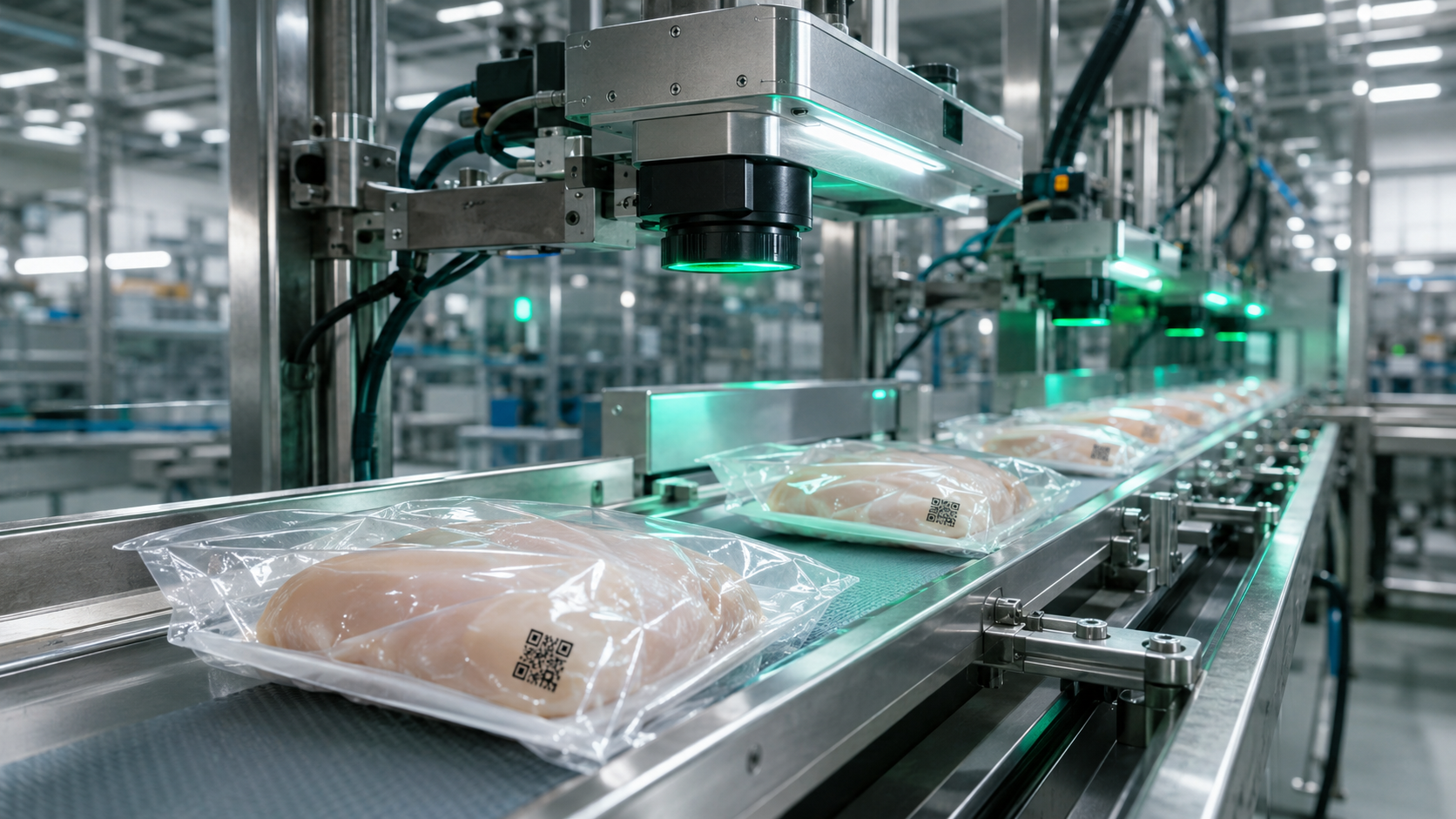
Automation can help reproduce defined assembly operations, but its effectiveness depends on equipment accuracy, the properties of the materials being handled and the inspection procedures used to identify defective units.
A responsive material may also have storage requirements before it becomes part of a finished food package. Manufacturers must consider whether transport or storage of the indicators themselves could influence their performance before application.
Additional quality control may therefore be required across the indicator’s own supply chain. The practical arrangements depend on the technology’s specifications, which Mimica has not disclosed in sufficient detail to establish particular equipment settings or environmental limits for its expanded factory.
Integration with existing packaging lines presents another development requirement. A tag applied to a pack and an indicator incorporated into a closure require different handling, positioning and assembly arrangements.
Packaging equipment must place the indicator correctly without compromising the protective function of the original pack. The additional component may also affect inspection procedures, because a production system needs to identify missing, displaced or damaged indicators before the finished product is released.
Pack design creates further considerations covering accessibility, visibility, consumer handling and compatibility with the materials already used. These characteristics may influence whether an indicator can be introduced through a minor adjustment or requires more substantial packaging development.
Mimica is also planning to expand the role of its Wrexham laboratory, bringing together food scientists, engineers and designers. This provides a route for product-specific testing and manufacturing development to take place alongside work on the equipment needed for commercial production.
The indicator’s relationship with statutory food date marking remains important. A freshness response does not independently establish that a product is safe to eat, and manufacturers must continue to comply with the applicable food safety and labelling requirements.
Products carrying a use-by date cannot simply be treated as safe beyond that date because an additional indicator appears favourable. Any change to declared shelf life must rest on suitable validation and an appropriate assessment of the complete product and packaging system.
The expansion in Wrexham is intended to increase the company’s ability to supply its technology to food manufacturers, with the grant supporting the transition towards a larger production operation. Mimica has not announced a new output figure, confirmed full commercial deployment across its waiting list or published independently measured waste reductions attributable to the planned factory improvements.
Its next manufacturing milestones will involve producing calibrated indicators consistently, validating their behaviour for different foods and establishing reliable application methods within customers’ packaging operations. Those requirements will determine how readily the technology can move from individual developments into repeated industrial production.