IN Brief:
- Pengelly Farms has installed Endoline’s 221 case erector and 613 case sealer in its potato packing operation.
- The system automates assembly and sealing of heavy 10kg cases after upstream grading and loading investment.
- Fresh produce packers are using targeted end-of-line automation to reduce manual strain and improve packing consistency.
Pengelly Farms has automated case assembly and sealing in its potato packing operation, integrating Endoline Automation equipment into its packing shed in Helston, Cornwall.
The installation includes an Endoline 221 case erector and 613 fully automatic case sealer, supporting the assembly and sealing of heavy 10kg cardboard cases used for salad potatoes. The equipment has been integrated around existing grading, optical sorting, and chute-loading assets, including Haith graders, Tomra 3A optical sorters, and a Newtec chute loader.
The investment addresses a bottleneck that emerged after upstream modernisation. Once grading and loading capability improved, manual case assembly and sealing struggled to match the pace of the rest of the packing line. The heavy twin-walled cases used for potato distribution are strong enough for transport, but their stiffness makes them difficult to open and form consistently by hand or with standard automated systems.
Endoline’s case erector uses dual opposing vacuum technology to open heavy-duty cases by applying force from both sides. That approach is designed to reduce bridging, tearing, and machine jams when handling stiff corrugated board. The case sealer then provides consistent closure, reducing variation from manual sealing and helping finished cases reach customers in uniform condition.
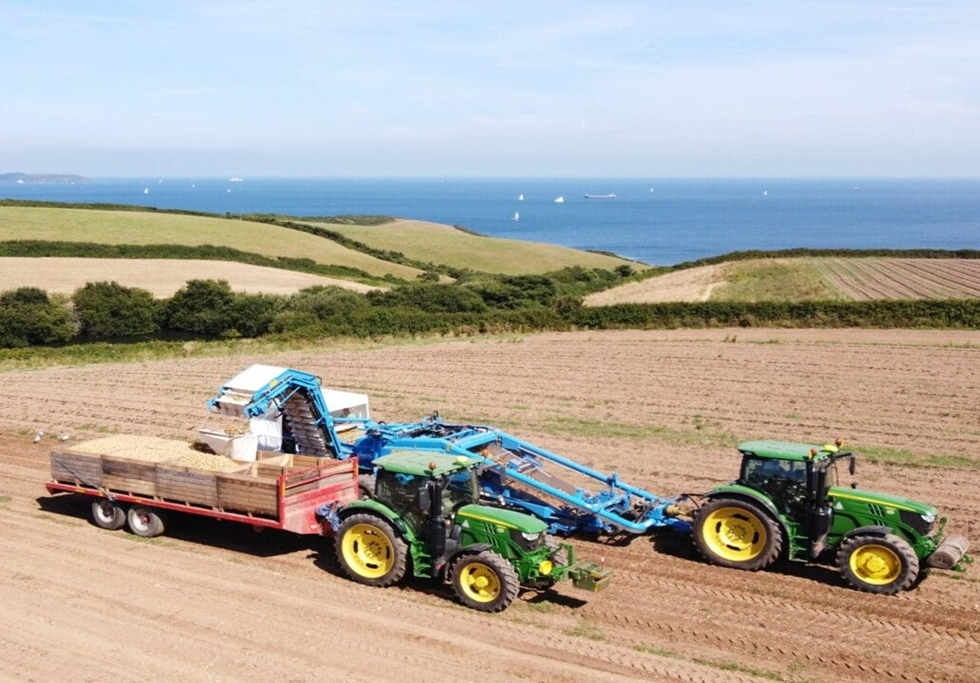
Pengelly Farms grows and packs potatoes for UK and European customers and stores up to 10,000 tonnes of potatoes in temperature-controlled buildings. Its operation manages harvesting and grading from May to October, with storage supporting supply through the rest of the year. Case packing therefore sits within a wider process involving crop handling, storage, order fulfilment, distribution, and retailer requirements.
Fresh produce packing has often remained labour-heavy because product size, shape, and condition vary by season. Automation is gaining ground where it solves specific physical constraints rather than attempting to standardise every part of a naturally variable crop. In this case, the constraint was the mismatch between high-speed grading and loading equipment and a manual case-handling step built around heavy 10kg boxes.
Those mismatches are becoming more visible across food production. When one stage of a line is upgraded, downstream manual processes can quickly become exposed. A faster grader, loader, filler, slicer, or weigher delivers limited benefit if packing, sealing, labelling, palletising, or despatch cannot keep pace. End-of-line automation protects the productivity of earlier capital investment by keeping the flow moving.
The ergonomics are also significant. Repeatedly forming and sealing heavy cases is physically demanding, especially through longer shifts and peak production periods. Automated case erection and sealing can reduce strain while improving consistency. That consistency is valuable when fresh produce needs to move through cold storage, loading bays, and distribution without pack failure or irregular presentation.
Space constraints often shape automation decisions in agricultural packing operations. Many packhouses and farm-based production sites cannot accommodate large equipment footprints without wider building work. Compact systems that can be fitted into existing sheds are more likely to progress because they avoid turning a targeted automation project into a facilities redevelopment.
Pengelly’s installation also reflects a more modular approach to automation in produce. Growers and packers are adding systems around the most repetitive or inconsistent tasks, including case erection, sealing, weighing, labelling, and palletising. The aim is not always full automation, but a more stable line in which manual labour is used where judgement and flexibility still add value.
Further automation around labelling and palletising is already under consideration. The current installation removes a clear constraint between washing, grading, sorting, case filling, and sealing. In a category where product value depends on careful handling from field to customer, consistency at the packing end of the line is a practical competitive advantage.