IN Brief:
- The National Wealth Fund is investing another £19.6m in Pulpex, alongside £4.4m from the Scottish National Investment Bank.
- Pulpex opened its Glasgow factory in October with designed initial capacity of up to 40 million bottles annually.
- The £24.6m total package supports technology transfer through licensed manufacturers in additional markets.
Pulpex has raised a £24.6m financing package to accelerate international deployment of its moulded-fibre bottle technology, following the opening of its first commercial factory near Glasgow in October. The National Wealth Fund is providing a further £19.6m, the Scottish National Investment Bank is contributing £4.4m, and existing investors are supplying the balance. The new capital was confirmed on 17 November during an official visit to the Scottish site.
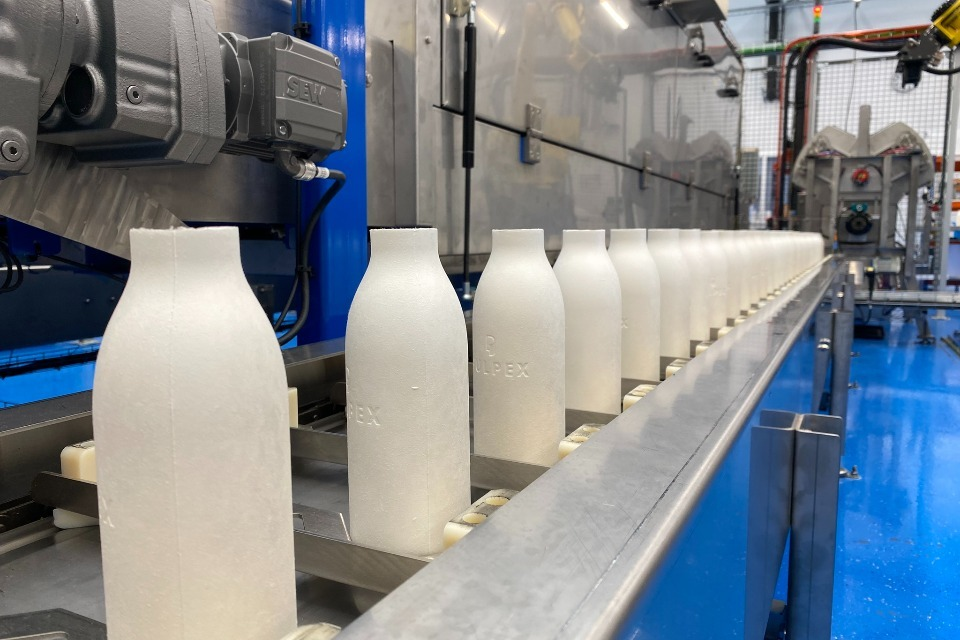
Pulpex’s Glasgow facility opened on 8 October, supported by an earlier £62m Series D financing round in February 2025 and £1.9m from Scottish Enterprise. Designed for initial output of up to 40 million bottles a year, the operation has created approximately 39 skilled manufacturing jobs. The current funding is therefore separate from the factory opening and will support faster deployment through manufacturing partners, rather than finance a site that has yet to be built.
The company is expanding through its Manufacture Under Licence model, under which packaging converters in other markets can make bottles using Pulpex technology and approved production methods. Glasgow provides a working reference plant against which equipment, process controls and finished container specifications can be evaluated. Pulpex intends to increase worldwide output towards one billion bottles annually, although the latest financing statement provides no confirmed schedule or committed capacity breakdown for that target.
Pulpex forms bottles from wood fibre through a wet moulding process that shapes a single-piece container before drying and application of an internal barrier. Its published technical information describes an ultra-thin, water-based polymer dispersion coating intended to keep the contents separate from the fibre structure. The coating is part of the finished pack and is important to product compatibility; the bottle should not be characterised as an entirely uncoated paper vessel. The process has to control fibre distribution, wall thickness, drying and barrier integrity at production-line speed.
Manufacturing a liquid-resistant fibre bottle involves more operations than converting flat board into cartons. Moulding and drying affect dimensional consistency, stiffness and the fit of neck and closure components, while barrier application determines resistance to the intended liquid. Pulpex says the complete sequence from fibre feedstock to a decorated bottle takes approximately an hour, with many containers processed simultaneously. That processing time is not the per-unit cycle rate of a whole factory and should not be compared directly with the stated annual capacity.
Existing filling infrastructure is an important part of the commercial proposition. The company describes its containers as designed for standard equipment, but actual use depends on bottle handling, neck finish, closure torque, filling temperature and the product being packed. Compatibility for a non-carbonated beverage does not establish suitability for every liquid, particularly products with different acidity, oil content, carbonation or required shelf life. A new packaging application still needs trials covering filling operations, transport damage, sealing and storage stability.
Pulpex states that its bottles are designed for established paper and card recycling streams and that its barrier separates during repulping. Because the coating has a polymer component, collection acceptance, mill processing and the quantity of recoverable fibre need to be judged for each receiving market. Published recyclability or repulpability results do not automatically guarantee that every local household collection scheme will accept the pack. The environmental case also depends on material sourcing, production energy and transport, rather than bottle composition alone.
Producing under licence could allow Pulpex to expand without building and financing every overseas plant itself. It nevertheless requires equipment transfer, qualified fibre inputs, agreed consumables, production training and checks that licensed sites can meet the same performance standards. The company says Glasgow acts as a reference for these arrangements. Customer packaging lines and regional recycling systems will also affect how quickly a licensed plant’s output can be used commercially.
Pulpex has already identified manufacturing partners, including India’s Alternicq, which agreed an October partnership covering opportunities in India and the Gulf Cooperation Council. The arrangement preceded the new financing and is not evidence of a separate November contract. The company has not specified when additional partner facilities will enter production or how much of the one-billion-unit ambition has been contractually committed.
The National Wealth Fund’s increased backing follows the move from development-scale trials to a commercial reference site. The financing provides resources for further licensing and manufacturing transfer, while the industrial test will be the performance of containers made at additional plants. Verified throughput, acceptable product compatibility and actual recovery in recycling systems will determine how far the Scottish model can be reproduced internationally.