IN Brief:
- Saica Pack says investments in its French operations have exceeded €60m since 2025.
- Upgrades include six-colour printing, one-pass double-sided processing, corrugator improvements and eight palletising robots.
- The equipment programme includes six-colour printing, double-sided conversion, corrugator upgrades and eight palletising robots.
Saica has invested more than €60m since 2025 in a programme to modernise corrugated packaging plants across France, adding printing capability, corrugator upgrades and automated palletising. The investment covers multiple facilities within Saica Pack, the group’s corrugated packaging division, as it seeks to offer more printed formats while improving manufacturing efficiency.
At Doullens and Beaulac, new high-quality printing equipment installed in 2025 allows production of corrugated packaging with graphics using up to six colours. The expansion enables Doullens, previously concentrated on larger packs, to make smaller and medium-sized formats. Saica is targeting demand for packaging that can move from distribution into retail display without requiring an additional outer presentation format.
Shelf-ready corrugated packaging has to combine retail presentation with the handling strength needed during distribution. Consistent graphic reproduction, accurate die cutting and reliable folding all affect whether a box can be filled, sealed, transported and placed on a shelf as intended. More printed variants can also increase changeover requirements at the converter, making set-up time and quality checks important alongside the capabilities of the press.
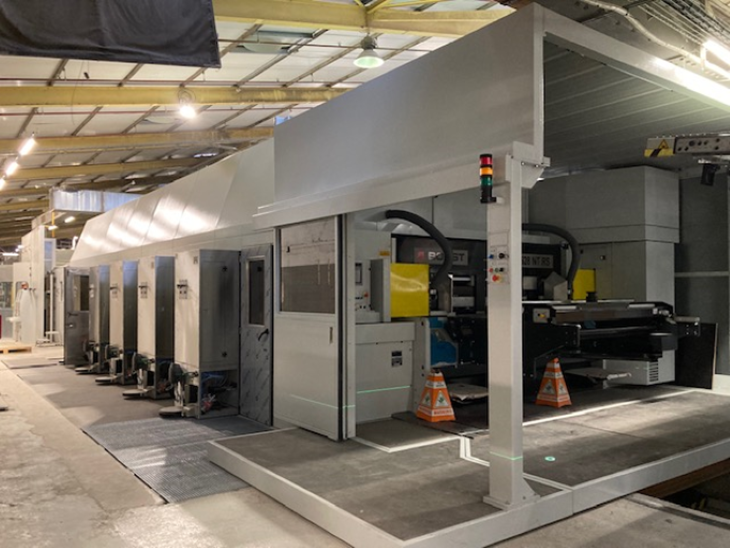
At Lamirande, Saica has introduced an in-line flatbed die-cutting machine with a six-colour printing unit. The equipment can print the inside and outside of a pack in one production pass, replacing a process that previously required two separate operations. That removes one transfer between production stages and can simplify handling of work in progress, although the group has not published a verified percentage gain in throughput for this particular machine.
The Lamirande plant also commissioned a new large-format packaging line during 2026. Saica says the line will replace two existing production lines whose combined output was 19 million square metres and add around four million square metres of capacity for printed products in formats it previously could not serve. The figures relate to the manufacturer’s specified lines and should not be confused with the total capacity of Saica’s French operations.
Saica has also upgraded the wet ends of corrugators at Venizel and Châteauneuf to process lighter technical papers developed by the group. A corrugator bonds fluted paper to one or more liner sheets, with heat, moisture and adhesive application influencing the stability of the finished board. Changes in paper composition and grammage therefore require compatible corrugating conditions before the material reaches printing and converting equipment.
The upgraded corrugators are intended to support lighter paper compositions without sacrificing the required mechanical performance. Reduced grammage can lower material use for a given packaging format, but the suitability of a particular board specification still depends on load, stacking height, humidity, transit conditions and the type of goods being packed. Saica has not provided a single weight-reduction percentage applicable across every product manufactured at the sites.
Lighter board still has to withstand the compression and stacking forces specified for each pack, including under humid conditions and through transport. Printing, cutting and folding introduce additional requirements for registration and dimensional consistency. For automated food packing lines, these properties affect whether cases can be erected and handled at the required speed without distortion or product damage.
Saica has installed eight palletising robots across the Montsûrs, Venizel, Lamirande and Beaune facilities. Robotic handling is intended to reduce repetitive manual movements and improve consistency in the transfer and stacking of finished products. The company also associates the investment with better working conditions and a reduction in tasks that can contribute to musculoskeletal strain.
A palletising cell must match the sizes, weights and arrival patterns of finished packs emerging from upstream equipment. Variations in format and conveyor speed influence the robot’s picking sequence and the stability of the completed stack. Control integration is therefore part of the installation, particularly where a site makes several packaging formats on the same production line.
Saica also identifies lower energy consumption and improved working conditions among the objectives of the investment programme. The company has not broken down the €60m-plus expenditure by plant or quantified a consolidated reduction in electricity use or emissions attributable to the installations. Its disclosure establishes the machinery deployed and the intended operating benefits rather than a measured network-wide environmental outcome.
Although food and beverage companies are among the markets served by corrugated packaging, the upgraded facilities also address e-commerce and other industrial demand. The Lamirande investment in double-sided printing, for example, is particularly relevant to packs where both internal presentation and external graphics matter. Saica has not identified individual food manufacturing customers or dedicated food-only production lines within the programme.
The investments give the French plants a wider range of print formats, board specifications and finishing options, with several machines already operating. Saica has not published consolidated production gains for the programme or named individual food manufacturing customers served by the upgraded lines. Output and operating performance will be determined by the utilisation of those new capabilities across the different factories.