IN Brief:
- SICK Nova now combines deep-learning tools with 3D height information for configurable quality inspection.
- Food and beverage applications include filled-carton deformation checks, completeness inspection, and missing-object detection.
- On-device training and combined AI and rule-based tools are designed to reduce integration work during deployment and product changes.
Machine vision specialist SICK has added AI-based 3D inspection to its Nova platform, combining deep-learning tools with height data to detect packaging and product defects that can be difficult to describe using fixed inspection rules.
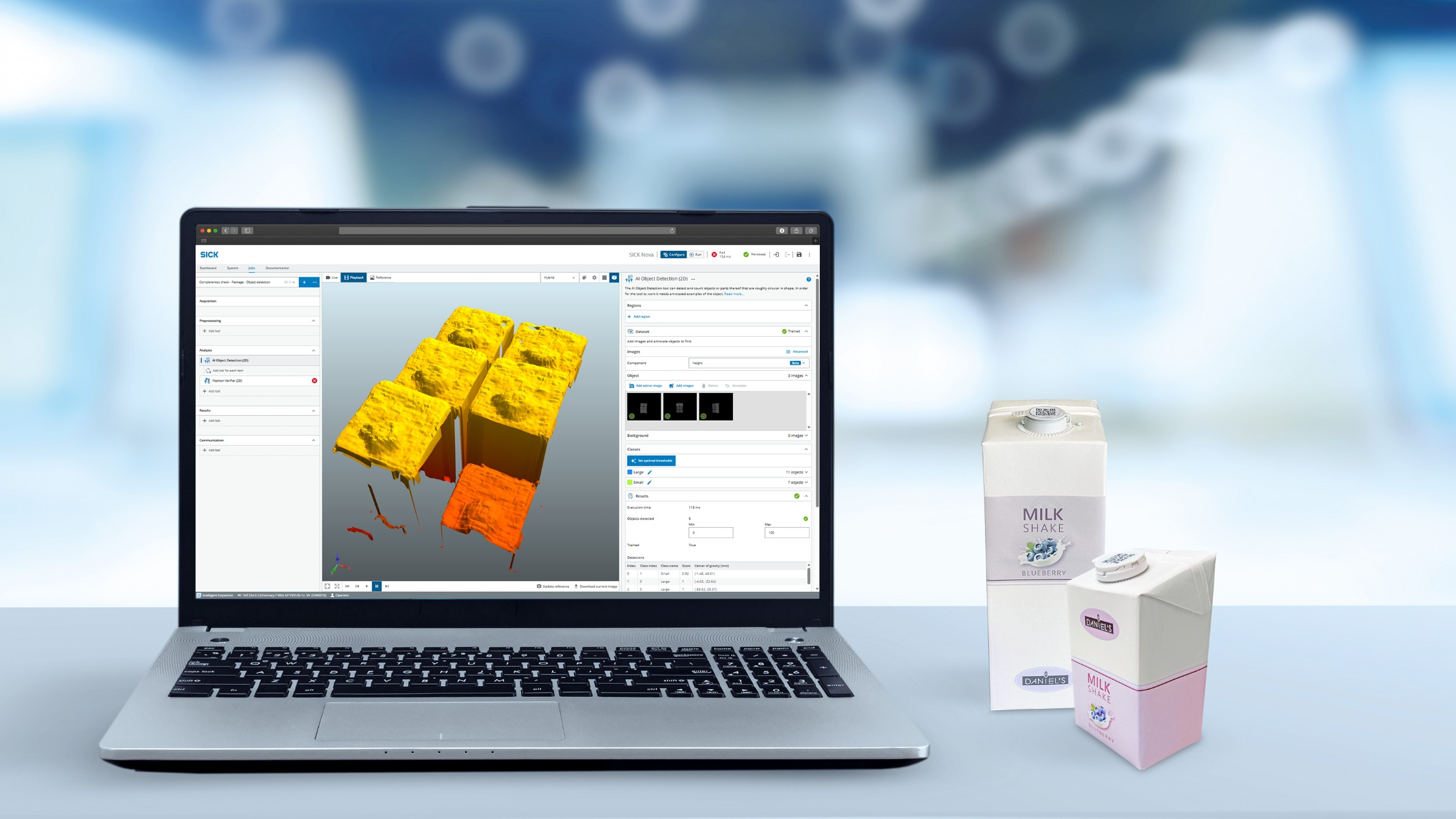
The technology adds spatial information to the inspection process, allowing a model to evaluate height, shape, and surface features rather than relying mainly on colour or contrast. SICK is targeting applications including package deformation after filling, completeness checks, missing-object detection, surface inspection, and classification.
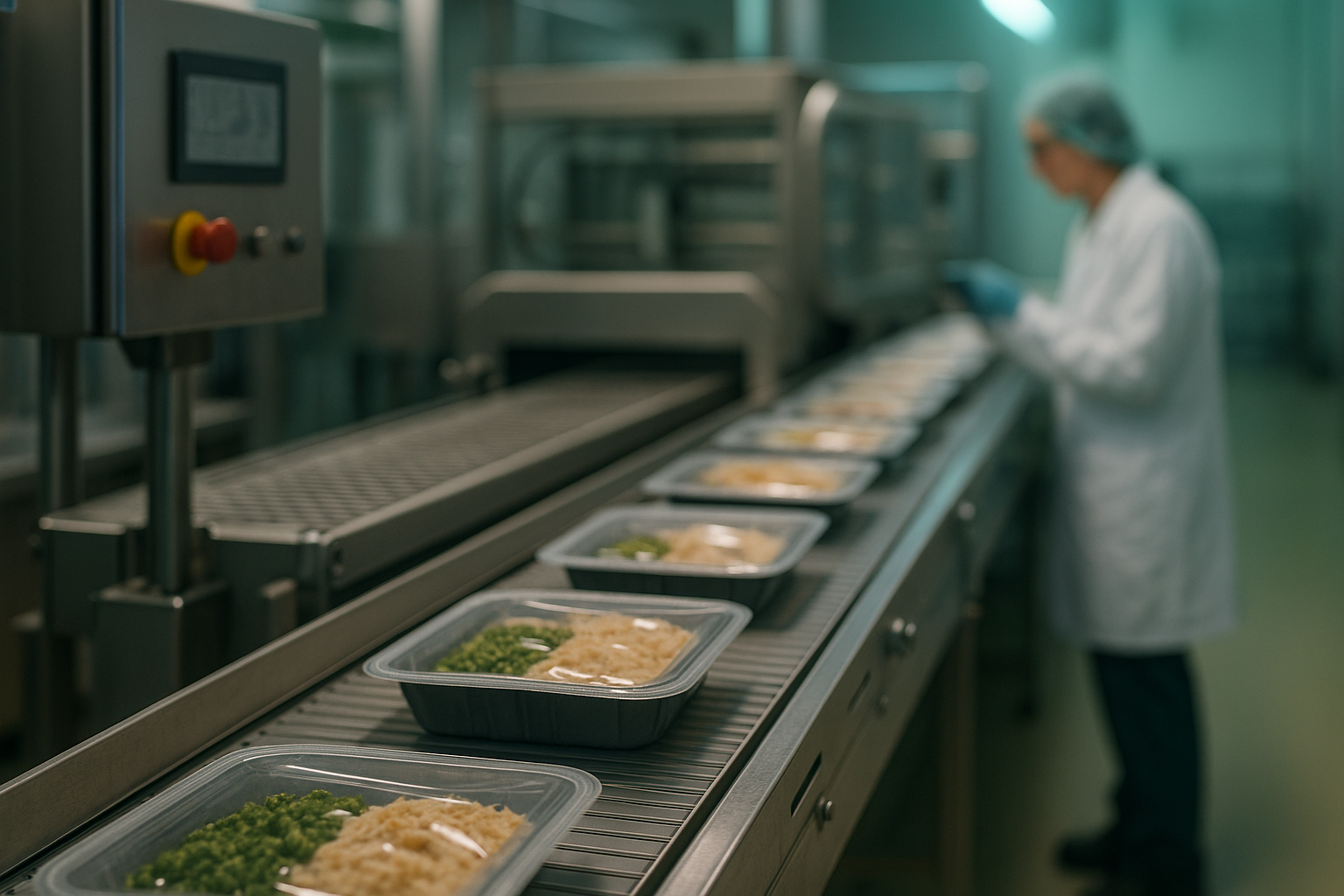
Food and beverage packaging is a useful application because many faults are geometric rather than cosmetic. A carton can carry the correct print and label while still showing a raised panel, crushed corner, poor closure, or deformation associated with filling, sealing, handling, or product condition.
Conventional machine vision handles well-defined inspection tasks effectively. Presence or absence, label position, code verification, fill level, colour, dimensions, and known defects can usually be expressed as measurable rules when the acceptable limits are clear.
Problems become more difficult when normal products vary naturally or when the defect itself does not have a simple geometric threshold. Deep-learning models can be trained using examples of acceptable and defective products, allowing the system to classify patterns that would require extensive rule building in conventional software.
SICK’s AI for 3D approach combines that learning with individual height values for captured pixels. The resulting data can reconstruct the surface of an inspected object and allow the software to assess deviations that might be difficult to distinguish in a conventional two-dimensional image.
The supplied system is designed around example-based training, with users collecting data and training inspection models against their own products. SICK says models can execute on-device, reducing the need for additional computing hardware and keeping more of the inspection process close to the production line.
The Nova environment also retains conventional rule-based tools. That allows integrators to use deterministic measurements for known dimensions while applying trained AI models to characteristics that are more difficult to define mathematically.
A packaging line could, for example, use fixed rules to confirm carton position and dimensions before an AI model assesses the surface for abnormal deformation. Combining the two approaches avoids using machine learning where a simple measurement provides a more transparent and repeatable answer.
SICK’s current Nova portfolio includes support for 3D devices such as the Ruler3000 and Visionary-T Mini. Its product material shows applications including completeness checks, fill-level monitoring, dents, deformation, and loose-label detection.
On-device processing may also simplify product changes, but it does not remove the need for validation. A model trained on one carton format, filling condition, surface finish, or operating range cannot automatically be assumed to perform identically when those conditions change.
Training data remains central to performance. Too little variation in the examples can produce a model that rejects acceptable product, while insufficient examples of actual faults can leave defects undetected. False rejects reduce yield and throughput; missed defects undermine the purpose of automated inspection.
Food plants face an additional practical constraint because line conditions rarely remain perfectly static. Lighting, vibration, contamination, equipment wear, packaging material variation, and product presentation can all alter the data reaching a vision system during extended production runs.
AI inspection therefore shifts part of the engineering task from writing rules towards collecting representative data, validating the model, monitoring false-reject rates, and controlling when retraining is required. The software becomes easier to configure in some respects, but quality assurance around the model becomes more important.
The combination of 3D measurement and deep learning is strongest where a recurring defect has enough physical structure to appear in height data but enough variability to resist a simple threshold. Deformed filled packs fit that description particularly well.
Detecting such faults before secondary packaging can prevent defective units reaching case packing, palletising, or distribution, while also giving production teams an earlier indication that a filling, sealing, handling, or materials problem is developing upstream.
SICK’s Nova development expands machine vision beyond a camera making pass-or-fail decisions from a flat image. The useful advance is more specific: height measurement and trained inference can now sit inside the same inspection workflow, giving packaging lines another way to find defects that previously sat awkwardly between measurable geometry and human visual judgement.