IN Brief:
- EOS-450 MW inlays are designed for RFID-labelled food packaging that may enter microwave ovens.
- Versions based on Impinj M830 and NXP UCODE X chips provide different memory and functionality options.
- Applications include inventory control, expiry management, traceability, loss prevention, and self-checkout.
Tageos has introduced two RAIN RFID inlays designed for packaged food applications where the identification label can remain attached while the product is defrosted or heated in a microwave oven.
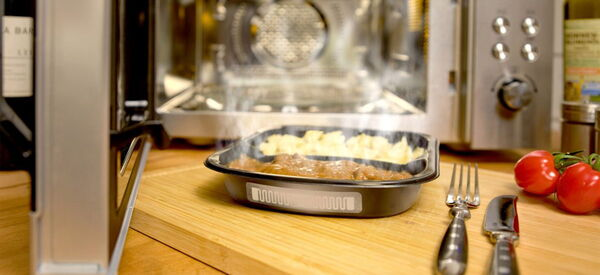
Tageos has launched the EOS-450 MW M830 and EOS-450 MW UX, using different RFID chip platforms to give label converters and end users a choice of memory and functionality. Both use antenna designs developed to resist arcing and sparking under specified microwave conditions.
The products address a practical complication in item-level food identification. RFID labels can support inventory visibility, expiry management, traceability, loss prevention, and automated checkout, but once the tag becomes part of the pack it also has to tolerate the environments through which that pack moves.
Food products create a broader range of conditions than many apparel and general-merchandise RFID applications. A tagged pack may move through chilled or frozen storage, encounter condensation, contain products with high water or fat content, and finally enter a microwave without the label being removed.
The M830 version uses Impinj’s M830 integrated circuit and provides 128-bit EPC memory together with functions including AutoTune and Gen2X support. The second version uses NXP’s UCODE X platform, with configurable EPC memory from 96 to 208 bits, up to 32 bits of user memory, Gen2v2 compliance, and memory-protection functions.
Tageos is offering the inlays in dry, wet-clear, paper-face, and plastic-face formats. That allows converters to integrate the electronic element into different label and packaging constructions rather than tying the technology to one finished facestock.
The initial applications are expected in packaged foods sold through retail and quick-service restaurant channels. Both environments handle high product volumes and short shelf lives, increasing the value of stock information that can be captured without scanning every barcode individually.
RAIN RFID allows multiple unique identifiers to be read without direct optical line of sight. In a food operation, that can support faster stock counts, movement records, expiry control, and verification that the right products have reached the intended location, provided the underlying software maintains accurate associations between each tag and its product data.
The label still has to behave as a packaging component rather than simply an electronic device. Water-rich food, metalised films, foil trays, closures, and pack geometry can affect radio-frequency performance, while printing, encoding, label application, transport, refrigeration, and consumer handling introduce mechanical and environmental stresses.
Microwave use adds another qualification point. A tag that has functioned correctly through manufacturing and retail becomes a poor packaging solution if it has to be peeled off before normal product preparation. Designing the antenna around the heating stage allows the identification system to remain attached for more of the pack’s useful life.
The two chip variants also allow specifications to be matched more closely to individual applications. Basic item identity and stock visibility do not necessarily require the same memory or security functions as more complex traceability programmes, so retaining a common inlay geometry across different IC options can simplify qualification while allowing the electronics to vary.
Expiry management is one potential food-specific use. RFID does not determine product quality by itself, but better item-level visibility can make it easier to identify which stock should be moved first, where short-dated inventory is accumulating, and whether products have reached the intended store or foodservice location.
Those gains depend on the rest of the data system. Installing a smart label cannot correct inaccurate product master data, poor stock rotation, or a warehouse process that does not use the information being collected. The useful part of RFID is the speed with which physical movement can be connected to records, not the presence of an antenna on the pack.
Tageos has been part of the Fedrigoni Group since 2022 and operates manufacturing and commercial locations across Europe, North America, and Asia. The company says the EOS-450 MW devices are the first members of a broader microwave-compatible product family.
The launch gives food packaging developers another technical variable to qualify alongside films, trays, adhesives, inks, barriers, and labels. The electronic specification may be sophisticated, but successful adoption will depend on something less glamorous: whether the tag can pass through converting, packing, cold-chain handling, retail systems, and the customer’s microwave without demanding a separate workaround at any stage.