IN Brief:
- Futamura's NatureFlex film forms the cellulose-based facestock while Bio4life supplies its BioTAK adhesive technology.
- The pressure-sensitive label is designed for fruit and vegetables and is certified for home and industrial composting.
- Development is being positioned around forthcoming European requirements for compostable labels attached to produce.
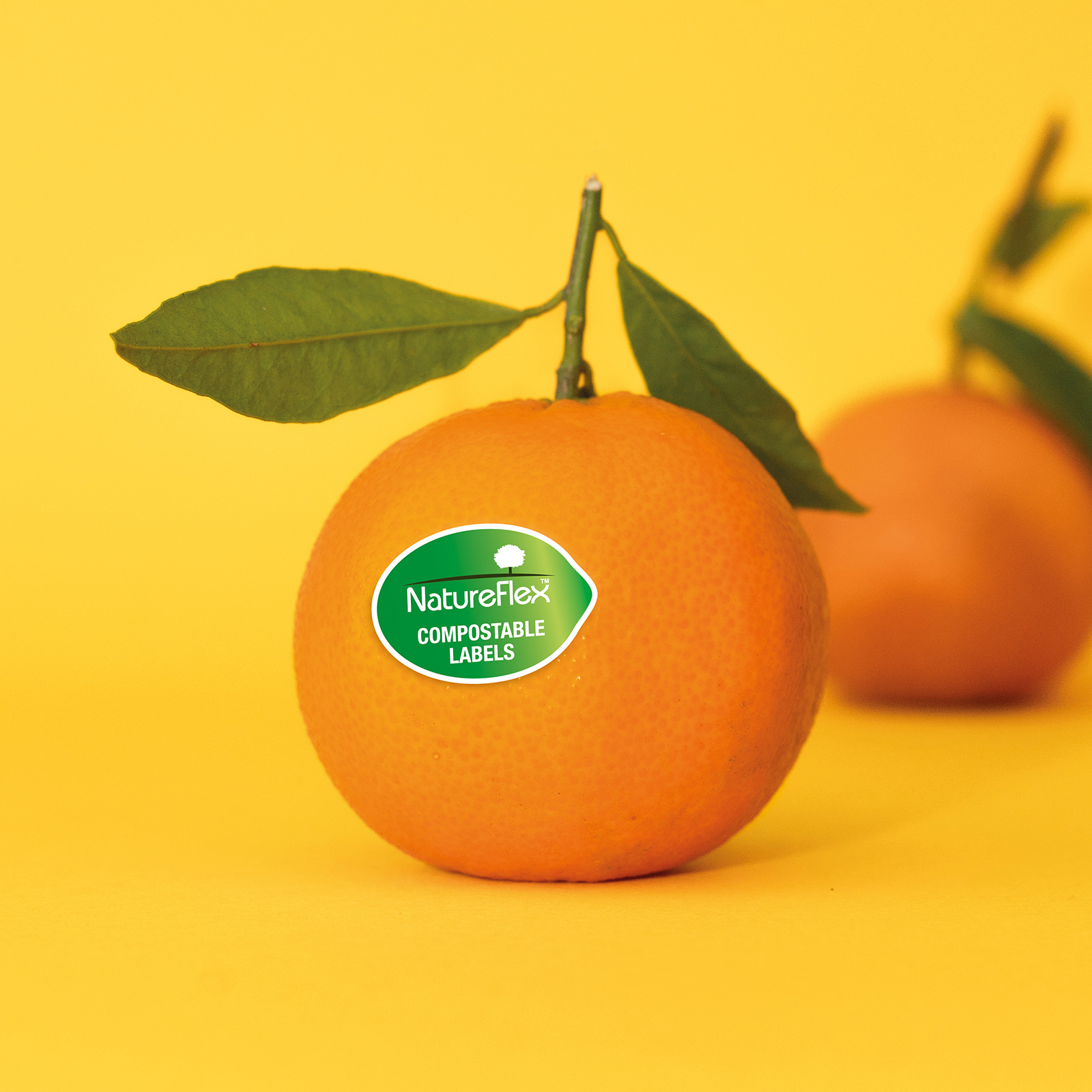
Futamura and Dutch self-adhesive materials producer Bio4life have developed a pressure-sensitive label for fresh fruit and vegetables that is certified for both home and industrial composting.
The format combines Futamura’s NatureFlex cellulose film with Bio4life’s BioTAK adhesive technology. It is intended for products including apples, citrus fruit, avocados and kiwis, replacing conventional plastic labels with a construction designed to break down alongside organic waste.
NatureFlex provides the printable facestock, while BioTAK forms the adhesive layer. Certifying the complete pressure-sensitive construction avoids a common weakness in sustainable label design, where a renewable or compostable face material is paired with an adhesive that remains incompatible with the intended disposal route.
Produce labels present a particular waste problem because consumers frequently discard them with skins, peel and spoiled fruit. Their small size makes mechanical separation difficult, allowing conventional plastic stickers to pass into composting or anaerobic digestion streams with organic material.
Futamura says NatureFlex labels can enter anaerobic digestion without contaminating the resulting digestate. The film is derived from cellulose sourced from wood pulp and is already used across food packaging, flexible films and pressure-sensitive label applications.
Mechanical behaviour remains central to adoption. Produce labels are converted, printed, die-cut and applied at high speed, often onto cold, damp, waxy or irregular surfaces. A compostable material has to pass through that equipment consistently if it is to replace established fossil-based films without increasing stoppages or waste.
NatureFlex is available in clear, white and metallised versions, with the material’s stiffness intended to support die-cutting and dispensing. Its anti-static characteristics and print surface are also relevant to high-volume label conversion, where web handling and adhesive performance can quickly determine whether a new substrate is commercially practical.
Bio4life’s contribution is designed to maintain the compostability of the label after the adhesive is added. Its BioTAK technology is formulated for renewable compostable substrates, allowing the two companies to offer the main functional layers as a matched system rather than leaving converters to combine independently qualified materials.
That reduces one part of the qualification burden, but packers and label applicators will still have to test individual constructions under production conditions. Adhesive tack, release behaviour, die-cutting tolerances, application temperature and retention on different fruit surfaces can all vary with equipment and operating environment.
The regulatory timetable is adding pressure to that development work. Futamura says the European Packaging and Packaging Waste Regulation is increasing demand for compostable labels attached directly to fruit and vegetables, creating a relatively short period in which materials have to move through testing, conversion and commercial trials.
The shift forms part of a broader attempt to move compostable packaging from material-development programmes into industrial use. Recent processing trials have increasingly focused on whether compostable formats can tolerate commercial filling, sealing and handling conditions rather than relying solely on end-of-life certification.
Produce stickers use very little material individually, but they are manufactured and applied in huge volumes. Small changes in substrate cost, conversion yield, press speed or label-application reliability can therefore become significant when multiplied across a retailer or produce packer’s annual throughput.
The waste issue is similarly disproportionate to label weight. A sticker may account for only a fraction of the material associated with a piece of fruit, yet its direct attachment means separation relies on consumers removing it before disposal. Designing the label for the same organic-waste route as the product skin removes that dependency.
Commercial use will still require clear disposal instructions and suitable local collection infrastructure. Home compostability and industrial compostability describe material performance under defined conditions; they do not guarantee that every consumer has access to the same waste-management route.
The immediate engineering task is more conventional: producing labels that converters can print and cut reliably and that packing lines can apply without slowing throughput. Futamura and Bio4life have addressed the substrate and adhesive together, leaving real production trials to establish how consistently the construction performs across different produce categories and application systems.
European packaging legislation is increasingly reaching components that previously attracted little attention because of their size. Fruit labels are measured in millimetres and fractions of a gram, but replacing conventional versions still depends on material science, adhesive chemistry and high-speed converting performance working together.