IN Brief:
- Four testo 174 models cover temperature-only and combined temperature-and-humidity monitoring.
- USB-C and Bluetooth versions store up to 16,000 readings at configurable intervals.
- The devices support traceable records across storage, refrigeration, and short-distance transport.
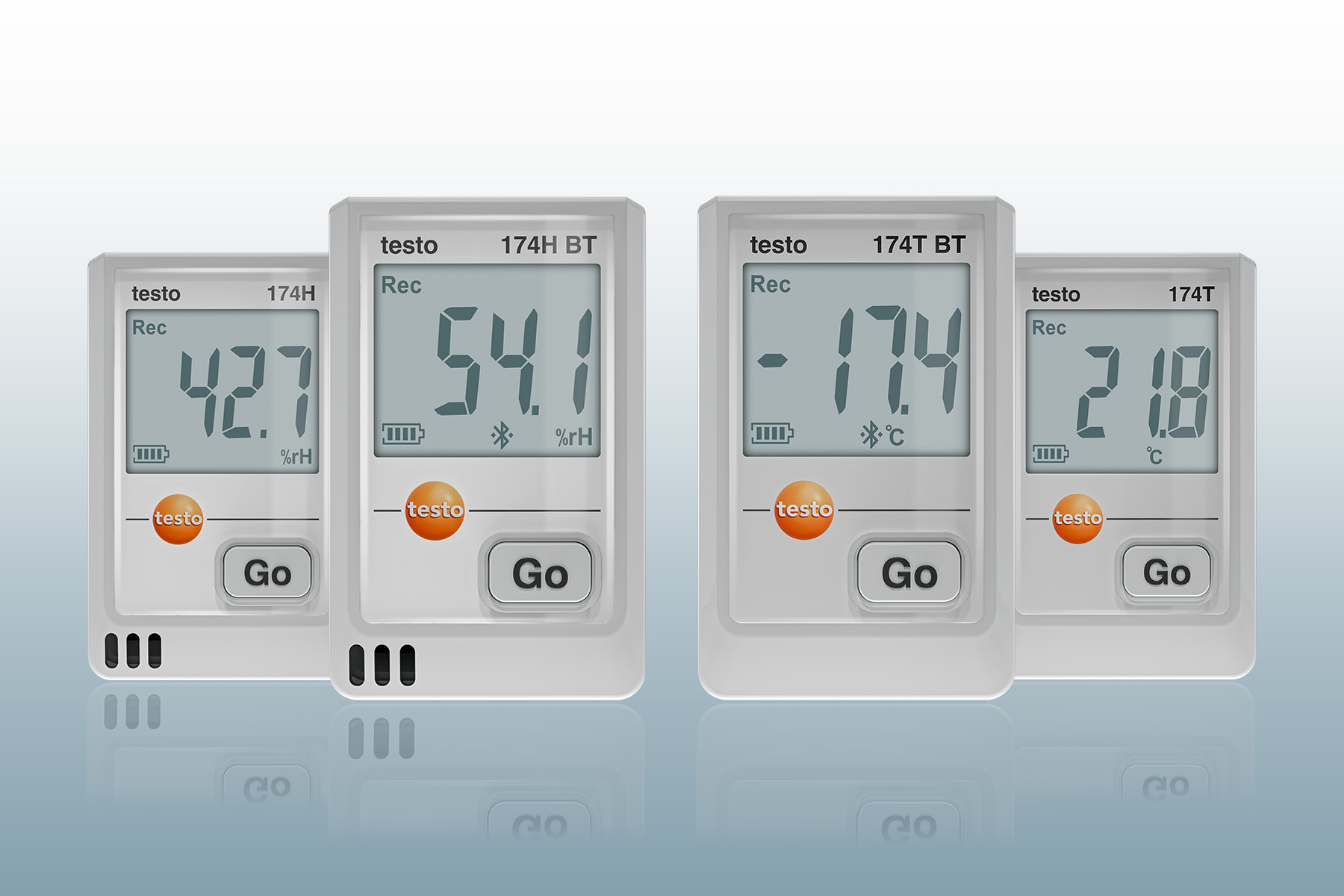
Testo has expanded its compact monitoring range with four testo 174 data loggers designed for temperature and humidity recording in storage areas, cold rooms, and transport applications.
The range includes the testo 174 T and testo 174 T BT temperature loggers, together with the testo 174 H and testo 174 H BT models for combined temperature and relative-humidity measurement.
USB-C versions transfer records to a computer without requiring a separate interface, while Bluetooth models communicate with the testo Smart App at distances of up to 30 metres under suitable conditions. Operators can configure the devices, read data, and generate reports through the selected connection route.
Each logger can store up to 16,000 measurements, with recording intervals configurable from one minute to 24 hours. An integrated display shows the current value, allowing routine checks without downloading the full dataset.
The temperature-only models operate between -30°C and +70°C and meet EN 12830 requirements for recorders used during the transport, storage, and distribution of chilled, frozen, deep-frozen, and quick-frozen food.
The testo 174 H and H BT versions measure temperature from -20°C to +70°C and relative humidity from 0% to 100%. All four devices are HACCP compliant and retain recorded data during battery changes.
Excel export and PDF reporting support documentation for internal review, customers, and audits. The compact format allows the units to be installed in refrigerators, cold rooms, dry stores, vehicles, insulated boxes, and other locations where a fixed monitoring network may be impractical.
Continuous data provides a fuller record than an isolated manual reading because food quality and safety depend on both the severity and duration of an excursion. A brief rise during loading may have a different effect from several hours above specification, even where both produce the same maximum temperature.
Humidity monitoring adds another control for powders, bakery products, packaging materials, ingredients, and dry stores. Excess moisture can contribute to mould growth, caking, loss of crispness, label failure, or weakened cartons, while low humidity can affect product weight and texture.
Portable monitoring closes gaps between fixed sensors
Warehouse and building-management systems provide continuous records at fixed locations, but they cannot always follow a pallet, cage, tote, or shipment. A compact logger can remain with the goods from dispatch through storage and transport, preserving evidence across handovers.
Bluetooth access reduces the need to retrieve each device for a physical connection, which can simplify checks in loaded vehicles or densely packed stores. Sites still need to determine whether mobile devices and wireless communication are permitted in the relevant production or storage area.
USB-C provides a controlled alternative where wireless access is restricted or a desktop reporting process is preferred. Maintaining both formats allows the same measurement platform to operate across businesses with different levels of digital infrastructure.
Automated Cook-to-X temperature records have already extended continuous monitoring into thermal-processing verification. The testo 174 range applies the same principle to storage and movement, replacing handwritten spot checks with a time-stamped history.
Data quality depends heavily on sensor placement. A logger beside a chiller outlet, directly against a warm door, or inside a stagnant corner may record conditions that do not represent the product or the wider storage area.
Temperature mapping can identify hot and cold spots before routine positions are selected. Large rooms may require several loggers, particularly where racking, airflow, door openings, refrigeration cycles, and product loading create significant variation.
Air temperature must also be distinguished from food temperature. Air responds rapidly when a door opens, while the product changes more slowly because of its thermal mass. Air monitoring can provide an early warning, but it does not always demonstrate the internal condition of the food.
Some applications may therefore require a penetration probe, surface sensor, or simulated-product device alongside the compact logger. The monitoring method should reflect the hazard, shelf-life sensitivity, and corrective action attached to the result.
Calibration and verification remain necessary regardless of memory capacity. A sensor that has drifted can generate thousands of precise but inaccurate readings, so businesses need defined intervals, serial-number control, battery checks, and procedures for dealing with failed verification.
Transport workflows also need clear ownership. The logger must be started at the correct stage, associated with the right shipment, protected from loss or damage, and read by someone authorised to interpret an excursion.
Bluetooth and automatic reporting can remove several manual steps, but they do not decide whether affected food should be released, quarantined, tested, or rejected. Those decisions require defined limits and an assessment of time, temperature, product characteristics, and intended use.
The testo 174 range provides a compact route into more complete monitoring where fixed infrastructure does not cover the entire chain. Its operational value will come from connecting the readings with release, investigation, maintenance, and supplier-management procedures rather than simply accumulating a larger archive.