IN Brief:
- French food ingredient developer Verley has appointed a chief operating officer and opened a US branch.
- Partner manufacturing has reached fermentation scales of up to 50,000 litres, not an annual finished-protein output figure.
- Its first US commercial products are now expected in the second or third quarter of 2027.
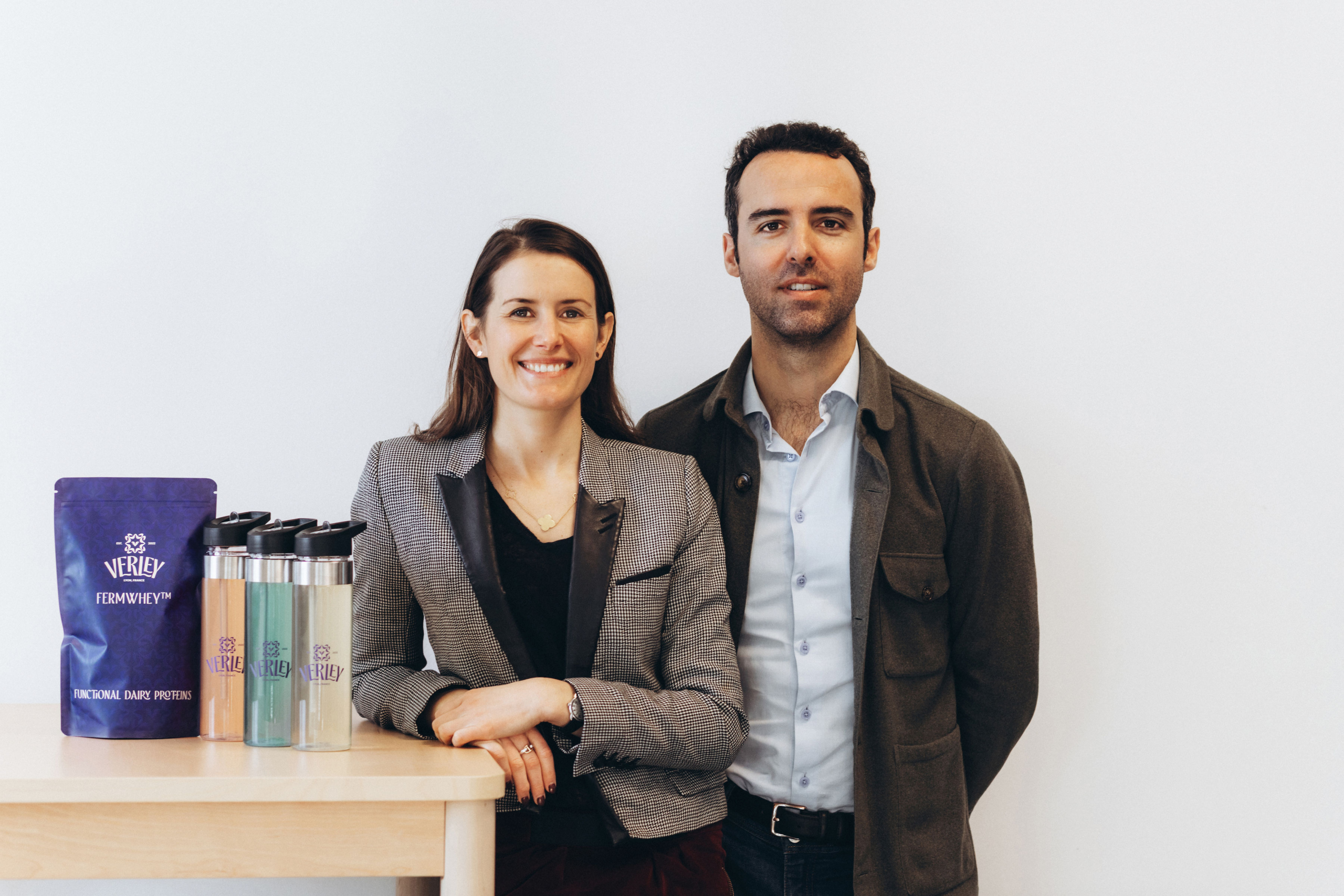
Verley has appointed Shayri Roychoudhury as chief operating officer and opened a US branch as it prepares to commercialise its precision-fermented dairy proteins. The French ingredient developer reports manufacturing runs at scales of up to 50 cubic metres, or 50,000 litres, through production partners. Expanding from such runs to routine contracted supply will require consistent recovery, product specifications and scheduled manufacturing capacity across different sites.
Roychoudhury previously spent seven years at Perfect Day, working across manufacturing, external production, quality and capital projects. She will oversee Verley’s global operations and the development of its contract manufacturing network. The new San Francisco branch establishes an operational presence in the intended first commercial market; it does not represent the opening of a new US fermentation plant.
FermWhey is based on beta-lactoglobulin, a dairy whey protein produced through fermentation rather than extracted from milk. A production microorganism expresses the target protein, which must then be separated from the fermentation broth, purified and made suitable for incorporation into foods. Removing conventional dairy farming from the protein production route does not remove the need to control fermentation contamination, downstream processing losses or energy and raw material consumption. Because the protein is a milk protein, its potential allergenicity must also be accounted for in finished product assessment and labelling.
Verley’s portfolio includes FermWhey Native 100, FermWhey MicroStab and FermWhey Gel. The variants are intended to offer different functional properties, including concentrated protein delivery, stability and gel formation. Those characteristics affect how a food behaves during heating, acidification, homogenisation and storage. Verley has described proprietary processing to achieve the functions, but it has not publicly specified industrial temperature profiles, retention times or recovery yields for the individual ingredients.
High-protein drinks are one target application because increasing protein loading can create viscosity, aggregation and stability problems. Different beverage formulations impose different pH, heat-treatment and shelf-life requirements; a performance result in one product cannot simply be transferred to another. Protein purity and nutrient composition are therefore only part of a manufacturer’s qualification process. The ingredient must also deliver acceptable texture, flavour and physical stability after the complete production and distribution cycle.
A 50,000-litre fermentation run demonstrates access to commercial-sized equipment, not annual production of 50,000 litres of finished ingredient. The quantity of recoverable beta-lactoglobulin depends on fermentation concentration, cycle duration, purification yield, equipment availability and batch rejection rates. Site-to-site technology transfer also requires matching the critical process conditions and verifying that products from different manufacturing partners meet the same composition and microbiological specifications.
The planned network will rely on external manufacturing partners rather than a single Verley-owned production site. That approach could allow capacity to grow across established industrial assets, but contract slots, downstream separation equipment and compatible quality systems must all be available. Roychoudhury’s experience in manufacturing partnerships is relevant to those arrangements. Verley has not disclosed the installed capacity or individual commercial production allocations of its partner plants.
Verley has described a roadmap towards 1,000 tonnes of production and a longer-term ambition of 5,000 tonnes a year. These are targets, distinct from the 50,000-litre scale reached in reported manufacturing runs. The company now expects products incorporating FermWhey to reach the US market in the second or third quarter of 2027, later than its earlier end-2026 ambition. Recent company interviews link that adjustment to customer volume requirements and the need to make supply arrangements reliable before launch.
The US Food and Drug Administration completed its review of Verley’s generally recognised as safe notice GRN 1241 on 16 September 2025. The agency had no questions about the company’s conclusion for a specified beta-lactoglobulin made using Aspergillus oryzae under the stated conditions of use. The response is not a blanket FDA approval for every formulation or a European market authorisation; food businesses must still assess the specific ingredient, application and applicable labelling requirements. Verley is pursuing other jurisdictions separately.
Earlier financing of approximately €32m in a Series A round has supported the company’s industrialisation strategy. Its newly appointed operations leader and US office provide organisational capacity, while the next tests remain technical and commercial: reproducible protein output, validated customers’ formulations and contracted delivery volumes. Neither the disclosed fermentation volume nor the production roadmap establishes that those milestones have already been met.