IN Brief:
- Wittmann has developed an automatic sack emptying station for granulate supply to injection moulding machines.
- The modular system uses a linear robot, pallet parking spaces, bag detection, R9 control, and optional inline bag grinding.
- The launch reflects growing automation pressure in material handling, including packaging production and food-sector supply chains.
Wittmann has introduced an automatic sack emptying station designed to improve granulate supply to injection moulding machines, reducing manual handling in plastics processing.
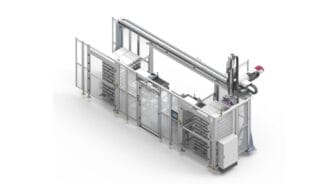
The system automatically destacks bags from a pallet, opens them, empties the contents, and disposes of the empty packaging. It has been developed for granule supply where operators may otherwise handle large volumes of raw material bags across multiple machines, materials, or production cells.
The standard configuration includes two pallet parking spaces and a linear robot. The robot detects the position of bags on the pallet, allowing it to work with partially used pallets as well as full stacks. Wittmann’s R9 control system is integrated into the station, supporting operation and connection with existing production and IT environments.
The system is modular, allowing processors to adapt the installation to plant requirements. Wittmann is also offering an optional grinder that shreds emptied bags directly at the station, supporting inline handling of the waste packaging generated by raw material supply.
The launch is initially focused on Germany, while the production pressures behind it are familiar across packaging and food-sector supply chains. Plastics processors and packaging suppliers are managing labour availability, ergonomic risk, material traceability, waste reduction, and machine uptime across increasingly automated plants.
Injection moulding is used in caps, closures, containers, tubs, trays, crates, reusable transport items, and components used across food and beverage packaging. If material supply is inconsistent, manual, or poorly controlled, the downstream effect can be felt in moulding uptime, quality, batch traceability, and operator workload.
Food packaging production is becoming more integrated. Packaging lines, moulding cells, raw material systems, recycling streams, and inspection processes are being tied into data-led manufacturing environments. Robotics, inspection, sustainable packaging, and line flexibility are already high on food manufacturers’ equipment agendas, as reflected in the latest interpack planning for food visitors.
Manual sack handling creates several operational risks. It is repetitive, physically demanding, and often poorly aligned with the level of automation found elsewhere in the plant. It can introduce spillage, foreign material risk, inconsistent feed routines, packaging waste build-up, and avoidable downtime.
Higher-mix production adds further complexity. Where materials and colours change regularly, incorrect handling or cross-contamination can create quality issues. Bag stacks are not always perfectly aligned, pallets may arrive partly used, and production schedules can change quickly. A rigid system that only handles ideal input conditions has limited value in real factory environments.
Wittmann’s emphasis on bag position detection and modular configuration reflects that reality. Automating an area that has traditionally depended on operator judgement requires flexibility, not simply mechanical repetition. The same point applies across food production and packaging: automation is most useful when it can handle variation rather than only remove labour from idealised tasks.
The optional inline bag grinding feature also links production with waste control. Packaging producers are under pressure to account for internal packaging waste as well as the recyclability of products they supply. Handling empty raw material bags at the point of use can reduce clutter, improve housekeeping, and support more controlled waste streams.
Comparable automation pressure is visible downstream. ULMA Packaging UK’s FoodTech Ireland debut and Reiser UK’s cheese processing and packaging showcase both reflected demand for more integrated production and packaging systems. Wittmann’s system applies related logic to the packaging supply base by removing manual bottlenecks before they undermine line performance.
Material handling can appear peripheral because it sits behind the production cell. A highly automated moulding machine still depends on raw material arriving safely, consistently, and on time. As packaging producers chase efficiency, traceability, and lower labour exposure, automated sack emptying becomes part of the machinery infrastructure needed for higher-throughput, lower-waste production.