IN Brief:
- Schubert has introduced a new generation of TLM top-loading machines at interpack 2026.
- The system uses a stiffer frame, new pick-and-place tools, EtherCAT robotics communication, and modular scanning.
- The launch reflects demand for higher output, smaller footprints, faster changeovers, and flexible material handling.
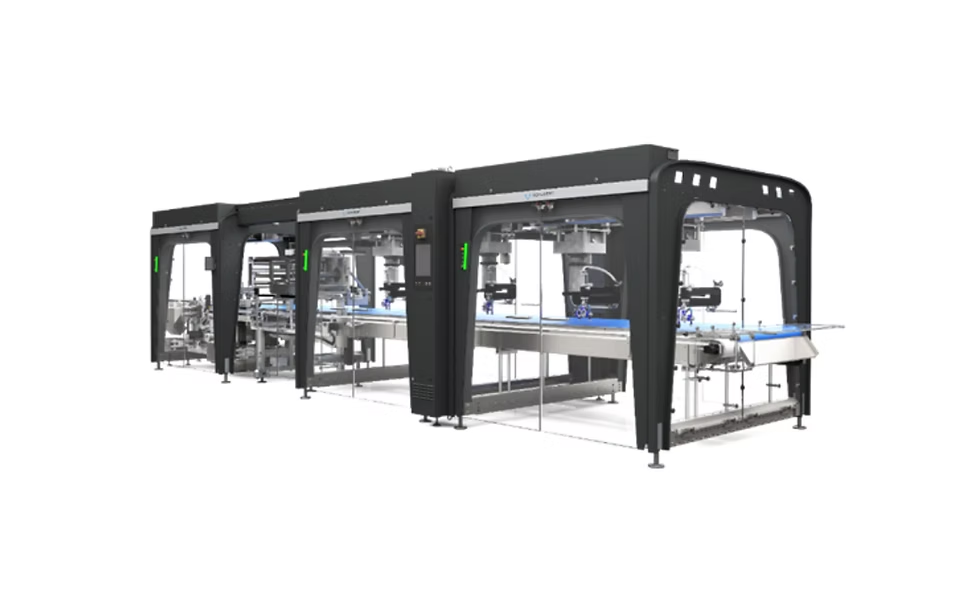
Gerhard Schubert has introduced a new generation of its TLM top-loading packaging machine technology, targeting higher performance density, smaller footprints, and greater production flexibility.
The redesigned TLM platform was presented at interpack 2026 in Düsseldorf and demonstrated using a flowpacker. Schubert has reworked the system around a stiffer machine frame, new pick-and-place tools, updated scanning, and device communication based on the EtherCAT robotics standard.
By increasing the rigidity of the frame and changing the way components are arranged, Schubert says more units and conveyor technology can be fitted into the same installation space. The design also improves operator access, which is increasingly important as food plants add automation without necessarily expanding floor space or rebuilding production halls.
Packaging lines are being asked to do more inside tighter physical and commercial constraints. Mature plants often have limited space for new equipment, while retailers and brand owners continue to demand more formats, shorter runs, and faster changeovers. Additional line speed only creates value when it does not introduce new bottlenecks around feeding, inspection, maintenance, material handling, or end-of-line packing.
Schubert’s new TLM generation sits within a wider portfolio that includes lightline systems and tog standardised production cells. The tog line is designed to carry out individual packaging functions and integrate into existing lines, including systems supplied by other manufacturers. That modular approach reflects how many food plants now buy automation: not as a single greenfield line, but as targeted upgrades to weak points inside mixed-generation production environments.
The engineering direction is consistent with other recent packaging developments. MULTIVAC’s connected packaging systems placed AI-supported traysealing, yield monitoring, thermoforming, and production data inside one operational platform, while TNA’s interpack programme focused on integrated conveying, processing, packaging, confectionery systems, and digital services.
Across these launches, packaging machinery is becoming less isolated from the wider plant environment. Machine builders are competing on software integration, data visibility, tool change speed, hygienic access, material flexibility, and lifecycle support as much as mechanical throughput. Labour scarcity, SKU growth, sustainability targets, and new packaging materials are all pushing machinery suppliers toward more adaptable systems.
Food producers are also under pressure to handle materials that do not always behave like the packs they replace. Fibre-based formats, thinner films, recyclable structures, and material-reduced packs can change feeding, sealing, handling, and reject patterns. A machine platform that can accommodate more variation while maintaining output gives processors a route to capacity improvement without full-line replacement.
The new TLM generation therefore reflects a practical automation priority: denser, more flexible packaging cells that can sit inside increasingly complex production networks. Plants that treat packaging investment as a line-level decision, rather than a single-machine purchase, are likely to see the strongest operational return.