IN Brief:
- Lucent is designed to use at least 20% less energy per cocoa batch than Bühler’s previous Tornado system.
- Throughput can increase by up to 20% without expanding the machine footprint.
- Heat recovery, sealed product handling, and self-learning controls support more consistent roasting and lower yield losses.
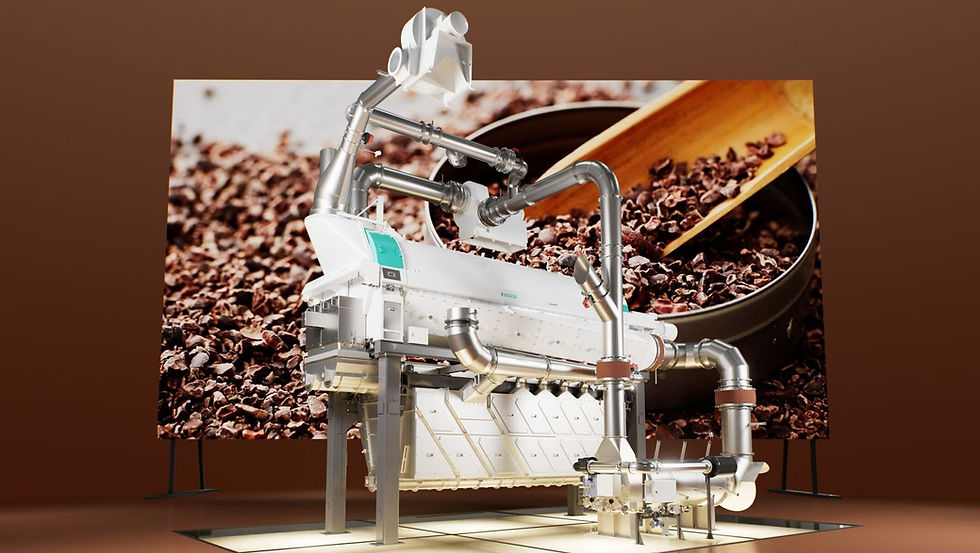
Bühler has introduced a cocoa nib roaster designed to increase production capacity while reducing the energy required during one of the most influential stages of chocolate manufacture.
Built at the company’s Appenzell operation in Switzerland, the Lucent system uses at least 20% less energy per batch than Bühler’s established Tornado roaster and can deliver up to 20% higher throughput. The additional output is achieved without increasing the machine footprint, allowing manufacturers to raise capacity within established factory layouts.
Cocoa roasting shapes flavour, colour, moisture, microbial condition, and downstream processing behaviour. Variations introduced at this stage can carry through grinding, refining, conching, and finished chocolate production, particularly when factories are handling beans from several origins, crop years, and quality grades.
Lucent operates with a sealed product chamber that separates cocoa from combustion air throughout the roasting cycle. Alongside improved hygiene and product protection, the design allows tighter management of temperature, airflow, and roast development, while reducing the risk of external contaminants entering the process.
Recovered thermal energy is returned to the process rather than discharged as waste heat. Self-learning controls monitor operating conditions and adjust roasting parameters to maintain the selected profile, helping to compensate for variations in incoming material without relying entirely on manual intervention.
A hybrid heating configuration can reduce energy consumption further where the site’s electrical infrastructure and utility arrangements permit. Bühler has identified potential savings of up to 40% under suitable operating conditions, although actual performance will vary with product mix, batch size, energy source, production schedule, and system integration.
The roaster extends the processing equipment programme unveiled around interpack 2026, where energy performance, connected controls, and more flexible production featured across new chocolate, bakery, wafer, and extrusion systems.
Roasting efficiency meets volatile cocoa economics
Energy consumption represents only one element of the investment calculation. Cocoa processors have faced sustained pressure from raw material prices, variable crop quality, freight costs, and higher working capital requirements, leaving less tolerance for yield loss or batches that fall outside specification.
Greater repeatability can reduce the amount of cocoa that is over-roasted, under-roasted, or transferred downstream with inconsistent moisture and flavour development. When the raw material itself accounts for a larger share of production cost, modest improvements in usable yield can carry greater financial weight than the utility saving alone.
Roasting behaviour also influences the equipment that follows. Moisture, particle characteristics, and roast intensity can affect grinding efficiency, liquor viscosity, refining, and conching. A process that produces a narrower range of material conditions gives downstream lines a more stable feed and reduces the need for corrective adjustments later in production.
Higher throughput becomes particularly valuable where the roaster restricts the output of a wider chocolate plant. Installing additional capacity within the existing footprint can avoid the cost and disruption of new buildings, extraction systems, utilities, product transfer routes, and structural modifications.
Those gains still depend on disciplined maintenance. Heat exchangers, airflow systems, sensors, seals, and product contact surfaces must remain within specification if thermal performance and process control are to be sustained. Fouling or poorly calibrated instrumentation can gradually remove the savings established during commissioning.
Manufacturers will also assess cleaning access, changeover time, start-up losses, roast uniformity, operator requirements, and integration with recipe management systems. Production sites running several origins or chocolate formulations need equipment that can move reliably between profiles without creating excessive downtime or transitional waste.
Automation can reduce routine intervention, although it cannot remove the natural variation found in cocoa. Operators and process technologists will continue to interpret bean condition, sensory results, and downstream behaviour, using the control system to reproduce decisions more consistently across shifts and production campaigns.
Plant trials will establish whether the energy and throughput improvements remain stable over sustained production rather than selected operating runs. Output per hour, yield, cleaning frequency, maintenance demand, and finished product consistency will determine the full commercial return.
With cocoa costs placing greater pressure on every processing stage, the roasting operation is being asked to deliver more than flavour development. Lucent brings thermal efficiency, product protection, and repeatable control into the same system, allowing manufacturers to pursue additional capacity without treating quality and energy as separate engineering problems.