IN Brief:
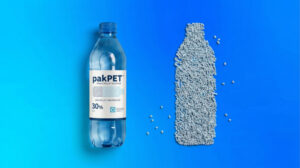
- pakPET incorporates 30% post-consumer recycled PET within a single ready-to-use pellet.
- The food contact approved resin is designed for drop-in use across established PET processing operations.
- Commercial availability is scheduled from August 2026, with production based in Verbania, Italy.
Plastipak has developed a food contact approved PET resin containing 30% post-consumer recycled material within a single ready-to-use pellet.
The pakPET material is intended to remove the need for packaging converters to blend separate virgin and recycled PET streams at their own facilities. Commercial availability is scheduled from August 2026, with production based at Plastipak’s operation in Verbania, Italy.
Applications include food and beverage containers, pharmaceutical packaging, thermoformed products, and other PET formats requiring controlled recycled content. The resin is designed for drop-in compatibility with existing PET operations, reducing the amount of additional handling and qualification associated with separate feedstocks.
Conventional recycled-content production often requires virgin PET and recycled PET to be stored, dried, dosed, and blended before injection moulding, stretch blow moulding, extrusion, or thermoforming. Each stage creates opportunities for variation in the ratio of materials, moisture level, viscosity, colour, and processing behaviour.
Combining the required proportion in one pellet gives the converter a single resin specification and a simpler chain of material movement. It may also reduce the equipment, silo capacity, dosing controls, and production records required to demonstrate that the intended recycled content has been maintained.
pakPET uses post-consumer feedstock supported by traceability certification under EN 15343, the European standard covering plastics recycling traceability and the assessment of recycled content. Documentation is becoming increasingly important as producers are required to substantiate environmental declarations and regulated recycled-content figures.
The EU’s recently clarified methodology for recycled content in PET beverage bottles has sharpened the need for consistent calculation and verification as material moves between recyclers, resin producers, preform manufacturers, bottle makers, and filling operations.
Recycled content becomes a production specification
European packaging policy is moving recycled polymer from a voluntary procurement preference into a measured component of pack design. Beverage bottles have been among the earliest high-volume formats affected, with collection targets, recycled-content thresholds, and producer responsibility fees creating stronger demand for verified food-grade material.
Supply remains constrained by the quality of collected packaging. Food-grade recycled PET depends on suitable bottles being recovered, separated from incompatible polymers and colours, washed, decontaminated, and converted under an approved recycling process. Contamination, poor collection rates, and competing demand can reduce the volume available for renewed food contact use.
A single-pellet product cannot remove those upstream restrictions, although it can simplify the final conversion stage. Plastipak will still need stable access to suitable post-consumer material and sufficient recycling capacity to maintain the 30% formulation across commercial volumes.
Consistency will determine whether the resin can support long production runs without creating additional scrap or intervention. PET processing is sensitive to intrinsic viscosity, crystallinity, moisture, thermal history, and colour, while even modest variation can influence preform quality, bottle wall distribution, haze, dimensional stability, and mechanical strength.
Food and beverage manufacturers will also need to confirm performance under filling and distribution conditions. Carbonation pressure, hot or cold filling, top loads, transport vibration, storage temperature, closures, labels, and shelf life can expose differences that are not visible during resin or preform testing.
Qualification may be simpler than introducing a newly blended material system, but it will not disappear. Drying parameters, cycle times, melt temperatures, mould performance, inspection limits, and finished pack specifications will need to be validated for each intended application.
The approach could prove particularly useful across manufacturing networks that operate several plants or rely on multiple converters. A controlled resin formulation provides a common basis for purchasing and compliance, avoiding local blending practices that may vary between factories, contractors, or production campaigns.
Commercial value will depend on the relationship between resin price and the costs removed elsewhere. A packaged single-pellet solution may carry a premium, while simpler storage, dosing, quality control, traceability, and line management can reduce expenditure inside the conversion operation.
Plastipak operates recycling facilities in Europe and the United States, giving the company control over parts of the collection-to-resin chain as demand for recycled PET grows. Integrating recycling and packaging production can improve visibility over feedstock quality, although market competition for suitable bottles remains intense.
Commercial processing data will show whether pakPET can maintain cycle speed, pack clarity, dimensional performance, and mechanical strength across preforms, bottles, trays, and other formats. As recycled content becomes a regulated production parameter, material systems will be evaluated as much for repeatability and evidence as for the percentage printed on the specification sheet.