IN Brief:
- Citeo’s reuse trial covers more than 360 supermarkets, nearly 170 products, and approximately 16m consumers.
- About 518,000 deposit-bearing products were sold during year one, with 108,000 packs returned and an average return rate of 24%.
- Shared containers, washing centres, return systems, and data management are being developed as common infrastructure.
Citeo is extending a shared reusable food packaging system across four French regions after its first year placed more than half a million deposit-bearing products into circulation through supermarkets and participating brands.
The ReUse trial has operated since June 2025 in Brittany, Normandy, Pays de la Loire, and Hauts-de-France. More than 360 supermarkets now participate alongside around 50 brands, retailers, and distributors, with nearly 170 products available to approximately 16m consumers.
Around 518,000 products in reusable packaging were sold during the first year, representing roughly 80% of the goods supplied into the trial. Consumers returned 108,000 packs, producing an average return rate of 24%, while individual stores or product lines achieved rates as high as 60%.
Standardised R-Cœur containers sit at the centre of the system and can be shared between participating businesses rather than retained within a single proprietary brand pool. Initial formats included one-litre bottles for milk, juice, and soup, together with 750ml beer bottles, while additional bottles, jars, and wine formats are joining the network during 2026.
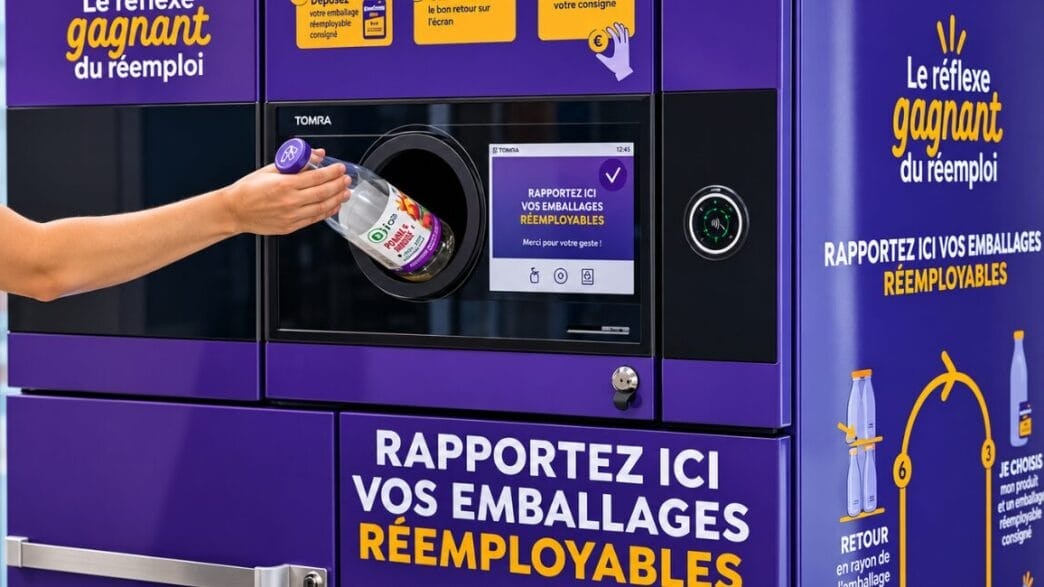
Deposits generally range from €0.10 to €0.20, with empty packs accepted through reverse-vending machines or semi-manual collection points. Returned containers are sorted and transferred to shared washing centres in Nantes and Lille, while Go! Réemploi manages stock, logistics, and system data across the loop.
Carrefour, Coopérative U, Intermarché, Monoprix, and E.Leclerc are among the participating retailers. Their combined coverage gives the system greater density than isolated brand schemes, which can struggle to provide enough return points, container rotations, or washing volume to support efficient transport and cleaning.
France is seeking a national approach as it works towards a target for reusable packaging to account for 10% of packaging placed on the market by 2027. The pilot has established a common pack family and regional operating network, although the first-year return rate shows that container recovery remains the central constraint.
Container rotations determine system capacity
A reusable pack begins to offset its additional material, collection, and washing burden only after enough rotations, so containers that do not return reduce pool availability and force the introduction of replacements. Some packs may remain in homes or retail storage, but slow recovery still lengthens the cycle and ties up capital.
Return rates of up to 60% in parts of the trial indicate that store layout, deposit visibility, customer communication, product frequency, and collection convenience can change performance substantially. Milk, beer, soup, juice, and wine have different purchase cycles and residue profiles, leaving a common system to accommodate varied consumer behaviour and cleaning needs.
Shared washing centres can improve utilisation, but they also introduce transport and scheduling requirements. Containers must be collected, sorted, inspected, cleaned, verified, and redistributed without creating long empty movements or leaving fillers short of the formats required for the next production campaign.
Residues, labels, closures, scuffing, and damage can slow inspection or cause rejection. Automated handling works best when dimensions, materials, and identification features remain standard, while proprietary shapes and decoration can complicate crate design, sorting, washing, storage, and filling-line changeovers.
Standardisation can also balance demand across participating businesses. A common container pool reduces the chance that one brand holds excess stock while another lacks bottles or jars, provided the data system records location, condition, ownership, and rotation accurately enough to support production planning.
The wider development of reusable transport packaging across Europe is placing similar emphasis on pooled crates, trays, pallets, and containers as managed assets rather than disposable consumables. Citeo’s project brings the same logic into consumer-facing food packaging, where return behaviour adds another variable.
Retailers must provide collection space, staff procedures, storage, and reliable handover to logistics operators. Reverse-vending machines automate recognition and refunds but require investment and maintenance, while semi-manual points lower the initial equipment cost at the expense of more labour and variation.
Filling plants face equally practical requirements. Returned packs need to arrive in usable condition, pass inspection, and fit washing and filling equipment, while product changes may require different cleaning parameters. Packaging life must be monitored so that damaged or visually degraded containers leave the pool before they affect safety or presentation.
The trial’s consumer rating of 8.6 out of ten suggests that reuse can fit normal shopping behaviour where the system is visible and convenient. Satisfaction alone will not provide enough containers for repeated industrial filling, however; return frequency and cycle time will decide the size and cost of the asset pool.
Citeo has moved reusable food packaging beyond a small local scheme by linking several retailers, standard containers, deposits, washing centres, and shared data across four regions. Expansion will depend on raising recovery, shortening rotations, and maintaining pack quality as the number of formats, products, and participating sites increases.