IN Brief:
- KOCH demonstrated robot systems for packing, palletising, labelling, and product handling to almost 60 visitors.
- A delta robot handled frozen food bags at high speed, alongside systems for cartons, sacks, rolls, and heavy containers.
- Flexible tooling, vision, commissioning, and pack compatibility increasingly determine whether robotics can absorb shorter production runs.
KOCH Industrieanlagen has demonstrated robotic systems for packing, palletising, labelling, and product handling at its Dernbach headquarters, including a high-speed delta robot configured to pick and place frozen food bags.
Almost 60 participants attended the 2026 demonstration day, where live installations handled products including rolls, hobbocks, cartons, sacks, and packaged foods. The systems were drawn from customer projects across food, converting, chemicals, and ceramics, showing how common robot platforms are adapted around different products, environments, and throughput requirements.
Within the food application, a delta robot handled flexible frozen packs at speed, using the rapid acceleration and compact working envelope associated with parallel-arm designs. Vision systems can identify pack position and orientation before the robot transfers each item into a case, tray, or downstream process.
Other demonstrations covered heavy-container packing, film-roll labelling, palletising, and intelligent product transfer. KOCH supplies individual cells as well as turnkey installations that connect filling, packing, order picking, intralogistics, machine linking, and end-of-line operations.
Representatives from ABB and KUKA joined discussions covering artificial intelligence, autonomous mobile robots, faster commissioning, and the longer-term development of humanoid systems. Those technologies are progressing at different rates, although each is intended to reduce the engineering effort required to configure, monitor, and adapt automated handling.
Food packing remains difficult to automate because products and packs can deform, arrive at irregular intervals, carry condensation, or vary in weight and surface condition. Frozen bags may be slippery and flexible, while bakery, produce, meat, confectionery, and dairy products require different gripper materials, pressure limits, cleaning methods, and temperature tolerances.
Reliable performance therefore depends on the complete cell rather than the robot arm alone. Grippers, cameras, lighting, conveyors, guarding, product presentation, rejection logic, and downstream case flow all influence output, and a small weakness in any element can create intermittent stops that are difficult to diagnose during production.
Shorter runs reshape automation design
Fixed automation traditionally delivered its strongest returns on long campaigns of stable products, whereas modern food plants increasingly manage seasonal packs, retailer-specific formats, and frequent recipe or artwork changes. Robotic systems offer greater flexibility only when tooling, software, and product presentation have been designed for the full intended range.
A gripper that handles one frozen bag reliably may struggle when film thickness, seal geometry, pack weight, or surface moisture changes. Recipe selection can adjust robot speed, position, and vacuum settings, although physical tooling changes and validation may still be required when the pack departs materially from the original specification.
Packaging redesign is adding further variation as manufacturers introduce thinner films, paper-based structures, mono-material packs, and reduced-plastic formats. Changes in stiffness, friction, static, porosity, or seal strength can alter how a pack behaves under vacuum or mechanical gripping, even when its external dimensions remain unchanged.
Live testing with representative products can expose those interactions before a full system is built. Trials reveal whether packs need better spacing, whether the gripper marks or deforms the product, and whether vision remains stable under realistic lighting, line speed, and background conditions.
Robotic handling, inspection, and rapid format change featured prominently among the food technologies selected at interpack 2026. KOCH’s demonstrations placed those capabilities into complete cells, where machinery, materials, labour, and control software have to operate as one production system.
Repetitive lifting and palletising continue to drive investment, particularly where labour is difficult to recruit or where staff work in cold, wet, or physically demanding areas. Automation can remove strain and improve consistency, but technicians are still needed to maintain grippers, sensors, safety systems, and conveyors, while operators must recover minor faults without waiting for specialist support.
Artificial intelligence may reduce some of that burden through more tolerant vision models, simpler programming, and earlier detection of abnormal machine behaviour. Predictive tools can identify changes in motor load, vacuum performance, or cycle time before a cell stops, although the results depend on reliable data and a clearly defined maintenance response.
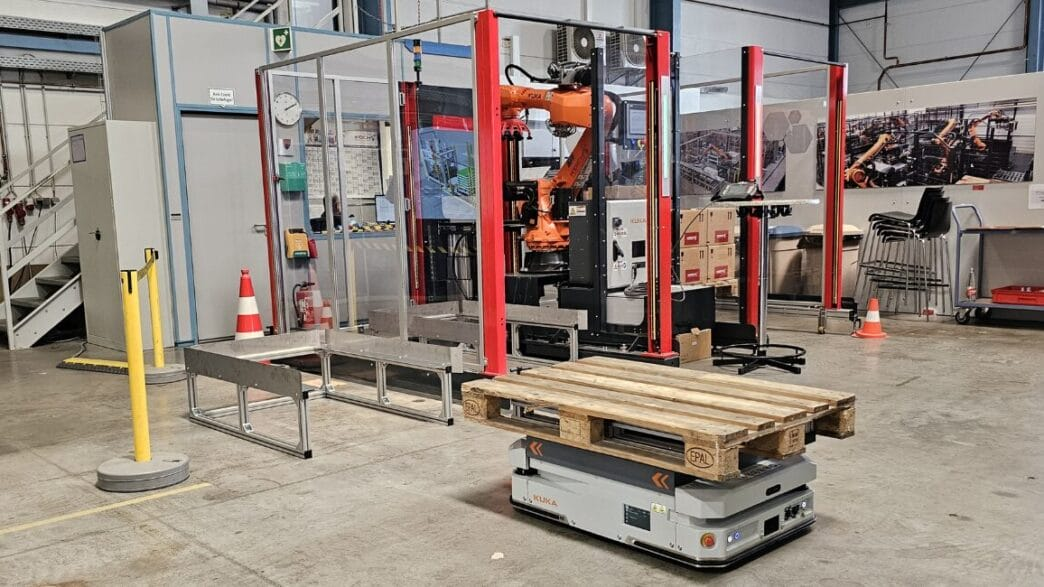
Autonomous mobile robots can extend automation beyond fixed cells by moving materials, empty packaging, and finished cases between operations. Their introduction requires traffic management, charging, pedestrian separation, hygiene-zone controls, and dependable interfaces with doors, lifts, production schedules, and warehouse software.
Commissioning remains the point at which theoretical flexibility meets the factory. Product variation, upstream timing, line clearance, sanitation, and downstream capacity all have to be represented accurately, otherwise a cell may reach its demonstration speed without sustaining it during a full shift.
The frozen-food application captured the central engineering problem in a familiar pack: flexible material moving at speed through vision, gripping, transfer, and placement. As product ranges widen and campaign lengths shorten, the quality of that integration will determine whether robotics becomes dependable plant infrastructure or another isolated machine that operators must continually accommodate.