IN Brief:
- Sycamore Process Engineering has designed, built, installed, and commissioned an automated single-channel CIP system for Müller Yogurts & Desserts.
- Cleaning capacity reaches 50,000 litres per hour, supported by a 16-way docking station for mobile stainless-steel tanks.
- Modular off-site assembly and Factory Acceptance Testing allowed the equipment to be installed through restricted roof access into a live dairy facility.
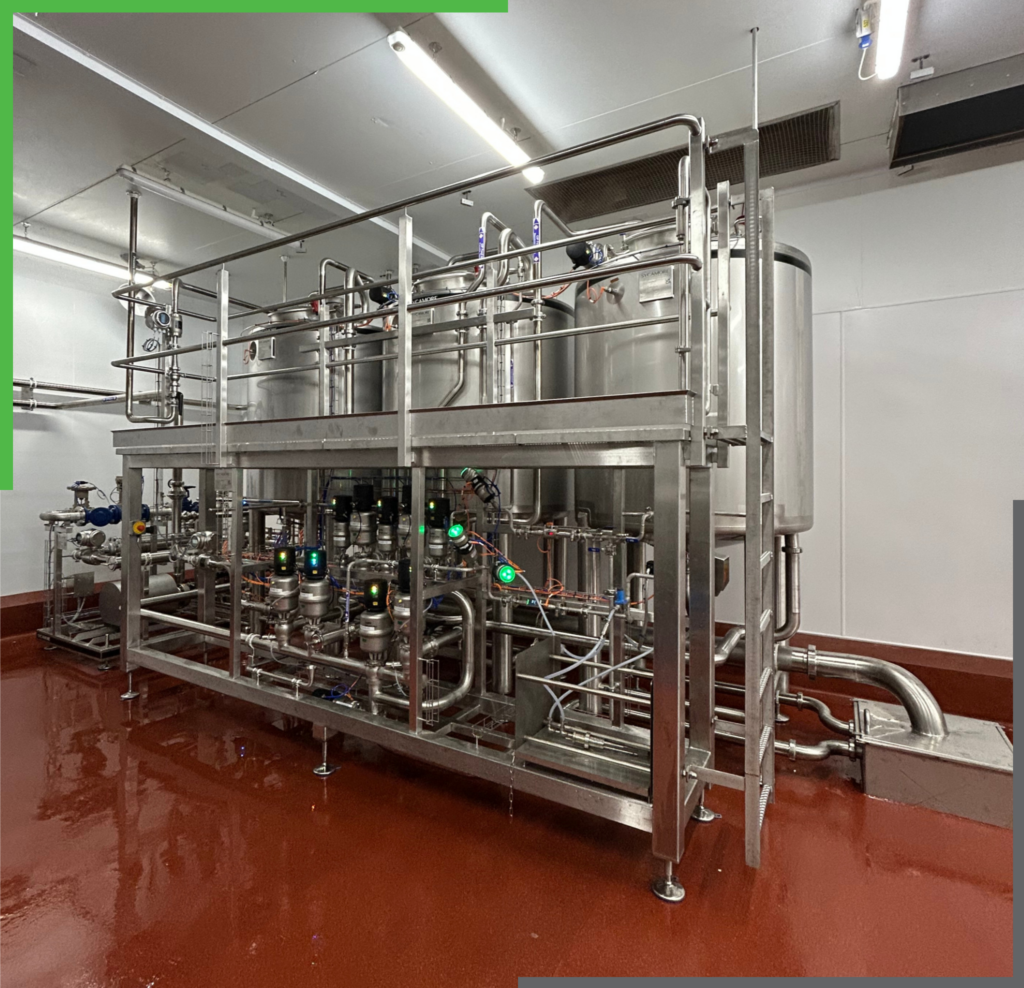
Müller Yogurts & Desserts has commissioned an automated Clean-in-Place system capable of delivering cleaning flows of up to 50,000 litres per hour, adding a high-capacity sanitation installation for mobile stainless-steel tanks within one of its UK production facilities. Sycamore Process Engineering designed, manufactured, installed, and commissioned the single-channel system alongside a 16-way docking station.
The installation combines a substantial cleaning duty with a constrained factory footprint. Mobile vessels can give dairy plants useful production flexibility, but every tank has to enter a controlled cleaning sequence before reuse, creating a sanitation task whose scale rises with the number of vessels moving between production duties.
Sycamore’s solution allows as many as 16 mobile tanks to connect through a dedicated docking arrangement. The central CIP system then provides the controlled cleaning flow needed to circulate detergent and rinse media through the selected vessel without requiring a separate fixed cleaning installation for every tank.
The maximum flow rate of 50,000 litres per hour is only one part of that process. Effective CIP depends on the interaction between flow velocity, turbulence, temperature, cleaning chemistry, concentration, contact time, and equipment geometry. A high-capacity pump cannot compensate for a poorly designed vessel, dead leg, incorrectly operated valve, or cleaning programme that fails to reach all product-contact surfaces.
Automation improves the repeatability of those variables. Once an approved recipe has been configured, the control system can execute a defined sequence more consistently than an operation dependent on repeated manual valve changes and timing decisions. Production and hygiene teams can then focus on whether the validated programme remains effective rather than recreating it from scratch for each tank.
That matters particularly in yoghurt and dessert production. Dairy residues combine protein, fat, sugars, cultures, stabilisers, flavour ingredients, and other materials that can behave differently during cleaning. Product changeovers may also introduce allergen, colour, flavour, or microbiological considerations, making the availability of clean tanks part of the production schedule rather than a separate housekeeping activity.
The physical installation created a second engineering challenge. Sycamore says the available factory space was restricted and that the only viable route for moving the equipment into the production area was through the building roof. The CIP package was consequently designed as modular sections that could be completed away from site and subsequently lifted into position.
Much of the assembly, piping, and wiring was carried out at Sycamore’s workshop. Müller then witnessed a Factory Acceptance Test before the modules were transported to the plant, lifted through the roof using specialist equipment, and reassembled for final commissioning.
That approach shifts labour and testing away from the live food-production environment. Factory assembly gives engineers more control over fabrication conditions and allows mechanical, electrical, and control issues to be identified before site access becomes the limiting factor. It can also reduce the amount of work required during a shutdown or installation window.
Three-dimensional design was used during development so that Müller and Sycamore could examine the equipment layout and service routes before fabrication. In a brownfield plant, that exercise can be more important than it first appears: a skid that technically fits into the available floor area can still be unworkable if valves, instruments, filters, or pumps cannot subsequently be reached for inspection and maintenance.
Sycamore says accessibility and maintainability were therefore retained despite the compact layout. That has direct hygiene implications. Sanitary equipment needs routine intervention, and components such as seals, pumps, valves, sensors, and dosing systems will eventually require inspection or replacement regardless of how automated the installation becomes.
The 16-way docking station adds another control requirement. Mobile tanks move physically around a site, so production teams need clear identification of which vessel is connected, what it previously contained, which cleaning programme it requires, and whether the completed cycle releases it for the next duty.
A well-integrated CIP system can make that process repeatable, but it does not eliminate the need for verification. Food plants still need evidence that the cleaning regime achieves the intended result, whether through conductivity and temperature records, visual inspection, ATP testing, microbiological checks, allergen verification, or other methods appropriate to the process.
Water, chemical, and energy consumption will also determine the operating performance of the new system. Faster cleaning is useful only if it does not create unnecessary rinse volumes or chemical losses, and high flow carries its own pumping-energy demand. Optimising CIP generally means balancing hygiene assurance with cycle time and utility consumption rather than maximising one variable in isolation.
Sycamore’s current installation is now beyond design and factory testing and has entered operational service at Müller. The more meaningful evidence will therefore come from repeated production cycles: tank turnaround, cleaning consistency, downtime, maintenance, and the volume of water and chemicals required per successful clean.
Those metrics rarely attract the attention given to a new filling or packaging line, but dairy production depends heavily on them. A mobile tank is only useful while it can be cleaned, released, and returned to production predictably; Müller’s new system has been engineered to make that supporting process considerably more controlled.