IN Brief:
- Edible Garden and Square Roots entered a non-binding product-development MOU on 21 August.
- The partners intend to optimise crops and formulations around naturally occurring bioactive compounds.
- Commercial manufacture is proposed for Edible Garden's planned Prairie Hills RTD facility in Iowa.
Edible Garden AG and agricultural technology business Square Roots have entered a non-binding agreement to develop clean-label functional ready-to-drink beverages, linking controlled-environment crop research with formulation work and a planned high-capacity manufacturing operation in Iowa.
The memorandum of understanding was entered into on 21 August and disclosed on 24 August. It envisages joint development of one or more RTD products using crops selected or optimised for naturally occurring bioactive compounds, with eventual commercial manufacture proposed at Edible Garden’s Prairie Hills facility in Webster City.
The agreement remains exploratory. Neither company has announced a completed commercial formulation, confirmed order volume, committed launch date, or binding manufacturing contract, so the current development is a defined product-development route rather than a guaranteed production programme.
Square Roots brings controlled-environment crop research to that programme. Its systems combine plant science, software, automation, and controlled growing conditions to screen varieties, develop crop recipes, and assess how production variables affect characteristics such as yield and composition.
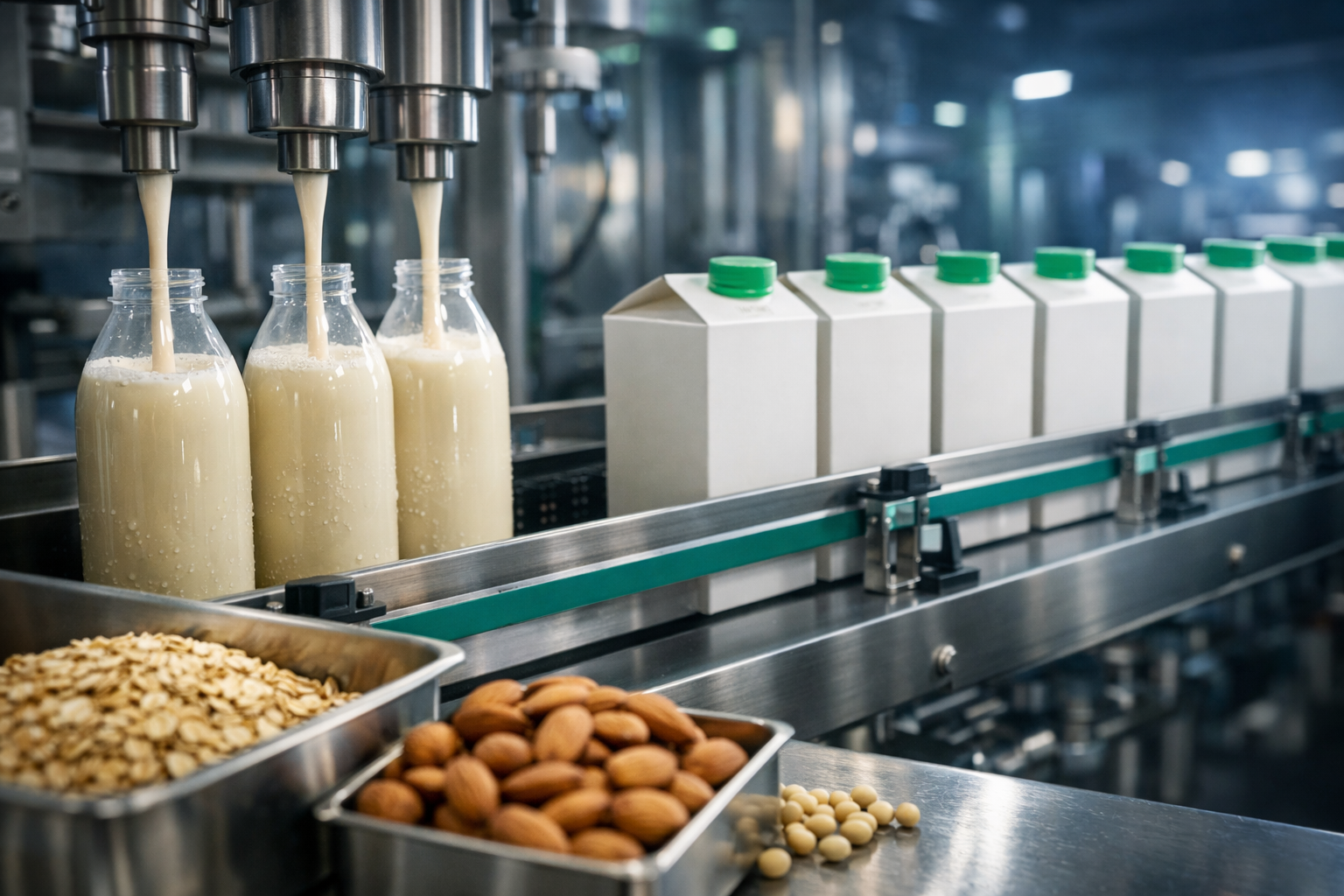
Edible Garden supplies the intended downstream manufacturing platform. The company is redeveloping Prairie Hills as a high-capacity operation for shelf-stable plant- and dairy-based nutritional beverages using Tetra Pak processing and aseptic packaging technology.
At full production, Edible Garden expects the site to have capacity for more than 100 million beverage units annually. The facility is intended to support the company’s own brands alongside private-label and co-manufacturing customers, giving the investment a broader utilisation model than a line dedicated to a single drink.
That capacity remains under development rather than in commercial operation. Edible Garden has engaged Structura Architects on design and engineering work, appointed E2 Building Group to support construction execution, and completed clean-label RTD prototype production at a Tetra Pak product-development centre under commercial processing conditions.
The prototype work matters because a functional ingredient that performs well before processing may behave differently in an aseptic beverage. Heat treatment, pumping, homogenisation, storage, oxygen exposure, pH, and interactions with proteins, minerals, sweeteners, or stabilisers can change flavour, colour, texture, and the concentration of sensitive compounds.
The companies have identified potential product territories including cognitive health, metabolic wellness, healthy ageing, inflammation management, GLP-1 support, and performance nutrition. Those descriptions set out development ambitions rather than substantiated claims for finished products, which would still need to comply with applicable ingredient and marketing regulations.
Connecting crop development with formulation could nevertheless give the partners greater control over an important source of variability. Agricultural ingredients are biological raw materials, and concentrations of nutrients or other compounds can move with variety, light, temperature, water, nutrient availability, maturity, and post-harvest handling.
A controlled-environment research platform allows some of those variables to be manipulated systematically. Square Roots can therefore work backwards from a desired crop specification rather than accepting whatever composition arrives from a conventional commodity stream and attempting to correct it entirely during formulation.
That approach does not eliminate variation. Commercial food manufacturing still requires incoming specifications broad enough to accommodate normal biological differences, analytical testing capable of identifying material outside tolerance, and formulations robust enough to remain stable when ingredient composition moves within an accepted range.
Prairie Hills would add another layer of discipline because high-volume aseptic production depends on repeatability. Product has to remain pumpable and stable through thermal processing, packaging material has to sterilise and form correctly, fills have to remain within specification, and the finished beverage must retain its sensory and nutritional characteristics throughout the intended ambient shelf life.
The planned relationship therefore connects two forms of process control that are usually separated by several stages of the supply chain. Square Roots is focused on manipulating how the crop is grown, while Edible Garden is building capability around how the resulting formulation is processed and packed.
Commercial economics will be equally important. Functional beverages can support higher selling prices than many conventional drinks, but specialised ingredients, analytical testing, aseptic packaging, product development, and customer acquisition also raise cost. A manufacturing platform designed for more than 100 million units has to secure substantial utilisation if those fixed costs are to be spread efficiently.
Edible Garden’s private-label and co-manufacturing strategy provides one route to filling that capacity. The company does not need every litre produced at Prairie Hills to belong to its own portfolio, reducing dependence on the performance of any single Farm-to-Formula product.
The Square Roots agreement could eventually contribute to that mix, but the next milestones will be practical ones: formulation selection, ingredient specifications, processing validation, construction progress, equipment installation, regulatory review, customer commitments, and commercial scheduling.
The MOU therefore sits somewhere between agricultural research and beverage manufacturing rather than representing a product launch. Its industrial interest comes from the attempt to design the crop and the process together — an approach that will be tested properly only when the resulting formulation has to run repeatedly through an aseptic line rather than a development laboratory.