IN Brief:
- The Oelde Process Test Center will expand to 3,500m² with a third test room by the end of 2026.
- More than 120 test machines support separation trials ranging from laboratory work to systems approaching industrial scale.
- Additional capacity will support process validation across dairy, beverages, and other separation-intensive applications.
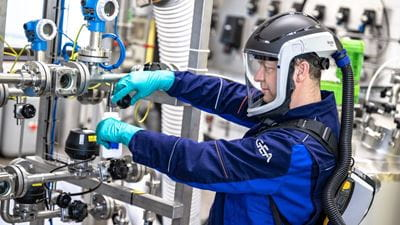
GEA is expanding its Process Test Center in Oelde, Germany, with a third test room for customer pilot trials, internal development work, and testing with larger machines and skid-mounted systems. Completion is planned by the end of 2026.
The enlarged facility will cover 3,500m² and support pilot work with raw-material or process-media inputs of up to 5,000 litres per hour. That puts the centre between laboratory investigation and full industrial production, allowing separation behaviour to be tested at meaningful scale before a processor commits to a final equipment specification.
Oelde is GEA’s headquarters for mechanical separation technology and the test operation has a history stretching back around 70 years. Customers use the site to characterise products, select and size disk-stack and decanter centrifuges, establish process parameters, and validate how separation systems respond to varying feed materials.
The centre has generated more than 60,000 test reports across its application base. Around 800 product samples are currently tested and developed there each year, supported by more than 120 machines ranging from laboratory units to skid solutions approaching industrial scale.
Food and beverage applications sit within a wider workload covering chemical, pharmaceutical, and renewable-raw-material processes. Beverage and dairy processing are specifically included, where centrifugal separation can be used for clarification, solids removal, concentration, fractionation, and the recovery of useful product streams.
Adding a third test room responds to a practical constraint in process development: equipment selection cannot be separated from the material being processed. Viscosity, solids loading, particle characteristics, temperature, and raw-material variability can all change separation performance, while the required product specification determines whether a higher throughput is commercially useful.
Pilot work gives engineering teams a controlled way to establish those relationships before the production line is modified. GEA’s test programme is designed to identify the appropriate machine, operating parameters, and likely product quality while examining how changes in feed material affect the process.
That evidence becomes more important where a processor is considering larger centrifuges or an integrated skid rather than replacing one machine with another. A new separator can alter upstream feed conditions, cleaning requirements, utility demand, product recovery, and downstream handling, so the surrounding process has to be considered alongside the centrifuge itself.
The Oelde expansion should also reduce competition for specialist test capacity between customer projects and GEA’s internal research work. The additional room gives the company more scope to develop new applications while preserving access for processors that need repeatable data before signing off capital expenditure.
Existing infrastructure already includes an ATEX-certified test room for work in potentially explosive atmospheres. That capability is primarily relevant to chemical, oil, gas, and related applications, but it demonstrates the range of operating conditions that the site is designed to reproduce safely.
The project also includes a dedicated wastewater-treatment system and a GEA heat pump. Both technologies are part of the company’s commercial portfolio, but at Oelde they will have a direct operational role because frequent pilot campaigns create liquid waste streams and thermal loads that have to be managed alongside the test equipment.
Resource use can be material in pilot facilities because tests are deliberately varied. Product changes, cleaning cycles, temporary pipework, and repeated set-up work can increase water and energy demand compared with a settled production line, so supporting infrastructure has to cope with short campaigns without becoming the limiting factor.
The data generated through those campaigns is also valuable beyond an individual trial. A 60,000-report archive gives engineers a reference base for comparing new products and process conditions with historical work, reducing the need to treat every separation problem as entirely new.
For dairy and beverage processors, that can shorten the route from sample testing to industrial design. A centrifuge that performs well on one product cannot simply be assumed to deliver the same result on another, but historical data can help define the most useful starting configuration before physical trials begin.
GEA reported sales of around €5.5bn in 2025 and employs more than 18,000 people, with food, beverage, and pharmaceutical processing among its major application areas. The Oelde centre therefore supports equipment specification across a large installed base rather than functioning solely as a demonstration site.
The third test room will increase the amount of work the centre can run in parallel and broaden the size of systems it can accommodate. For processors, the gain is more opportunity to test product, equipment, and operating conditions together before the same decisions become considerably more expensive on a live manufacturing line.
Once construction is complete, the expanded centre will combine higher pilot throughput with laboratory analysis, historical test data, and a broader machine fleet. That does not remove scale-up risk, but it gives separation projects more evidence before they move from development work into plant design and commissioning.