IN Brief:
- Jacksons has introduced white and seeded sliced sourdough bloomers following a multi-million-pound manufacturing investment.
- Specialist equipment added the capability to manufacture sourdough products that the bakery could not previously produce.
- The slowly fermented range uses a Belgian sourdough starter and contains no artificial preservatives or added sugar.
Jacksons of Yorkshire has added commercial sourdough production to its bakery operation following a multi-million-pound investment in manufacturing capacity and specialist equipment, allowing the company to make a product format that its previous process could not support.
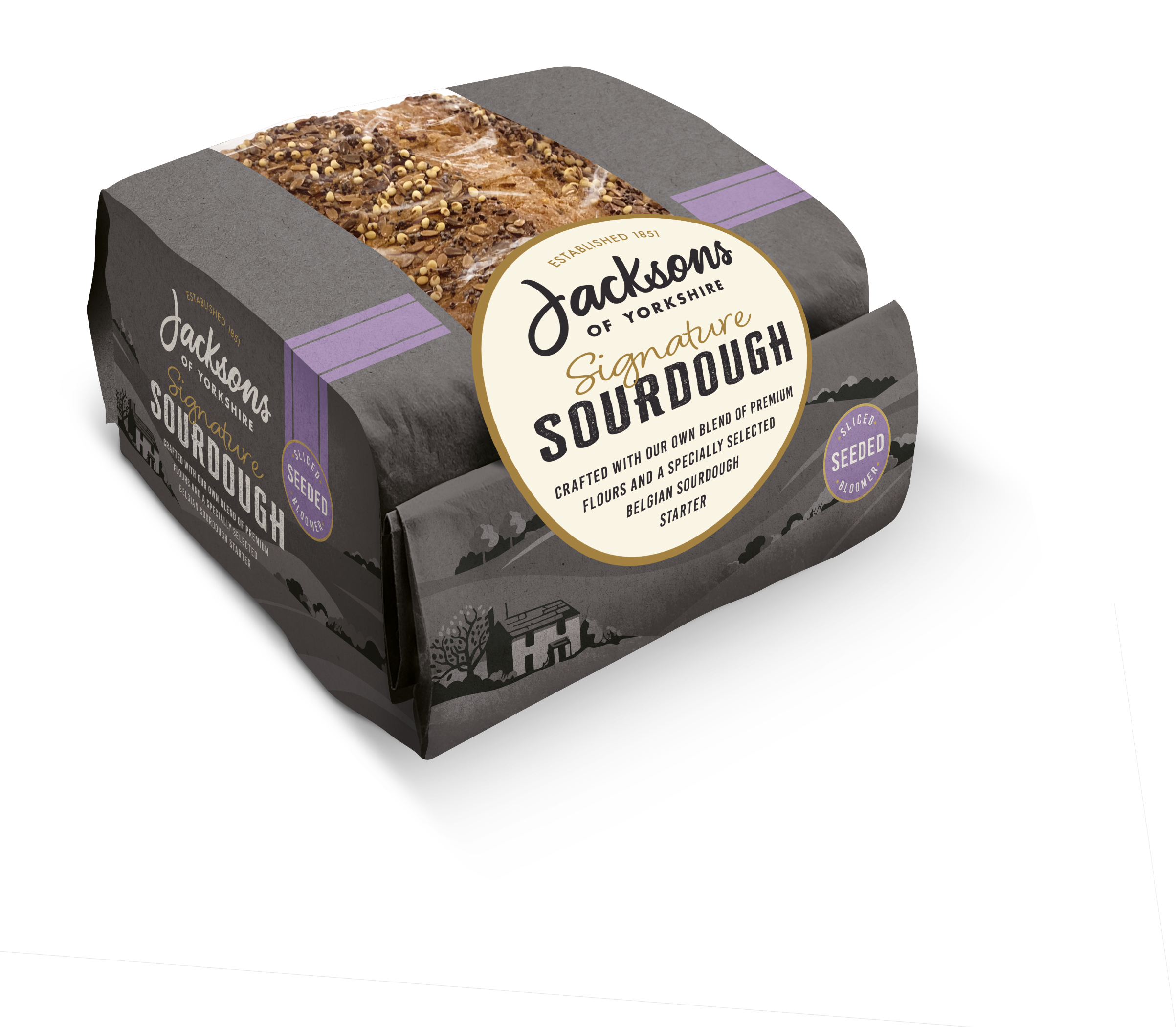
The investment underpins the launch of Sliced White Sourdough and Seeded Sourdough bloomer loaves, which are entering UK grocery channels from September. The range is being positioned as a convenient sliced format rather than an artisan-style unsliced loaf, placing additional emphasis on production consistency and downstream slicing performance.
That manufacturing step separates the launch from a conventional flavour extension. Jacksons has confirmed that specialist equipment purchased through the investment gave the business the capability to manufacture sourdough itself, rather than adapting an existing bread line around a minor formulation change.
The two loaves use a selected Belgian sourdough starter and a blend of flours. Jacksons’ current product specifications describe the products as slowly fermented, with no artificial preservatives, added sugar, or palm oil.
The white product contains wheat flour, water, durum wheat flour, salt, and fermented wheat flour, while the seeded version adds millet, golden linseed, brown linseed, and poppy seeds. Jacksons markets the formulation around a small number of ingredient types rather than the longer ingredient systems common in some packaged bread.
Transferring sourdough characteristics into a high-volume sliced product creates a different manufacturing challenge from producing small batches for an artisan bakery. Fermentation influences acidity, gas development, dough strength, flavour, and handling, while commercial production has to reproduce those characteristics within a tightly controlled schedule.
Longer or more sensitive fermentation steps can affect the rhythm of the whole bakery. Dough preparation has to be coordinated with dividing, moulding, proofing, baking, cooling, slicing, and packing so that additional process time does not simply create bottlenecks elsewhere on the line.
The product also has to retain sufficient consistency for automated handling. An artisan loaf can tolerate substantial variation in profile and crumb structure; a sliced retail bloomer has to remain stable enough to travel through cooling, slicing, bagging, and distribution without excessive deformation or crumb loss.
That requirement helps explain why Jacksons needed additional manufacturing capability rather than relying on its existing processes. A sourdough recipe may be relatively simple on paper, but producing it repeatedly at supermarket volumes requires control of fermentation and physical product characteristics across thousands of loaves.
Adrian Hipkiss, managing director of Jacksons of Yorkshire, said: “Ultimately, we have combined the flavour and character consumers associate with sourdough with the quality, consistency and convenience they need from an everyday loaf.”
Consistency is particularly significant for a packaged bread supplier because the product has to meet both consumer expectations and retailer specifications. Loaf weight, slice dimensions, packaging integrity, shelf life, and availability all have to remain within defined ranges regardless of the greater fermentation complexity associated with sourdough.
Jacksons is using the investment to target a category that has expanded beyond specialist bakery counters. The company cites a UK sourdough market worth around £480m a year and reports strong growth in shopper penetration and spending, providing the commercial case for installing manufacturing capability rather than treating sourdough as a temporary limited-edition product.
The launch will be supported by a six-figure marketing programme, including outdoor advertising, retailer activity, shopper activation, digital promotion, and public relations. That may generate the initial demand, but the investment case ultimately depends on repeat sales keeping the new manufacturing capability sufficiently utilised.
New sourdough production also introduces raw-material and scheduling considerations into an established bakery. Starter and flour specifications have to be incorporated into purchasing and quality-control systems, while longer fermentation requirements have to coexist with other products sharing labour, space, ovens, cooling, and packaging capacity.
The seeded product creates an additional material flow through the bakery. Seeds must be stored, dosed, and controlled consistently, while allergen and contamination risks have to be managed within the wider production environment even though the principal allergen remains wheat and other gluten-containing cereals.
Downstream slicing is another point where process development matters. A loaf that appears acceptable after baking can still cause manufacturing losses if crumb structure or softness produces poor slice definition, excessive tearing, or unstable packs.
The ability to manufacture sourdough at commercial scale therefore depends on the whole production route rather than on fermentation alone. Jacksons’ investment has to make the product repeatable from dough preparation through to a sliced loaf that can survive normal grocery distribution.
The company has not disclosed the detailed equipment specification, rated throughput, or precise capacity increase created by the project. Those figures should not be inferred from the size of the investment, particularly where capital may cover several pieces of equipment or broader factory capability.
What has been confirmed is more fundamental: the investment enabled a manufacturing process that the bakery could not previously undertake. That is a meaningful industrial change because it creates a new production platform from which additional sourdough products could be developed if demand supports them.
Jacksons traces its history to 1851 and already operates at the scale required for national grocery supply. Entering sourdough therefore involves translating a product associated with smaller-scale fermentation into the repeatability expected from an established packaged-bread manufacturer.
The commercial test begins once the launch period passes. New bakery equipment only creates value if customer demand produces sufficient throughput, while sourdough’s growth will attract competing capacity from other large bakers.
Jacksons has nevertheless crossed the more difficult initial threshold by putting manufacturing capital behind the category. The new loaves are the visible output; the lasting change is that the bakery now has a sourdough production capability it previously lacked.