IN Brief:
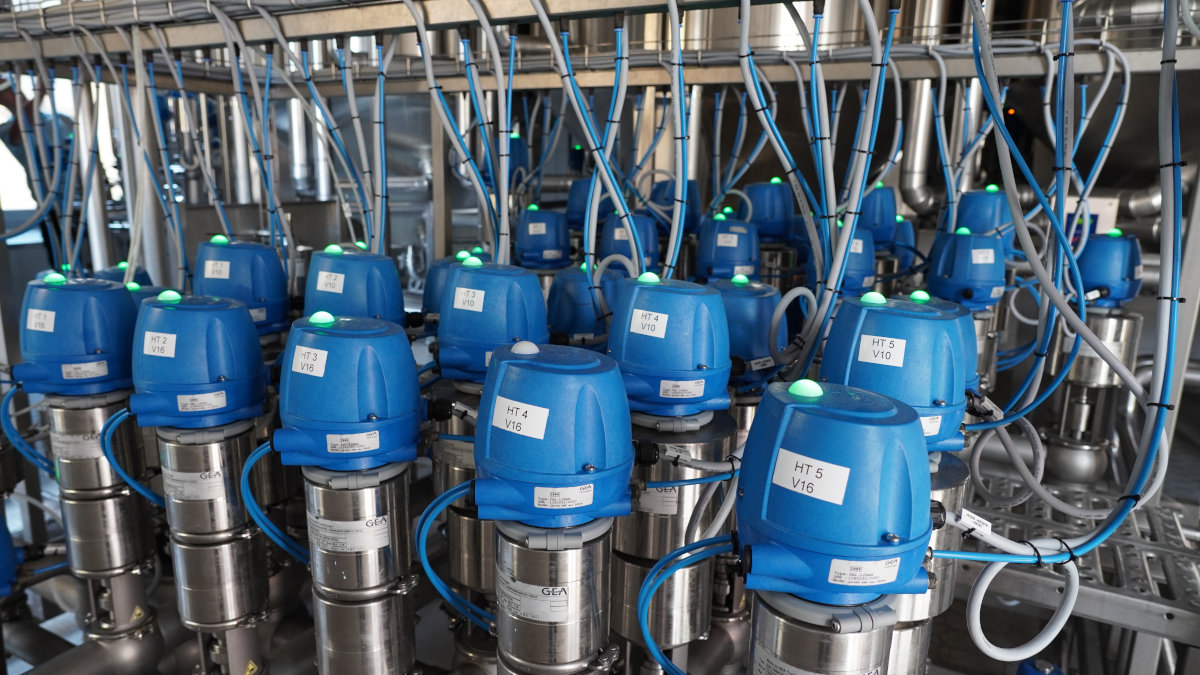
- GEA is adding Hydract water hydraulic actuation to selected single seat, divert and double seat VARIVENT valves.
- A closed hydraulic circuit replaces compressed air while allowing stable valve positioning as process pressure and flow change.
- A Carlsberg application showed more than 95% lower valve actuation power consumption and higher tank utilisation.
GEA is bringing water hydraulic actuation into selected VARIVENT process valves, extending technology already used by Carlsberg into its established hygienic valve platform for beverage, dairy and other liquid food operations.
Hydract will initially be available on selected single seat, divert and double seat VARIVENT valves. Instead of compressed air moving and positioning the actuator, the system uses a closed hydraulic circuit containing treated water or an approved mixture of water and glycol, supplied from a compact pump station through flow and return lines.
Hydraulic fluid is effectively incompressible under the operating conditions involved, which allows the valve position to remain stable as process pressure or flow changes. Pneumatic actuators depend on compressed air, whose behaviour can make very precise intermediate positioning more difficult when operating conditions fluctuate.
Greater positioning accuracy becomes important when a valve is regulating flow rather than simply opening or closing. GEA is using Hydract to support continuous inline blending, where different liquid streams can be combined and adjusted as product moves through the process instead of relying entirely on separate mixing and storage stages.
At Carlsberg, the technology has already provided an industrial reference case. GEA says valve actuation power consumption in the proven application fell by more than 95%, while the more precise control allowed the brewer to pursue later product differentiation and reduce the number of separately prepared variants held in tanks.
In a greenfield scenario based on the Carlsberg application, GEA calculated that the required number of bright beer tanks could fall from 26 to 14 while average utilisation rose from 54% to 90%. The figures describe a modelled plant configuration rather than a universal saving, but they show how the behaviour of a valve can influence equipment requirements elsewhere in a process.
Beverage plants frequently prepare finished or near finished variants before filling, which can leave tank capacity allocated to different recipes, strengths or market requirements. Moving part of that differentiation downstream allows a common base product to remain undivided for longer, provided the final blending stage can control the required proportions accurately and consistently.
Carlsberg Brewing and Quality Director Anders Kokholm has linked that capability with lower inventory, production on demand and reduced waste at the bottling plant. GEA is now taking the underlying actuation system beyond the original brewery application by incorporating it into VARIVENT, a valve range already used across hygienic liquid processing.
Compressed air is deeply established across food and beverage factories because it provides a convenient source of actuator power. Generating and distributing it, however, introduces conversion losses, leakage risk and additional utility demand. A hydraulic alternative changes that utility architecture rather than merely substituting one valve model for another.
Hydract still requires a pump station and dedicated flow and return lines, so the system introduces its own installation requirements. Its value will therefore depend on the process duty, the positioning accuracy required, the number of valves involved and the opportunity to simplify other equipment through more controlled inline processing, rather than actuation energy savings alone.
GEA acquired the Hydract technology before integrating it into its own portfolio, and the VARIVENT launch gives the system a route into a substantially broader installed base. Breweries are an obvious early application because blending, tank utilisation and recipe differentiation are closely connected, while dairies and other hygienic liquid processors face comparable requirements for repeatable flow control and cleanable valve systems.
As the technology moves into the wider VARIVENT range, its performance will be judged across the process rather than at the actuator alone. More stable valve positioning has the potential to change tank allocation, recipe management and inline blending, but those gains depend on how successfully the hydraulic system integrates with the wider plant.