IN Brief:
- Pulsed LED backlighting in visible and near infrared wavelengths is intended to improve product segmentation under difficult inspection conditions.
- Optional three-way sorting can divide one incoming stream into three independently configurable outputs in a single pass.
- The new COMPASS B200 uses a sorting belt two metres wide for higher throughput food processing lines.
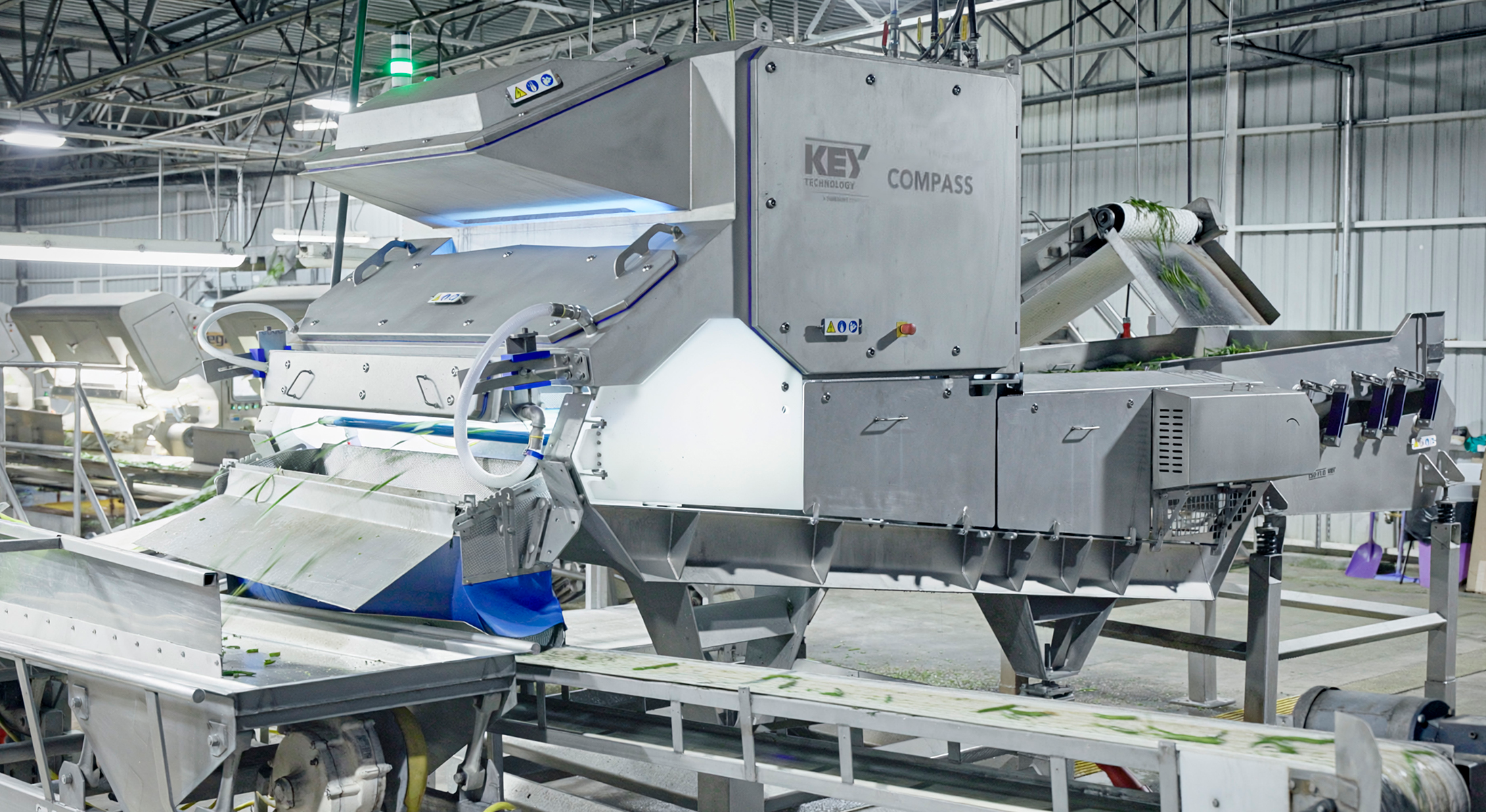
Key Technology has expanded its COMPASS belt fed optical sorting platform with pulsed LED backlighting, optional three-way separation, and a larger model intended for higher throughput food processing lines.
The changes target three different limitations in automated inspection: separating product reliably from a difficult visual background, making more than one quality decision during a single pass, and presenting enough material to the inspection system without overcrowding the belt.
The new backlight system uses pulsed LED illumination available in visible and near infrared wavelengths. Rather than relying only on light directed at the product from above, the system transmits light through the belt to create additional contrast between the food and its background.
Key has highlighted kettle chips as one application where the change can improve inspection. Irregular shapes, shadows, oil, seasoning, and staining on the belt can all make it more difficult for an optical sorter to distinguish product edges cleanly, particularly when acceptable and defective material have similar colours.
Product segmentation matters because the sorting system has to establish where an individual piece begins and ends before it can decide whether it meets the programmed specification. A high resolution camera provides limited benefit if lighting conditions prevent the software from identifying the object consistently.
Production conditions also change during a shift. Belts accumulate residues, product presentation varies, and natural foods differ in shape, colour, moisture, and surface condition. The value of additional illumination is therefore in helping maintain a stable inspection environment as the line moves away from the clean conditions present at start-up.
Visible and near infrared sensing provide different information. Conventional colour imaging can identify many obvious visual defects, while infrared wavelengths can reveal differences that are difficult to distinguish through colour alone. The appropriate configuration still depends on the product and defect being targeted.
Key has also introduced optional three-way sorting by adding a second ejection manifold. Instead of dividing material simply into accepted and rejected streams, COMPASS can direct the incoming product into three independently configured outputs during one pass.
The third stream can be used for rework, a separate defect class, or another commercial grade. That gives processors more control over material that does not meet the main finished-product specification but may still have value elsewhere in the operation.
A potato or snack processor, for example, may want to remove foreign material completely while diverting a second category for rework or lower grade use. Treating both categories as reject would discard potentially recoverable product, while installing another sorter would add capital cost, floor space, controls, and another transfer point.
Three-way separation can therefore influence yield as much as food safety. Foreign material removal remains the critical function, but a more selective reject strategy can reduce the amount of good or recoverable food leaving the production stream with genuine defects.
The third change is the COMPASS B200, which uses a belt two metres wide. Key has introduced the model for higher capacity lines where a wider presentation area can allow the required throughput to pass through one sorter rather than several smaller machines.
Sorter width is important because optical inspection depends on presenting the product in a way that allows individual pieces to be seen. Feeding excessive volume onto a narrower belt increases overlap and can hide defects or foreign material from the cameras.
A wider belt can spread the same tonnage across a larger inspection area, although feeding equipment still has to distribute the product evenly. Poor presentation upstream can compromise sorting performance regardless of the width or sensing capability available at the inspection point.
Using one larger machine can also simplify line architecture. Splitting material between two sorters requires additional conveyors, controls, support structures, access, cleaning, and recombination of accepted streams, all of which create more equipment for the processing plant to maintain.
The sorter retains Key’s recipe driven operating system, allowing settings to be stored for different products or specifications. That is useful on plants running multiple SKUs because inspection requirements can change substantially between product types while operators still need a repeatable method of returning to approved settings.
COMPASS also includes Key Discovery analytics and reporting software. The system records production information that can be used to examine sorter performance and operating trends rather than treating inspection solely as a point at which rejected food disappears from the line.
That information can help processors distinguish between a sorting problem and an upstream process problem. If the proportion of defects begins to rise, the cause may be incoming raw material, cutting, frying, coating, handling, or another process stage rather than deterioration in sorter performance itself.
The open equipment design is intended to improve cleaning and maintenance access. Inspection equipment frequently sits at a critical point in a food line, so sanitation or service time can interrupt the complete production process if the sorter cannot be returned to operation quickly.
Optical sorting has consequently moved beyond the relatively simple task of identifying a visibly bad item and firing it from the stream. Modern systems are being asked to classify material, protect yield, collect process data, and adapt to several products while maintaining enough inspection certainty for food safety and quality control.
The latest COMPASS changes address those requirements from different directions. Better lighting improves the information available to the inspection system, three-way sorting increases the number of decisions it can make, and the B200 increases the volume that can be presented for inspection.
The useful measure for processors will be the amount of acceptable product retained at the required quality level. A sorter earns its place on the line by removing the right material consistently, not by producing the largest possible reject stream.