IN Brief:
- Glasgow and Kyushu researchers are developing a CubeSat experiment based on whisky processing chemistry.
- The planned 2028 mission will carry around 10ml of fluid and a nanophotonic chemical sensor.
- Cask wood will also be exposed to repeated orbital temperature changes during the experiment.
University of Glasgow engineers are working with Kyushu Institute of Technology on a CubeSat experiment that will use whisky chemistry to study ethanol processing and chemical change in microgravity.
The spacecraft is planned for launch in 2028 carrying around 10ml of fluid and could remain in orbit for up to five years. Glasgow will develop the whisky experiment, while Kyushu Institute of Technology will build the satellite bus and its own mission instruments.
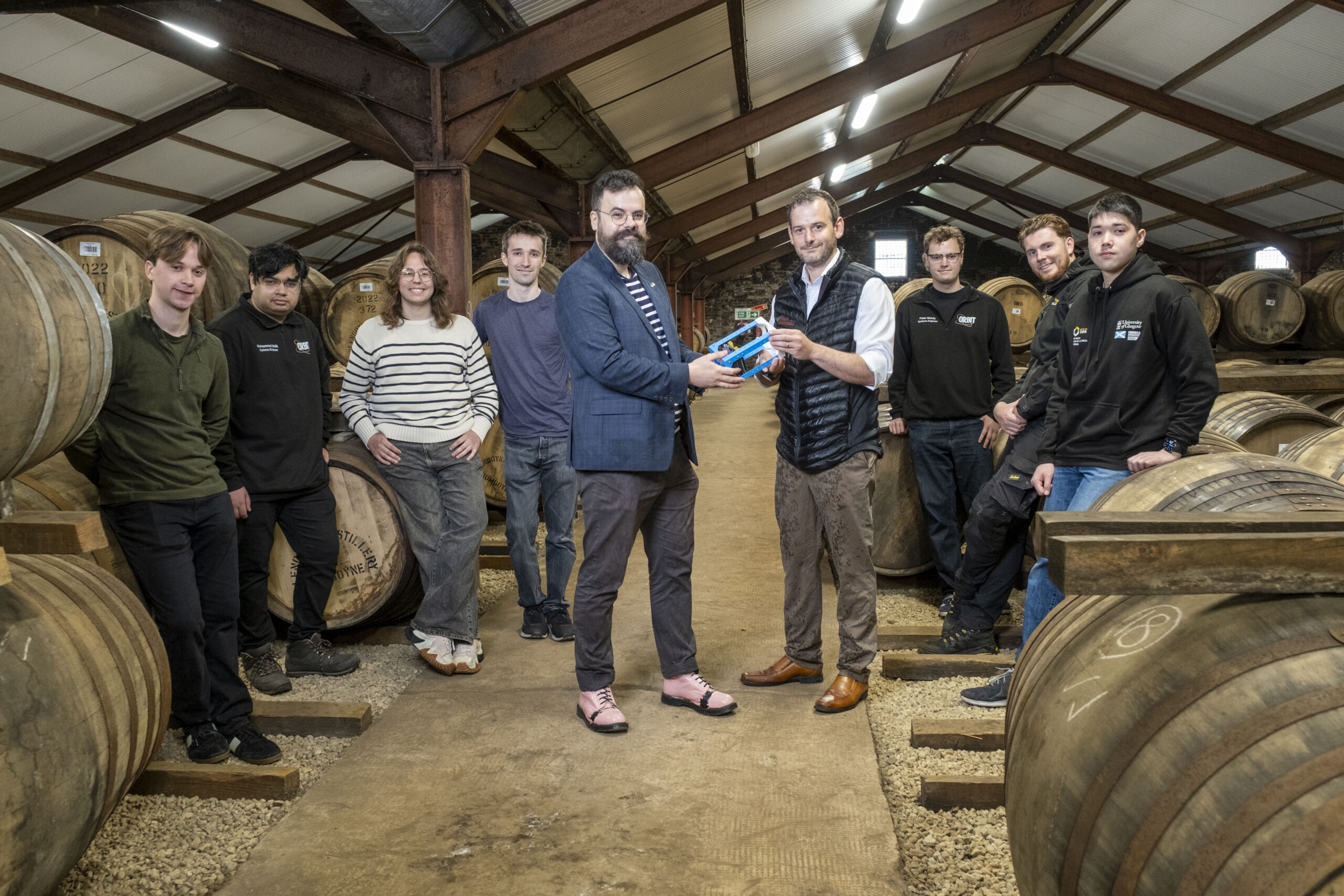
Seven final year mechanical engineering students from Glasgow have joined colleagues in Japan for three months to work on the design. Their contribution includes the battery, radio and onboard computer systems needed to operate the payload once the CubeSat reaches orbit.
Whisky provides a familiar process through which the researchers can examine how fermentation products and volatile compounds behave when gravity no longer drives fluid movement in the way expected inside terrestrial equipment.
Conventional whisky production begins by converting cereal starch into fermentable sugars before yeast produces ethanol and other compounds. Distillation then separates and concentrates volatile components as the fermented liquid is heated and vapour is condensed.
Gravity influences convection, liquid distribution and separation between vapour and liquid phases throughout that process. Reducing its effect changes the assumptions on which vessels, condensers and other process equipment are normally designed.
The CubeSat experiment will investigate how ethanol can be extracted under orbital conditions. It is a small research process rather than a complete distillery, with the objective of understanding chemical behaviour that could inform larger manufacturing systems later.
Dr Gilles Bailet of Glasgow’s James Watt School of Engineering is leading the project. His wider work examines manufacturing in microgravity, including methods for producing structures and materials where normal gravitational forces can interfere with formation.
Chemical monitoring inside the CubeSat will use a nanophotonic artificial tongue developed at Glasgow. The sensor distinguishes liquids through changes in their optical response, allowing chemical differences to be detected without carrying the analytical equipment normally available in a terrestrial laboratory.
Earlier work with the sensor showed that it could differentiate between whisky samples. The orbital version will monitor changes in the composition of the experimental liquid, including variations in compounds such as terpenes as the mission progresses.
Compact sensing is essential because a CubeSat imposes tight limits on mass, electrical power and physical volume. The experiment has to generate useful chemical data using equipment small enough to share the spacecraft with power, communications, control and thermal systems.
A second part of the mission will examine a fragment of whisky cask wood. The material will experience repeated heating and cooling as the spacecraft moves around Earth, exposing it to temperature cycles far faster than those encountered in a maturation warehouse.
The researchers expect that thermal cycling to drive more frequent expansion and contraction of the wood, allowing them to observe how the material and associated whisky compounds respond over time.
Orbital exposure will not reproduce conventional maturation. Whisky ageing on Earth takes place over years inside oak casks where extraction, oxidation, evaporation, temperature and humidity interact continuously across a much larger volume of liquid and wood.
The CubeSat instead isolates some of those physical effects under extreme conditions. Repeated thermal movement can be observed far more quickly, while the onboard sensor provides a way to track chemical change without returning every sample to Earth for analysis.
Ethanol also gives the project relevance beyond beverage production because it is widely used as a solvent and process material in chemical and pharmaceutical manufacturing. Understanding how it can be produced, separated and monitored in microgravity contributes to the engineering required for more complex orbital processing.
Microgravity is already being studied for processes in which gravity can interfere with material formation, including crystal growth and protein research. Any commercial orbital factory would still have to solve substantial problems around power, thermal control, fluid handling, automation and the absence of routine maintenance.
The whisky experiment brings several of those constraints into one compact system. Fluids have to be contained and moved predictably, sensing has to operate with limited power, and the equipment must function autonomously for long periods without the intervention available inside a normal processing plant.
Allen Associates, whose engineering work includes distillery design, is supporting the initial student programme in Japan. The collaboration combines practical process knowledge with spacecraft engineering and the University of Glasgow’s sensing research.
The mission remains in development ahead of its planned 2028 launch. Hardware still has to be designed, built, tested and integrated before any orbital processing data can be collected, leaving the whisky system as an engineering experiment rather than a demonstrated route to manufacturing spirits in space.
Its value lies in the process questions the researchers can test at small scale: how liquids separate without normal gravity, how chemical change can be tracked inside a compact autonomous system and how repeated orbital temperature cycles affect materials familiar from terrestrial whisky production.