IN Brief:
- Atria reported Q3 sales of €475.2 million, up 4.0%, while EBIT was €25.3 million.
- The €7 million Järna microwave meal line and €1 million Nurmo pancake packaging investment were announced in May.
- After the quarter, Atria decided to end Jyväskylä cattle slaughtering and centralise it at Kauhajoki, targeting €2 million annual savings.
Finnish food manufacturer Atria has confirmed progress on Nordic production investments and a decision to centralise cattle slaughtering at Kauhajoki, following third-quarter sales growth of 4.0% to €475.2 million. The restructuring decision, made after the reporting period, will end cattle slaughtering at Jyväskylä and is expected by the company to generate approximately €2 million in annual savings.
The interim report published on 22 October 2026 also confirms that existing investments in convenience food and meat processing are advancing as planned. Among them are a €7 million microwave meal line at Järna in Sweden and a €1 million pancake packaging solution at Nurmo in Finland. Both were announced in May, so the fresh October development is their reported progress rather than a new funding commitment.
Group EBIT for July to September was €25.3 million, virtually unchanged from €25.4 million a year earlier. The quarterly margin slipped to 5.3% from 5.6%, even though revenue increased. The improvement in Sweden’s results was offset by weaker profitability in Finland, where restrictions on pork exports added pressure to the business.
Atria Sweden recorded quarterly sales of €107.3 million, up 8.3% on the equivalent period in 2025. EBIT rose to €6.1 million from €3.6 million, supported by a more favourable sales mix and commercial performance. The company identified fresh convenience food under its Gooh brand and a chicken barbecue range among the activities contributing to demand.
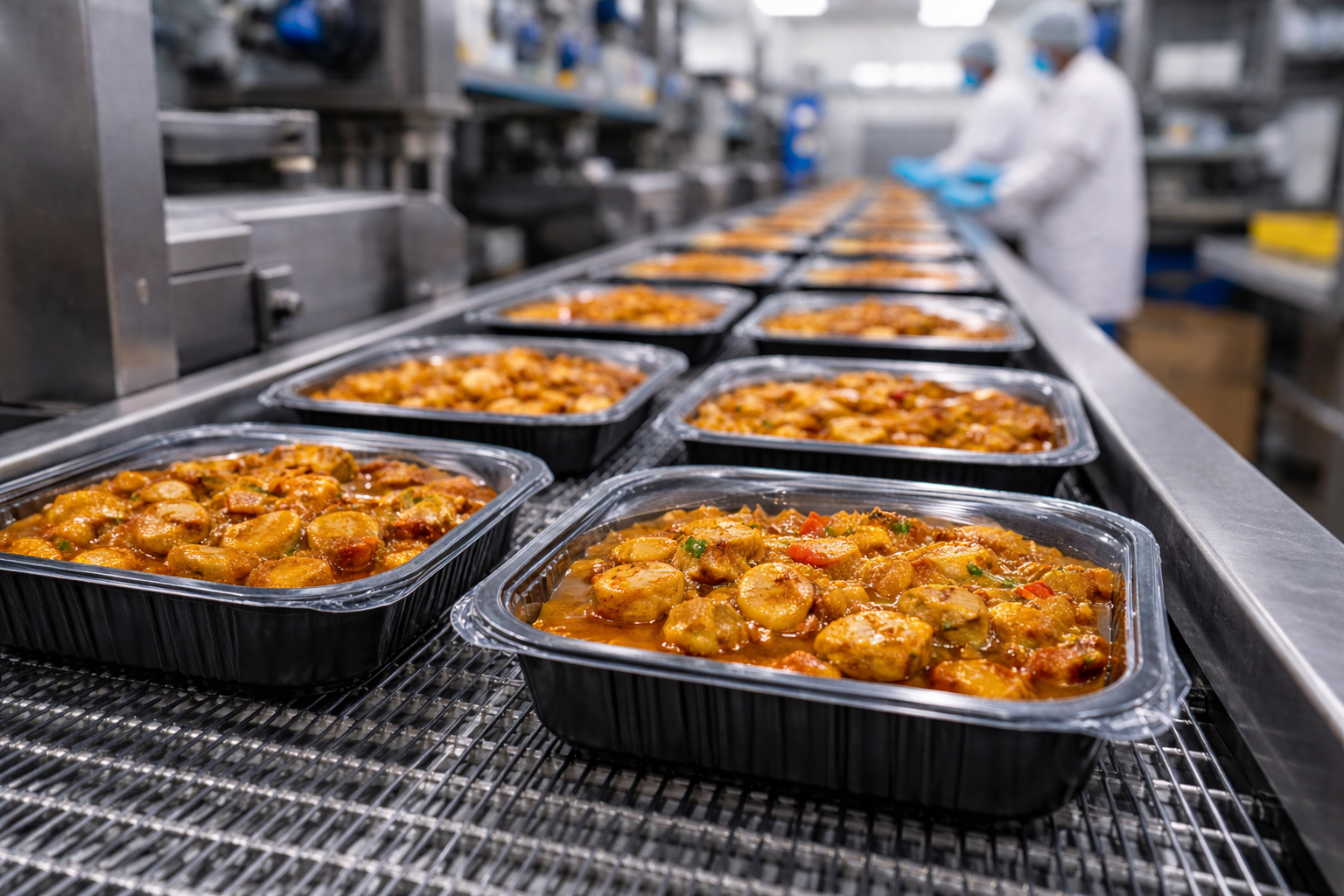
The Järna project is intended to provide additional capacity and greater manufacturing flexibility for Gooh microwave meals. Atria has not specified the new line’s hourly output, equipment supplier or commissioning date in the October report. The €7 million figure therefore establishes the scale of the earlier investment, not a verified throughput gain from a line already in full production.
Convenience meal operations combine preparation and portioning of ingredients with packaging and controls appropriate to the finished product. A plant introducing additional product varieties needs to coordinate recipe requirements, equipment settings, format changes and distribution arrangements. The exact manufacturing sequence at Järna has not been disclosed, so technical details of the new line should not be inferred from its intended microwave meal application alone.
In Finland, Atria’s wider Nurmo investment includes a convenience food factory project previously valued at about €110 million. The separate €1 million packaging development is designed to improve pancake packaging capacity and allow a broader range of pack sizes and products. The October report says strategic investments launched in 2025 continued according to schedule but does not give a revised line speed or measured efficiency gain.
The company also reported that the first Gooh quark pancake batches produced at Nurmo had been supplied to Swedish retailers. Finland began exporting poultry products to Sweden during the review period, illustrating how the group’s production arrangements support product distribution between national markets. Early sales performance does not establish the eventual volumes these activities will generate.
Energy and side-stream projects are progressing alongside food production investments at Nurmo. Atria said construction began on a 200 megawatt-hour high-temperature energy storage facility intended to support the new convenience food factory. Separately, Nurmon Bioenergia, in which Atria Finland has a minority interest, commissioned a plant to produce liquefied biogas and biofertilisers from agricultural and food industry material streams.
These projects concern different operating functions. Thermal energy storage is intended to provide an energy resource for manufacturing, whereas a biogas plant processes organic feedstock into fuel and fertiliser products. The announcement does not quantify either project’s contribution to the food factory’s energy demand, nor does it provide measured emissions savings from the new arrangements.
The fresh post-quarter decision concerns the processing footprint for cattle. Atria completed negotiations relating to its Jyväskylä slaughterhouse and decided to move cattle slaughtering activity to Kauhajoki. It cited a sharper decline in cattle procurement than previously expected and intensified competition in the beef market as reasons for consolidating operations.
Slaughter capacity must be aligned with the supply of animals and with downstream cutting, handling and distribution arrangements. When procurement falls, separate facilities may have more capacity than is needed to process available animals. Concentrating activity at one plant can change how equipment and supporting services are used, but the result also depends on transport, staffing and the receiving facility’s capabilities.
Atria estimates annual savings of about €2 million from the consolidation. That is a forward estimate, not an amount already realised in the third-quarter accounts. The October statement does not specify the final transfer date, additional implementation expenditure or employment consequences, and these details should not be assumed.
Atria Finland’s third-quarter sales were €341.8 million, up 3.4%, but EBIT declined to €19.4 million from €21.7 million. Exports to Asian markets were affected after African swine fever was detected in wild boar in south-eastern Finland on 30 July. The company’s report does not describe an outbreak at an Atria food processing plant.
Atria forecasts that export disruption will reduce its 2026 EBIT by approximately €4 million to €5 million, of which around €2 million had been reflected during the reporting period. Its separate estimate of roughly €7 million is the direct annual profit effect of lost and redirected export sales under stated assumptions, not a second confirmed expense in the quarter.
For the first nine months, group revenue was €1,406.6 million, up 5.2%, and EBIT reached €59.9 million against €55.9 million a year earlier. Free cash flow was negative €10.6 million, compared with positive €37.2 million, reflecting higher investment and working capital requirements. Atria retained guidance for 2026 adjusted EBIT above its 2025 figure of €69.9 million.
The immediate industrial programme now combines continued construction and commissioning work at previously announced projects with the implementation of the cattle slaughtering decision. Actual savings at Kauhajoki and production capacity from the Järna and Nurmo investments will require subsequent operating evidence. The October report establishes progress and a consolidation decision, rather than completed output improvements at all the sites involved.