IN Brief:
- A ten-year €41 million NIB loan will support Atria’s €82.4 million Nurmo convenience-food modernisation.
- Production processes, technical systems, heat supply, and energy efficiency are being overhauled across the factory.
- The renewed facility is due to enter operation in 2028 and will test systems intended for wider deployment across Atria.
Atria has secured a €41 million, ten-year loan from the Nordic Investment Bank to support the modernisation of its convenience-food factory at Nurmo in Finland, adding long-term financing to one of the company’s largest manufacturing investments.
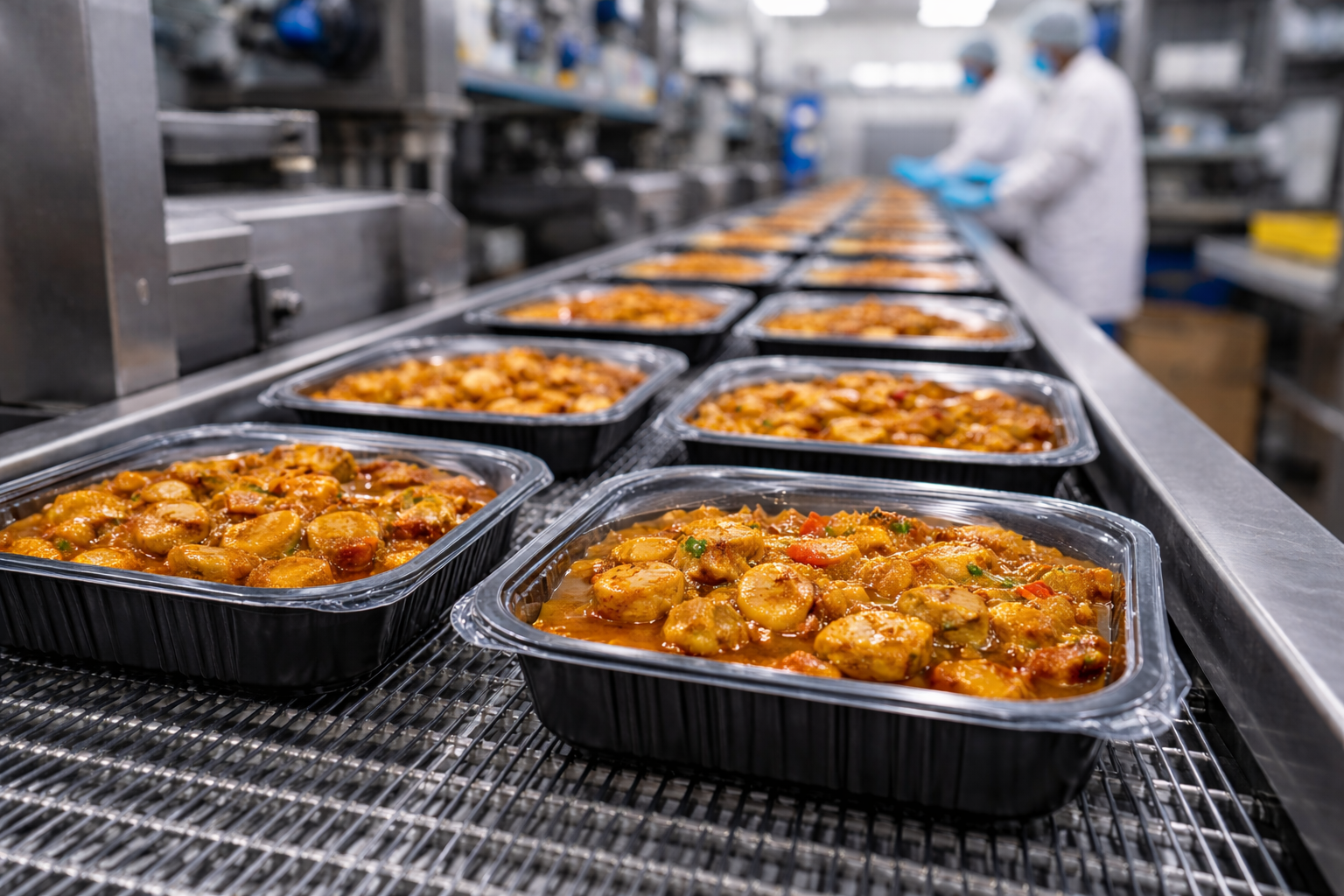
The loan will finance part of an €82.4 million programme covering a substantial refurbishment of the factory, replacement of production processes and technical systems, and energy-efficiency measures. Atria expects the modernised facility to be operational in 2028.
The distinction between the financing and the underlying project is material. NIB is providing €41 million towards the work, while Atria’s approved investment covers a much broader rebuild of convenience-food production and associated energy infrastructure at Nurmo.
The factory is being reworked from production processes through to building services and energy systems. Atria says the programme is intended to improve product quality, support new types of convenience food, cut energy demand, and reduce direct operational emissions.
Construction began in late 2025, and the project has since progressed through civil works and the installation programme required to renew a large operating food plant. Atria marked another construction milestone in August 2026 as the new factory reached its topping-out stage.
The scale of the work reflects the importance of convenience food within Atria’s current investment strategy. The company has also committed capital to a microwave-meal line at Järna in Sweden and a new packaging solution for pancake production at Nurmo, both aimed at increasing capacity and widening the range of product and pack formats the business can produce.
At Nurmo, however, the investment reaches much further than individual line capacity. Atria previously estimated that the energy measures connected with the €82.4 million programme could reduce annual energy consumption by around 50,000MWh, equivalent to roughly 21% of Atria Finland’s energy use, with annual energy savings exceeding €5 million.
Business Finland has granted €24.7 million of clean-transition investment support to the project. Alongside the NIB loan, that gives Atria a combination of public support and long-term financing for a programme intended to change both how food is processed and how energy is supplied to the operation.
Electrification is an important part of the design. NIB says key production processes are being electrified, while the upgraded site is expected to lower Atria’s Scope 1 and Scope 2 greenhouse-gas emissions and provide operating data for a carbon-neutral factory concept.
The useful test will come once the plant is running. Food factories rarely operate under fixed conditions: product mix changes, packaging formats evolve, hygiene cycles consume utilities, and line utilisation shifts with retailer and consumer demand. Energy-efficiency calculations made at the design stage ultimately have to survive those everyday production variables.
Nurmo is also becoming a wider test bed for changes in energy and material flows around food manufacturing. A separate industrial-scale biogas project in the area is converting manure and food-industry by-products into renewable gas and recycled nutrients, with Atria Finland holding a minority stake in the operating company.
The biogas development is not part of the convenience-food factory financing, but the two projects illustrate the scale of infrastructure change around the Nurmo production cluster. One addresses manufacturing processes, energy demand, and electrification inside the factory; the other creates a route for agricultural and food-production residues outside it.
Atria is Finland’s largest meat processor and operates across Finland, Sweden, Denmark, and Estonia, employing around 3,800 people. Its production network gives the Nurmo project a potential significance beyond a single plant if the technologies installed there prove suitable for wider replication.
That is explicitly part of the financing case. NIB describes the modernised factory as a pilot for a carbon-neutral production concept, with successful solutions intended to be introduced at other Atria sites later.
Replicability will depend on more than headline energy savings. Process electrification has to operate reliably at production scale, heat systems must match factory demand, and changes to utilities cannot compromise throughput, hygiene, food safety, or product quality. Those constraints are what separate a low-carbon factory concept from a conventional building-efficiency project.
By 2028, Atria expects Nurmo to be operating with substantially different production and energy infrastructure from the plant being replaced. The €41 million NIB facility gives that programme another defined source of capital, while the factory itself will provide the harder evidence — whether the redesigned processes can deliver the promised reductions while producing convenience food at commercial scale.