IN Brief:
- Bakers Basco recovered 1,326 baskets and 1,097 dollies in its latest Northern Ireland enforcement operation.
- More than 80 baskets found outside Belfast shops were linked to suspected unauthorised bakery supply into the region.
- The story is as much about pooled logistics control as theft, with shared bakery equipment under growing pressure across complex delivery networks.
Bakers Basco has doubled its tracking capability across Northern Ireland and the Republic of Ireland after a fresh enforcement operation recovered more than 2,400 pieces of bakery delivery equipment and identified Belfast as a growing hotspot for misuse.
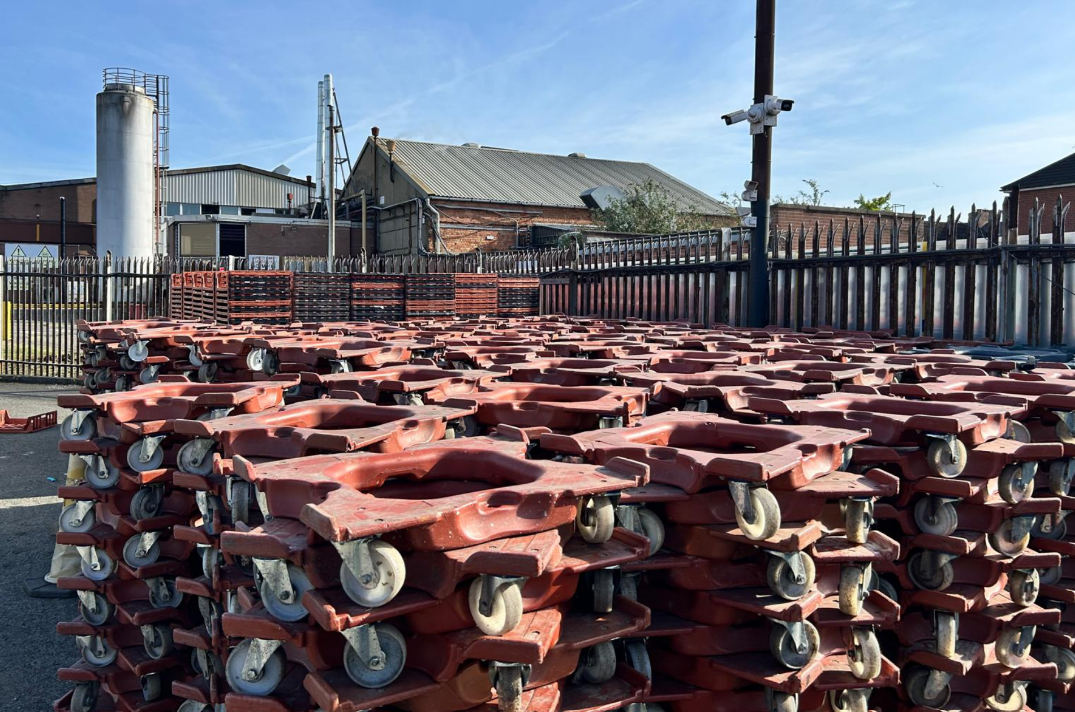
During the latest reporting period, the organisation recovered 1,326 baskets and 1,097 dollies from unsecured locations, investigated 51 separate leads, and issued £12,600 in charges to businesses found misusing equipment. A particularly notable finding was the recovery of more than 80 baskets from outside shops in central Belfast, with the equipment believed to be linked to an unauthorised bakery operation delivering into the region from England on a weekly basis. Bakers Basco has also confirmed that two legal cases have now been successfully settled in Northern Ireland.
On one level, the numbers underline a familiar issue in bakery distribution: baskets and dollies disappearing from the intended delivery loop and being diverted into other uses. On another, the Belfast case suggests something more structurally messy. Shared transit assets are not only being lost or borrowed. They are being drawn into parallel supply activity outside authorised systems, which creates a more persistent control problem for plant bakers trying to keep reusable equipment circulating where it belongs.
Bakers Basco was formed by leading UK plant bakers to manage and protect a shared pool of bakery logistics equipment that includes millions of baskets and hundreds of thousands of dollies. The model only works if assets move quickly and predictably between bakeries, depots, retailers, and recovery points. When equipment is withheld, repurposed, or drawn into unauthorised routes, the cost does not sit neatly with one operator. It spreads across the network through replacement needs, service disruption, slower deliveries, and avoidable waste. In that sense, the latest recovery figures are less about petty misuse than about friction inside a pooled logistics system that underpins daily bakery supply.
The decision to double tracker deployment across Northern Ireland and the Republic reflects that reality. Asset visibility is no longer a nice-to-have for pooled equipment schemes. It has become a basic control layer. In reusable transit packaging, the operational question is increasingly the same one heard elsewhere in food logistics: not just where the asset should be, but whether the network can prove where it actually is. Trackers, geofencing, body cams, and mobile case management may once have felt excessive for bread baskets. They do not look excessive once the losses begin to scale or concentrate geographically.
There is also a useful reminder here about the value of reusable equipment. Bakery baskets and dollies are easy to treat as low-tech background items, but that is precisely why their misuse can go under-analysed. They are part of the physical system that keeps high-frequency, short-shelf-life distribution working. If they are unavailable, damaged, or trapped outside the loop, the consequences show up downstream in handling inefficiency, extra procurement, and more single-use substitution. For a sector trying to reduce both cost and waste, that is not trivial.
The Belfast hotspot points to another pressure on bakery supply chains: boundary management in regional delivery networks. When product and assets cross into territories through routes or operators that sit outside recognised arrangements, enforcement becomes harder and losses can become embedded before anyone has a clear picture of what is happening. That is where intelligence gathering, driver briefings, and legal follow-through become part of mainstream operations rather than specialist side activity.
Bakers Basco says it carried out a driver briefing at Allied Bakeries in Belfast alongside the latest recovery work, reinforcing reporting practices across the logistics chain. That matters because pooled systems tend to perform best when recovery is not left solely to investigators. Drivers, depot teams, retailers, recyclers, and local operators all become part of the detection network.
The immediate issue is equipment misuse in Northern Ireland. The broader point is that reusable transit assets are now a visibility and compliance challenge as much as a physical one. Bakery logistics may look simple at street level, but the systems behind it are getting more data-driven, more controlled, and less willing to absorb silent losses as a cost of doing business.