IN Brief:
- Domino used interpack 2026 to focus on integration, automation, and 2D code deployment.
- Manufacturers are moving from awareness of 2D codes to implementation planning.
- Connected coding, vision systems, and enterprise integration are becoming central to traceability and line control.
Domino Printing Sciences has reported a shift in 2D code adoption discussions, with manufacturers moving from basic awareness towards practical implementation across production lines, enterprise systems, and connected workflows.
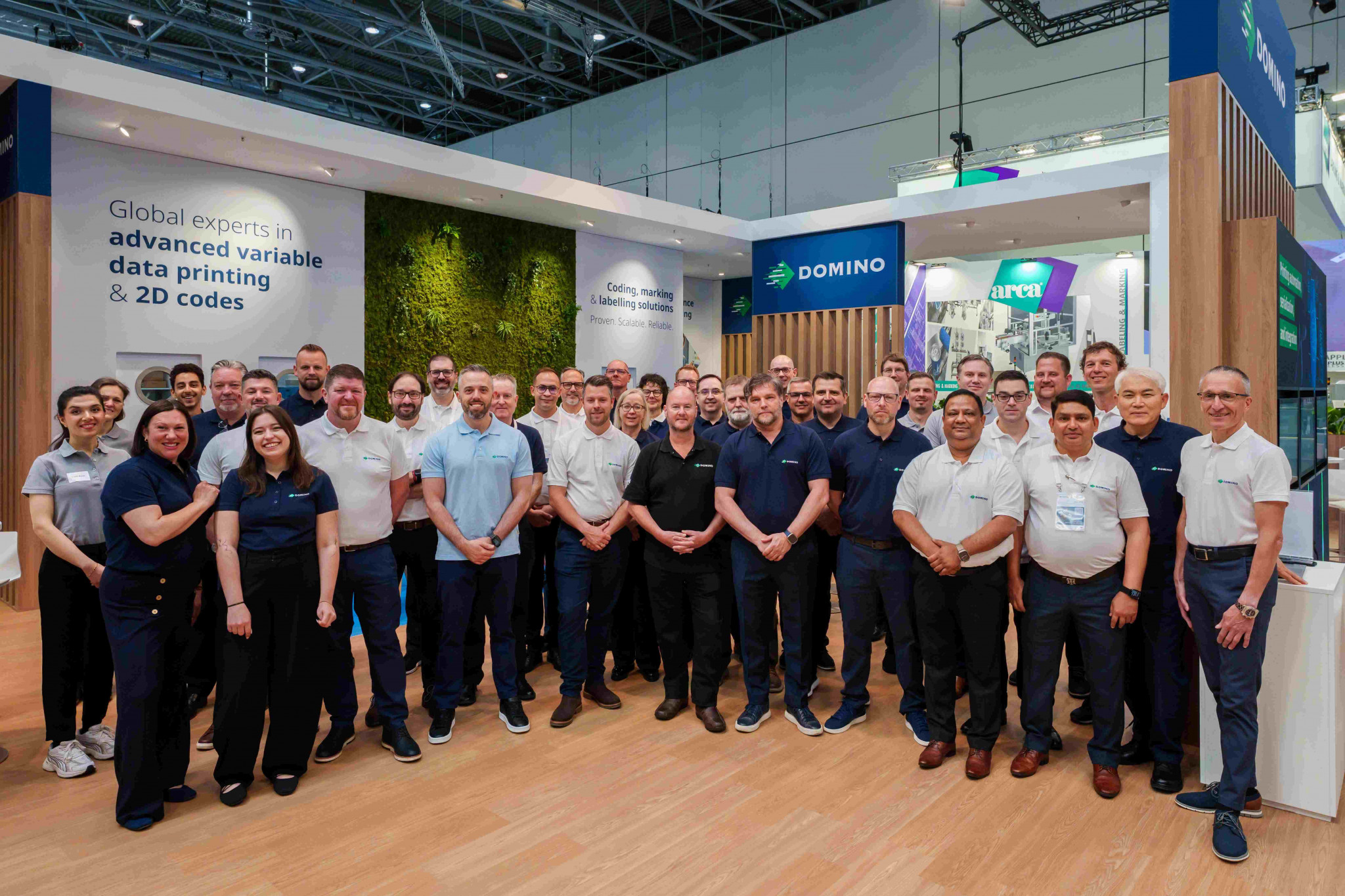
The company used interpack 2026 to demonstrate integrated coding and marking systems for advanced variable data printing, with a focus on automation, vision inspection, late-stage customisation, pallet labelling, and traceability. Visitors to Domino’s stand came from FMCG, pharmaceutical, and industrial sectors, with conversations increasingly focused on how to deploy 2D codes at scale without slowing production or adding avoidable waste.
“The conversation has shifted from ‘what are 2D codes?’ to ‘how do we make them work?’” said Craig Stobie, Global Sector Development Director at Domino. “Manufacturers want to know how they can get the benefits from implementing variable data 2D codes without compromising on speed, efficiency, or sustainability commitments, and they are seeking partners with real-world experience to support this journey.”
The interpack showcase included high-speed inkjet, laser, and pallet labelling systems capable of producing GS1-compliant 2D codes. Domino also presented integrated vision and automation systems designed to verify code accuracy, reduce waste, and support end-to-end traceability. The emphasis was on moving beyond standalone coders towards connected systems that can manage data, printing, inspection, and line response as one process.
“The shift to 2D codes touches everything from product coding and marking right through to enterprise systems, making connectivity and integration more critical than ever,” said Adem Kulauzovic, Director of Automation and Integration at Domino. “Manufacturers are increasingly recognising the value of connected solutions that reduce complexity, ensure consistency, and support advanced variable data printing at scale.”
For decades, coding was treated as a line-end necessity: date, batch, price, and basic traceability information applied reliably enough to satisfy customers and regulators. The move to 2D codes changes the role of the mark. A single code can carry richer data for product identification, traceability, stock rotation, recall handling, consumer information, and retail systems.
That shift makes poor print quality more consequential. A damaged date code may create a local quality problem. A failed 2D code can disrupt scanner performance, undermine traceability, block downstream automation, or break the link between physical product and digital information. The code must be generated from accurate data, applied at line speed, verified in real time, and connected to systems that can react when something goes wrong.
Domino’s earlier Gx-Series PRO Printhead launch positioned higher-volume 2D printing as a growing requirement for food manufacturers preparing for GS1 Digital Link. The interpack update extends that development from printhead capability into implementation. Hardware remains important, but adoption depends on the full coding architecture around it.
Food lines create particular pressure because products can be fast-moving, chilled, wet, irregularly shaped, and packed across multiple substrates. Meat, fish, poultry, dairy, bakery, ready meals, beverages, and direct-to-box applications all create different print and verification demands. Any move to richer variable data must work across those conditions without adding excessive changeover time or operator complexity.
The inclusion of Amazon and GS1 Germany in Domino’s on-stand discussion reflects the wider value-chain requirement. Retailers, standards bodies, manufacturers, and equipment suppliers need compatible data structures if 2D codes are to work reliably beyond individual factories. Standards and interoperability will decide whether richer product data becomes a practical operating tool or another layer of packaging complexity.
The implementation challenge now reaches artwork control, master data, line automation, verification, supplier requirements, retailer acceptance, and recall readiness. Coding can no longer sit at the edge of the packaging line as a minor utility. It is becoming part of the factory’s data infrastructure.