IN Brief:
- University of Arkansas-led research is evaluating electron-beam processing as a non-thermal safety intervention for ground chicken and turkey.
- Earlier work achieved a 99.99% reduction in Salmonella and Campylobacter using a 3kGy treatment on inoculated ground poultry.
- Current research shows packaging and product conditions affect whether pathogen reduction can be achieved without unacceptable quality changes.
Researchers from the University of Arkansas, the US Department of Agriculture, and Texas A&M University are examining whether high-energy electron beams can provide an additional food-safety intervention for poultry without introducing unacceptable changes to the finished meat.
The latest work focuses on ground chicken and turkey exposed to electron-beam treatment, a non-thermal process that uses ionising energy to damage microbial DNA and prevent microorganisms from reproducing. The technology is being assessed against pathogens including Salmonella and Campylobacter, both of which remain significant control targets in poultry processing.
Reducing bacteria is only one part of the problem. Poultry meat contains relatively high levels of unsaturated fats, making oxidation a particular concern when products are exposed to ionising treatment. Excessive oxidation can alter aroma and flavour even where the microbiological result is favourable.
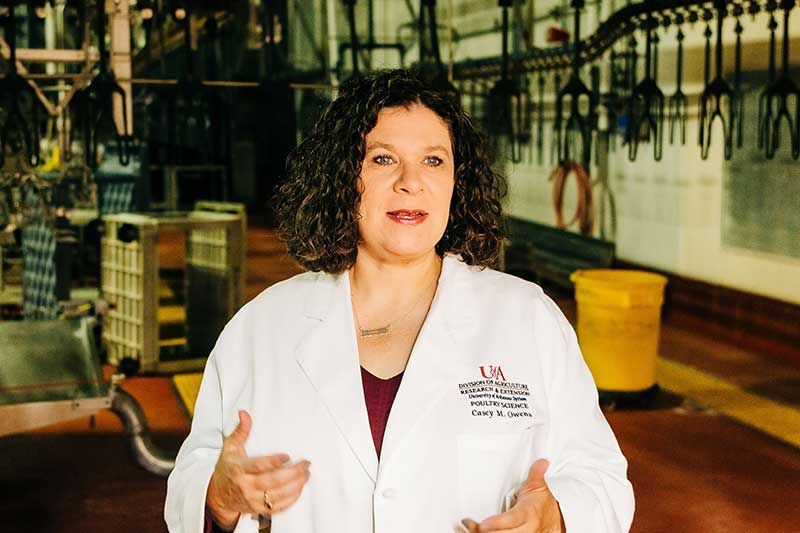
Casey Owens, professor of poultry processing and products at the University of Arkansas Division of Agriculture, said: “You’ve got to do the meat quality testing, because the oxidation is really the main thing that can start changing quality.”
The latest study found differences between chicken and turkey. Turkey treated while held in modified-atmosphere packaging retained more acceptable quality alongside pathogen control, while the chicken used in the work developed an off-note that requires further investigation.
That result underlines why food-safety interventions cannot be evaluated solely through bacterial counts. A treatment strong enough to achieve the desired microbial reduction must also preserve colour, flavour, odour, texture, and other characteristics sufficiently for the product to remain commercially viable.
The quality research follows earlier work by the same team in which a 3kGy electron-beam dose produced a 99.99% reduction in Salmonella and Campylobacter in one-pound packs of inoculated ground poultry. Demonstrating that level of reduction established the microbiological potential; the current work addresses whether the process can be tuned around the product rather than simply delivering the maximum possible treatment.
Ground poultry is a useful application because contamination can be distributed throughout the product during mincing. Surface-only interventions have obvious limitations where microorganisms are no longer confined to the outside of a whole cut, making a process capable of treating packaged ground meat technically attractive.
Electron-beam treatment does not depend on raising the entire product to a pasteurisation temperature and then removing that heat again. Energy is delivered rapidly, reducing the thermal changes associated with conventional cooking or heat treatment.
That does not make the technology mechanically simple. Industrial adoption would require electron accelerators, shielding, dose measurement, conveyor systems, safety controls, product-handling equipment, and validation procedures capable of demonstrating that every pack receives the required treatment.
Dose uniformity is particularly important. Differences in product thickness, density, composition, orientation, and pack weight can affect how energy is distributed, so a setting demonstrated under controlled trial conditions still has to perform consistently across normal factory variation.
Packaging has also emerged as part of the process rather than a separate downstream decision. The better quality result achieved with turkey in modified-atmosphere packaging suggests that the gas environment surrounding the meat can influence oxidation during treatment.
That creates a direct link between processing and packaging engineering. Poultry plants already use vacuum and modified-atmosphere systems to manage shelf life and product appearance, but an electron-beam application could require those packaging conditions to be optimised around the treatment dose as well.
A commercial line would consequently need to consider where irradiation sits relative to grinding, weighing, packing, sealing, chilling, and final inspection. Treating a sealed pack offers advantages for avoiding recontamination after the intervention, but it also means the packaging material itself must tolerate the process without losing sealing or barrier performance.
Throughput presents another constraint. Food plants cannot justify a strong microbiological result if the treatment system becomes a bottleneck against surrounding equipment. Accelerators, conveyors, and material-handling systems therefore have to deliver the required dose within a cycle time compatible with industrial production volumes.
Validation would extend beyond installation. Processors would need evidence that pathogen reduction remains repeatable across changing raw materials and operating conditions, while quality teams would have to monitor whether sensory changes remain within an acceptable range over shelf life.
The research involves the University of Arkansas departments of poultry science and food science, its Center for Food Safety, USDA Agricultural Research Service specialists, and the National Center for Electron Beam Research at Texas A&M University.
Electron-beam treatment is not being presented as a replacement for hygiene, chilling, process control, or cooking requirements elsewhere in the poultry chain. Its potential lies in adding another validated intervention where existing controls leave residual pathogen risk.
The research has already demonstrated substantial microbial reduction. The remaining engineering challenge is less dramatic but more important for adoption: establishing a dose, packaging system, and line configuration that kills enough microorganisms without leaving processors with meat that has technically passed a safety test but commercially failed the taste test.