IN Brief:
- FDF Scotland has launched its free HFSS Advice Tool through the Reformulation for Health Programme.
- The tool calculates Nutrient Profile Model scores, explains nutrient contributions, and identifies potential reformulation opportunities.
- Developed with the universities of Stirling and Glasgow, it also includes an interactive decision tree for retailers.
The Food and Drink Federation (FDF) Scotland has introduced a free online tool designed to help food and drink manufacturers assess product nutritional profiles and understand restrictions on promotions of food high in fat, sugar, or salt (HFSS).
Launched on 11 November 2026, the HFSS Advice Tool allows manufacturers to calculate a product's Nutrient Profile Model (NPM) score and examine how individual nutrients contribute to its overall classification.
Developed through FDF Scotland's Reformulation for Health Programme, the resource also identifies opportunities for improving nutrient scores through changes to product formulations.
The tool was developed with the University of Stirling and University of Glasgow, with funding provided by Scotland Food & Drink. It is available free to food and drink businesses, including smaller manufacturers seeking technical guidance on product development.
Its launch follows the introduction of Scotland's Food (Promotion and Placement) Regulations on 1 October 2026, bringing restrictions on certain HFSS products into force across qualifying retail businesses.
The Scottish regulations restrict specified forms of promotion and prominent placement involving prepacked foods and drinks that fall within the relevant product categories and meet the definition of less healthy.
These include certain confectionery products, biscuits, cakes, breakfast cereals, savoury snacks, yoghurts, pizzas, ready meals, and soft drinks.
Classification depends on the product category and its nutrient profile. A product's nutritional composition alone does not determine whether every restriction applies, because the legislation identifies particular categories and commercial activities.
The current framework uses the 2004–05 Nutrient Profiling Model, which is also used within comparable advertising and promotions rules elsewhere in Great Britain.
The model calculates a numerical score from nutritional information including energy, saturated fat, total sugars, sodium, fibre, protein, and specified fruit, vegetable, and nut content.
Different scoring thresholds apply to food and drink. The model also contains rules governing how favourable nutritional characteristics contribute to the final result.
FDF Scotland's new tool is intended to make these calculations more accessible while showing the contribution of individual nutrients to the result.
Manufacturers can enter product information and assess how changes to the composition could alter the score. The tool identifies where improvements may be possible and how close a formulation may be to achieving a different classification.
It also highlights front-of-pack labelling and nutrition claims that may be achievable under an existing or revised formulation, providing additional information for product development.
Joanne Burns, Reformulation for Health Manager at FDF Scotland, said: "The HFSS Advice Tool is more than a calculator, it’s a catalyst for healthier product innovation."
Burns explained that the tool is intended to give businesses a clearer understanding of nutritional scoring and the options available through recipe development.
"By helping food and drink businesses understand NPM scores, front-of-pack labelling and health claims, while showing how close products are to achieving healthier outcomes, the tool empowers manufacturers to make informed decisions, measure progress and unlock opportunities for healthier products."
Understanding the score is one part of a wider product development process. A change to the nutrient composition must still be compatible with the intended manufacturing method, product quality requirements, and commercial specifications.
Ingredients can perform several functions simultaneously. Sugar contributes sweetness, but can also influence texture, moisture behaviour, browning, and stability in products such as baked goods and confectionery.
Reducing sugar may therefore require adjustments elsewhere in a recipe to maintain the desired product characteristics. The appropriate solution depends on the ingredients, processing method, and quality requirements.
Salt can contribute to flavour and influence product functionality in some applications. Reformulating a savoury food may consequently involve more than replacing one ingredient with a lower-sodium alternative.
Manufacturers must also consider how changes affect shelf life, food safety, ingredient costs, and the performance of production equipment.
The HFSS Advice Tool does not replace factory trials, technical validation, or nutritional analysis where those activities are necessary. Its function is to support the calculation and interpretation of nutrient scores and help identify possible areas for reformulation.
Smaller businesses can use the calculations to examine ingredient changes before commissioning specialist advice, potentially reducing the cost of early product development decisions.
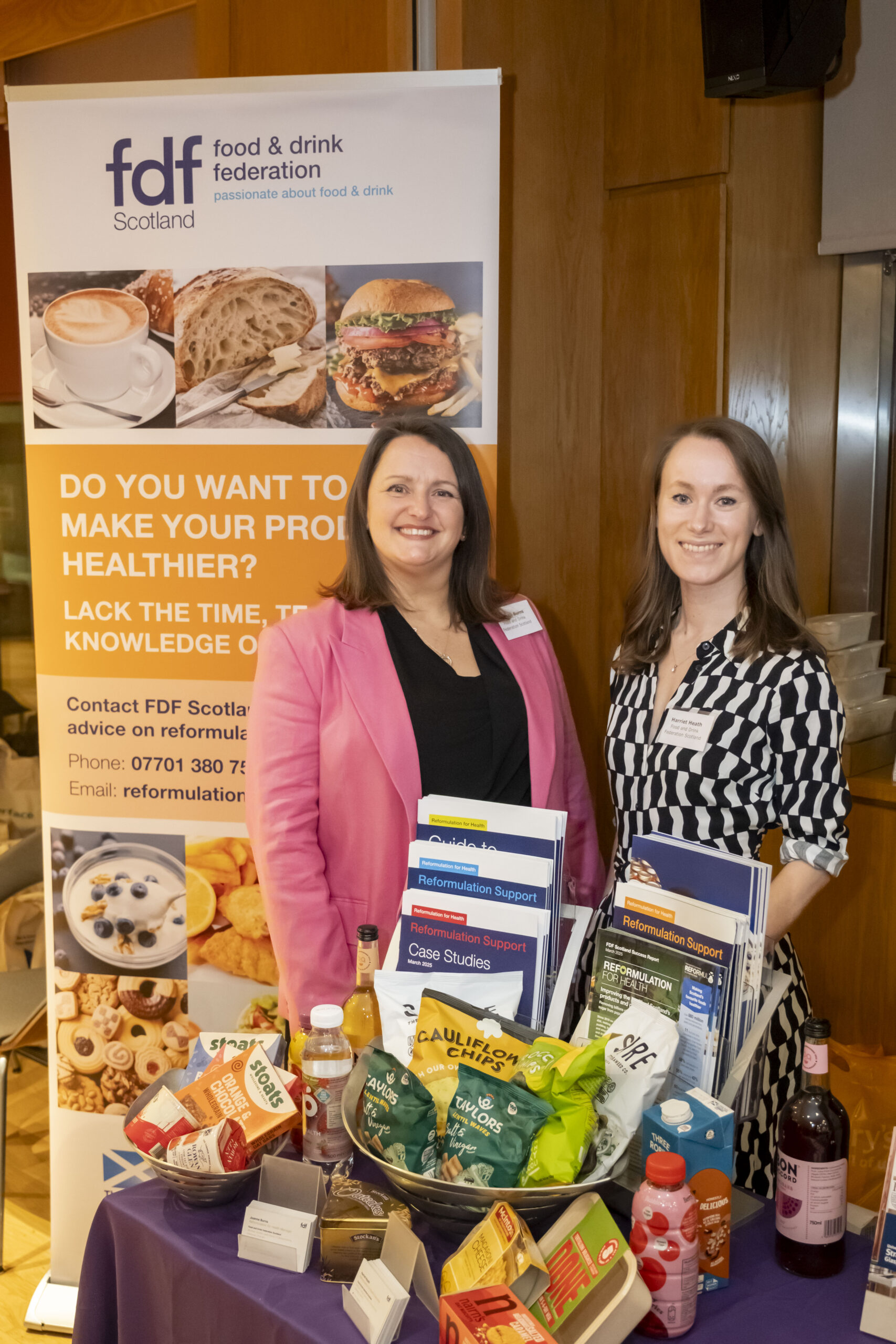
FDF Scotland's Reformulation for Health Programme provides support to small and medium-sized Scottish food and drink manufacturers seeking to improve the nutritional composition of their products.
The programme has previously supported reformulation work involving technical advice, ingredient development, nutritional analysis, and other activities associated with healthier product development.
The new resource extends that support through an online system that can be accessed without charge, including by businesses that are not already receiving assistance through the programme.
The tool also provides a separate function for retailers. An interactive decision tree helps businesses identify which promotion and placement restrictions apply to their retail environment.
Scottish regulations generally apply to qualifying businesses employing at least 50 people, subject to specified exemptions. The employee threshold relates to the business as defined in the legislation, rather than necessarily to the number of employees working in an individual Scottish store.
The rules include restrictions on certain volume-price promotions, such as qualifying multi-buy offers, and controls on placing affected products in prominent areas of retail premises.
Additional location restrictions generally apply to qualifying stores with a relevant floor area exceeding 185.8 square metres, equivalent to 2,000 square feet, subject to further exemptions.
The arrangements for online retailing also require consideration, including restrictions affecting specified promotional locations on websites and other digital sales environments.
Consequently, businesses with different store formats, employment structures, and product ranges may face different requirements. The decision tree is intended to help retailers establish the provisions relevant to their circumstances.
Manufacturers supplying affected retailers may experience commercial consequences even where responsibility for complying with a particular promotional restriction rests with the retailer.
A product's HFSS classification can influence the promotional options available to retail customers. Reformulation may therefore form part of a manufacturer's product development and account management decisions.
However, improving an NPM score does not automatically authorise a particular nutrition or health claim. Claims must satisfy their own applicable legal requirements, including the conditions associated with the claim being considered.
The Scottish regulations also do not prohibit the sale of products classified as HFSS. They restrict specified promotional activities and placements involving products within the scope of the legislation.
The UK government has separately consulted on the possible use of an updated 2018 Nutrient Profiling Model within future advertising and promotion rules. That revised model has not replaced the 2004–05 version underpinning the current Scottish restrictions.
FDF Scotland's latest resource therefore addresses the existing regulatory framework while offering manufacturers practical assistance with evaluating current formulations.
Burns said: "We want to make reformulation clearer, more achievable and more impactful for businesses across Scotland."
The HFSS Advice Tool is available at www.HFSSAdviceTool.org.uk. Manufacturers seeking further reformulation support can contact FDF Scotland at reformulation@fdfscotland.org.uk.