IN Brief:
- Geary's Bakeries has secured an eight-figure HSBC UK funding package following major expansion of its production estate.
- The Glenfield hub contains two sourdough lines and combines production, packing, and distribution.
- The wider expansion has more than doubled capacity and added hundreds of roles to the bakery operation.
Geary’s Bakeries has secured an eight-figure funding package from HSBC UK as the Leicestershire manufacturer continues to expand sourdough production across a larger manufacturing estate.
The family bakery has opened two additional production facilities following several years of rapid growth. Its expanded Glenfield operation includes two sourdough lines and acts as a central hub for production, packing, and distribution, with overall manufacturing capacity now more than double its previous level.
The new lines support products sold under the Jason’s Sourdough brand, including Ciabattin and Boule loaves, while Geary’s also maintains substantial own-label bakery activity. The company is forecasting turnover growth of more than 70% over the next two years as it seeks to use the additional production capability.
The HSBC UK package provides further financial capacity around a programme that has already changed the physical scale of the business. Geary’s has also transferred its wider banking relationship to HSBC UK and has indicated that further investment, including another site, remains under consideration.
Scaling sourdough production places different constraints on a bakery from simply increasing the rated speed of a conventional bread line. Extended fermentation remains part of the product process, so increased output requires sufficient space, temperature control, dough handling, proving, oven capacity, cooling, and packing to support more work in progress.
A longer process creates additional scheduling complexity because fermentation time cannot simply be compressed whenever demand rises. Mixers and forming equipment may be able to prepare dough more quickly, but the biological process continues on its own timetable and has to arrive at later production stages within the required condition.
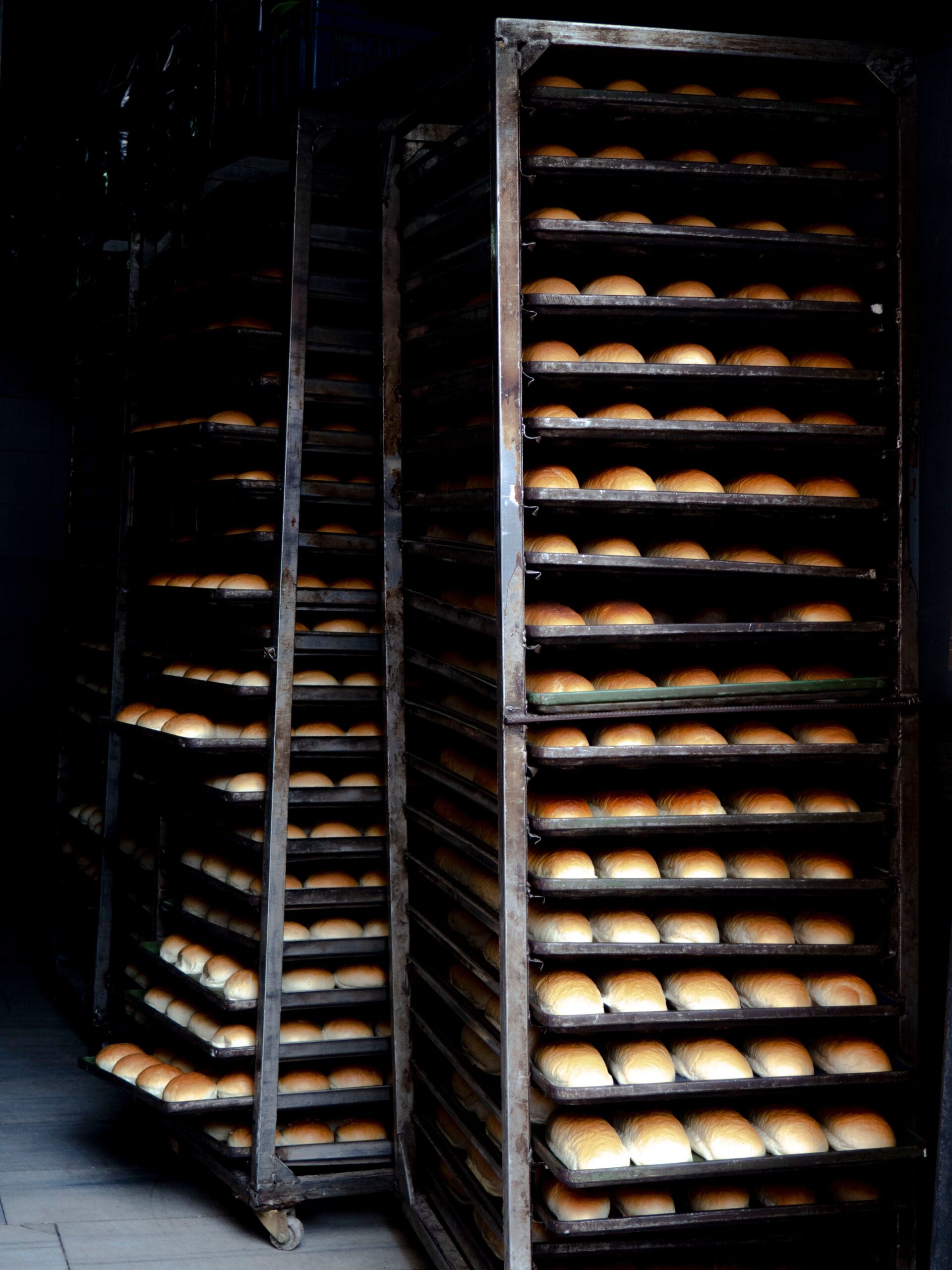
That makes buffer capacity central to factory design. Dough prepared in one part of the shift may not reach baking for several hours, so vessels, trays, racks, conveyors, and proving areas have to hold larger volumes without allowing batches to drift outside the defined process window.
Temperature becomes another control variable. Fermentation responds to dough temperature, yeast activity, ingredient condition, and ambient environment, and a larger plant has more opportunities for variation to appear between batches, shifts, and production areas.
Automation can improve repeatability around weighing, mixing, dividing, shaping, loading, baking, cooling, and packing, but it cannot remove biological variation entirely. A larger sourdough operation therefore needs tighter process control as well as more mechanical capacity.
The expansion at Glenfield combines production with packing and distribution, reducing some of the interfaces between separate sites. Higher bakery output places immediate pressure on cooling, bagging, labelling, case packing, storage, and dispatch, particularly for bread with relatively short commercial lead times.
Finished loaves cannot remain in storage indefinitely while downstream operations catch up. Oven capacity therefore has to be balanced with packing and logistics closely enough to prevent production gains being lost after baking.
The company has also expanded its workforce substantially as the new facilities have come on stream. Hundreds of additional roles have been created across the operation since 2024, with the larger estate requiring bakers alongside engineering, hygiene, technical, quality, packing, warehousing, and distribution staff.
Training formed part of the transition. Bakers joining the expanded operation were initially trained at existing Geary’s sites before moving into the new facilities, allowing established process knowledge to transfer alongside the equipment.
That is particularly relevant where product quality depends on process judgement as well as machinery. Dough consistency can change with flour, hydration, temperature, fermentation, and handling, and operators still need to recognise when the process is moving away from its expected condition.
Geary’s traces its history to 1906 and has invested heavily in capacity over the past decade. A previous £15 million bakery project established the Glenfield production base, followed by further expansion as Jason’s Sourdough moved into a much larger retail footprint.
The recent capacity programme has been considerably larger, with a custom-built bakery opening in 2025 as part of the wider manufacturing expansion. The latest funding package arrives after that physical investment rather than representing the first commitment to expand.
Customer growth remains necessary to absorb the new capacity. A line running below utilisation carries fixed labour, depreciation, maintenance, utilities, and building costs regardless of the number of loaves sold, so manufacturing expansion has to remain aligned with retail and own-label volumes.
Product consistency becomes equally important as more output moves across multiple lines. Retail customers expect loaf size, weight, bake, crumb, crust, packaging, shelf life, and delivery performance to remain stable regardless of which shift or production line handled the batch.
That turns scale into a control problem rather than a simple volume exercise. A bakery can install more mixers and ovens comparatively quickly; reproducing a long-fermentation product reliably at the higher rate is the more demanding task.
The HSBC package gives Geary’s additional room to manage that growth and consider further investment. The manufacturing measure will be whether the expanded estate can maintain the process characteristics that built the Jason’s range while using enough of its new capacity to justify the larger cost base.