IN Brief:
- Agristo is targeting 1.4 million tonnes of finished potato-product output annually by 2030.
- A fourth production line at Wielsbeke is scheduled to add capacity to the Belgian operation.
- New and expanded plants in France, India, and the US are moving production closer to crops and customers.
Agristo is targeting annual finished-product output of 1.4 million tonnes by 2030 as the Belgian potato processor expands production across Europe, India, and the United States.
The growth programme combines additional lines at established factories with new manufacturing sites in regions where Agristo wants to shorten the distance between potato production, processing, and end markets.
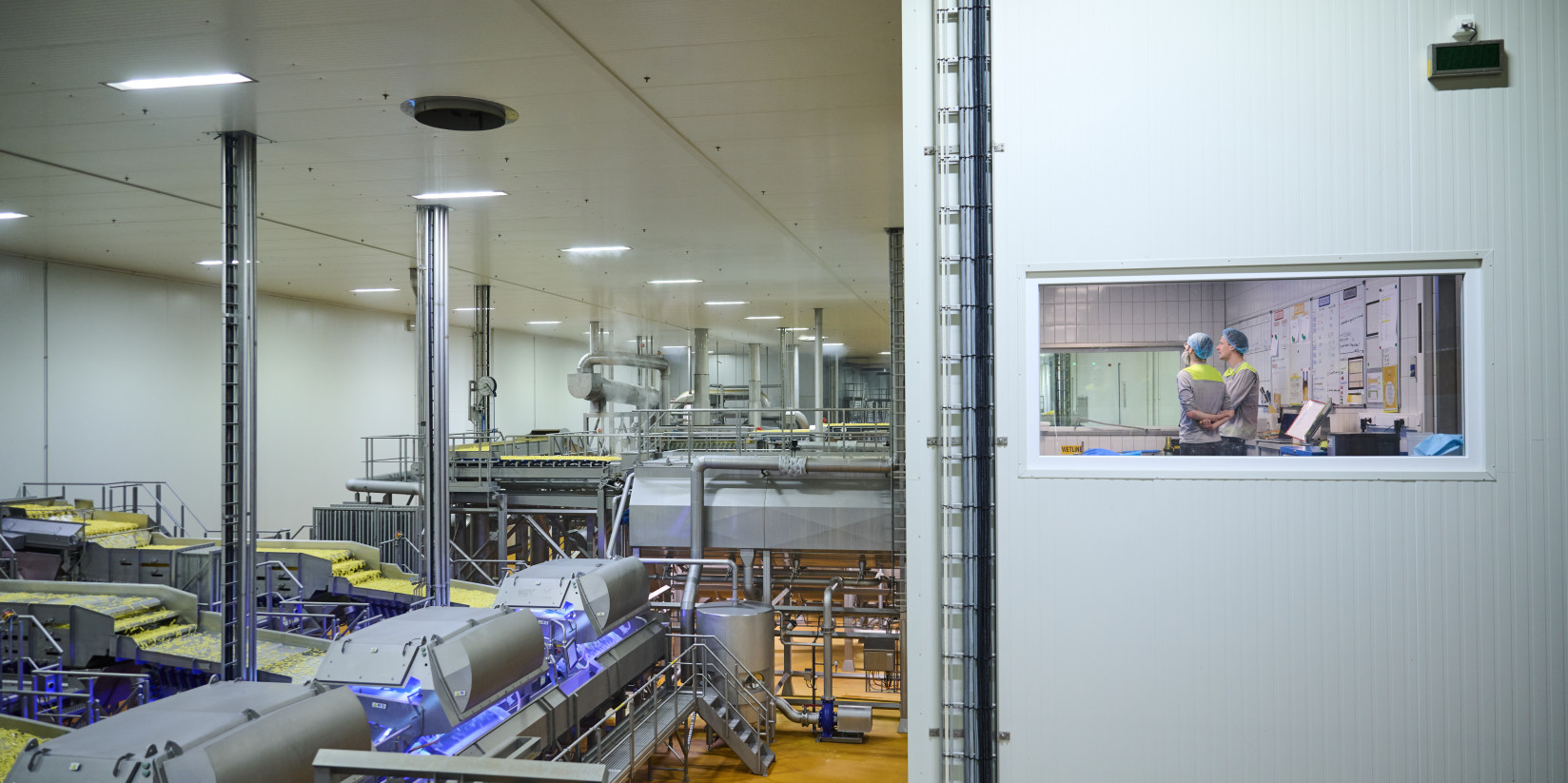
At Wielsbeke in Belgium, the company currently operates three processing lines within infrastructure designed to accommodate further expansion. A fourth line is due to add capacity, using an existing production base where utilities, technical teams, storage, and transport connections are already established.
France forms another part of the programme. Agristo is developing processing capacity at Escaudœuvres in northern France, with the site intended to handle a range of frozen potato products as operations are built out over several phases.
The company is also increasing its presence in India. Agristo established its Bijnor operation around potato flakes before committing further investment to French fry capacity, using the plant as a base for local sourcing, grower development, storage, and processing.
Its first US manufacturing site is being developed at Grand Forks, North Dakota. Agristo has previously placed the initial phase of investment at at least $450 million and has begun site preparation for a factory intended to produce French fries, hash browns, and other frozen potato products.
The geographic spread reflects the raw-material requirements of potato processing. A large frozen-product factory depends on a sufficiently concentrated crop base, suitable varieties, storage infrastructure, transport access, and long-term grower relationships before processing equipment can operate near its design capacity.
Potatoes also have to meet specifications that extend beyond simple tonnage. Size, dry matter, sugar content, defects, storage condition, and variety influence cutting, frying behaviour, colour, texture, yield, and the proportion of crop that can be converted into the required finished product.
Moving processing closer to growing regions reduces some transport exposure and gives the processor more direct access to local crop development. It can also shorten the distance travelled by finished products where the same region sits close to major customer markets.
The trade-off is a more complicated operating network. Agristo has to maintain product specifications, quality systems, engineering standards, production planning, and customer service across factories operating in different agricultural and labour markets.
Greenfield plants add another layer of risk because agricultural supply has to be developed alongside the factory. Growers need suitable seed, contracts, agronomic support, storage, and confidence that the processor will require predictable volumes over several seasons.
A factory can be mechanically complete while its supply base is still immature. Potato processors therefore work several years ahead when establishing new sourcing regions, particularly where the varieties required for frozen fries or specialist products are not already grown at sufficient commercial scale.
Existing factories offer a faster route to incremental tonnes. At Wielsbeke, additional processing equipment can draw on an established raw-material network and plant organisation, although the rest of the site still has to absorb higher flows of potatoes, oil, energy, refrigeration, packaging, finished goods, and by-products.
Agristo’s current press material describes annual finished-product capacity of around 900,000 tonnes. Reaching 1.4 million tonnes would therefore require a substantial increase across the network rather than a marginal improvement in utilisation.
The company is simultaneously adding capacity in several markets. Its Bijnor expansion includes an €80 million investment programme, while its US site represents a considerably larger greenfield commitment. Each project operates on a different development timetable, making commissioning sequence as important as the headline capacity target.
Frozen potato processing is also exposed to seasonal crop variation. Poor yields or unsuitable quality can restrict factory utilisation even when installed capacity is available, while unusually strong harvests require enough storage and processing headroom to avoid losing raw material.
A broader geographic footprint can spread part of that exposure by reducing dependence on one agricultural region. It does not eliminate crop risk, but production across Europe, India, and North America gives Agristo several separate sourcing systems from which to serve customers.
The expansion comes as regional potato-processing capacity is increasing in several parts of the world. Newer producers can compete more effectively when they are closer to raw material and customers, reducing the advantage once held by European plants supplying distant markets almost entirely through exports.
Agristo’s response is to build more of that proximity into its own network. The 1.4 million-tonne target is therefore tied to where output is produced as much as how much is produced.
Reaching the figure by 2030 will require new lines, factories, growers, storage, utilities, and logistics to become productive on schedule. The steel is only one part of the capacity calculation; the potatoes have to arrive in the right condition and at the right time.