IN Brief:
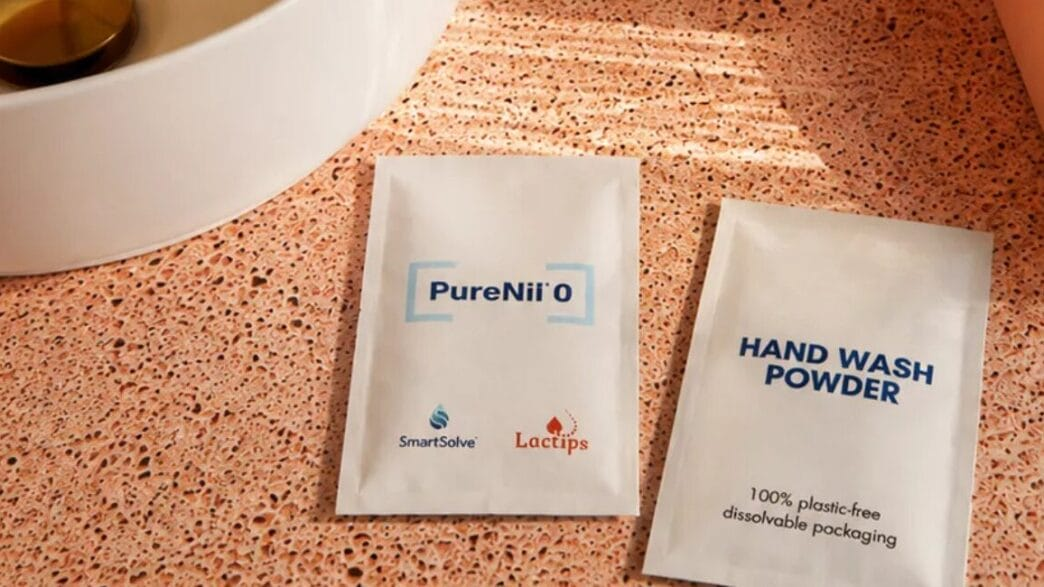
- Lactips and SmartSolve have presented water-soluble packaging based on PureNil 0 bio-based functional paper.
- The material disperses in water without leaving microplastic residues.
- Food use would depend on moisture control, direct-contact approval, machinery performance, and product compatibility.
Lactips and SmartSolve have developed water-soluble, microplastic-free packaging applications based on PureNil 0, a bio-based functional paper designed to disperse rapidly in water after use.
The companies presented the material for beauty, cosmetics, and personal care applications, but the underlying substrate has wider relevance for dry and unit-dose packaging. PureNil 0 is designed as a plastic-free flexible packaging material that dissolves in water without leaving microplastic residues, creating a potential alternative to conventional single-use packs in controlled-use formats.
Water-soluble packaging is most credible where the product can tolerate moisture-sensitive handling and where dissolution is part of the intended use or disposal route. Dry powders, tablets, concentrates, sachets, portioned ingredients, nutritional sticks, and some single-use food-adjacent applications may be better suited than high-moisture or long-shelf-life foods requiring robust barrier protection.
SmartSolve’s PureNil 0 platform is already positioned for printable, flexible packaging and direct food-contact capable applications in areas such as confectionery, snacks, and single-use food packaging. That creates a clearer food packaging route than the initial personal care presentation might suggest, although any commercial application would still need product-specific validation, food-contact documentation, and line trials.
The technical balance is difficult. A soluble pack must remain stable during converting, printing, filling, sealing, storage, transport, and handling, then disperse quickly and cleanly at the intended point. It must protect against humidity before use, resist blocking or deformation, seal reliably, and avoid introducing contamination or sensory issues. Moisture management becomes both the material’s weakness and its purpose.
The broader fibre and paper packaging transition has already moved into practical production questions through functional fibre packaging development and paper flowpack conversion. Lactips and SmartSolve take a different route. Rather than making paper behave more like conventional plastic film, the material is designed to disappear under defined conditions.
That approach has potential in formats where the pack is part of the dosing experience. A soluble sachet can reduce contact, support portion control, and remove an empty wrapper from the waste stream. In food and drink, possible areas include powdered beverage sticks, dry ingredient concentrates, flavouring systems, supplements, and other low-moisture products where secondary packaging can provide the main barrier.
Machinery performance remains a major test. Form-fill-seal lines are usually tuned to films with predictable tensile strength, friction, stiffness, seal response, and roll stability. A water-soluble paper-based substrate may require changes to web tension, humidity control, sealing conditions, storage, and inspection. Production teams would need to test not only whether the material can be sealed, but whether it can run consistently across full commercial campaigns.
Regulation and wastewater behaviour will also shape adoption. Microplastic-free dissolution is attractive, but dispersal in water still requires evidence around degradation, residues, additives, and environmental fate. Food-contact applications add another layer through migration testing, allergen considerations where relevant, and documentation for direct contact with specific product types.
The market is moving toward a more varied packaging toolkit rather than one universal replacement for plastic. Some applications will suit mono-material recyclable films, others paper-based packs, reusable containers, compostable formats, recycled-content plastics, or soluble materials. The strength of a material will depend on how closely its end-of-life route matches the product, production process, and local infrastructure.
Lactips and SmartSolve’s work adds another option to that toolkit. Its near-term food use may be selective, but the development shows how far packaging innovation is moving beyond conventional substitution. Dry, portioned, and controlled-use products could benefit if soluble materials can deliver the necessary stability before use and reliable dispersal after it.