IN Brief:
- The Hyperion 973IPS provides adjustable pulsed DC output from 6 to 35 kV, with a default setting of 30 kV and an operating distance of 450–1,500 mm.
- Full-length ionisation, rounded titanium emitter pins and revised mounting components support integration into packaging and converting machinery.
- Ion current monitoring, cleaning alarms and PLC-compatible outputs provide maintenance information, with Meech presenting the unit at PACK EXPO International.
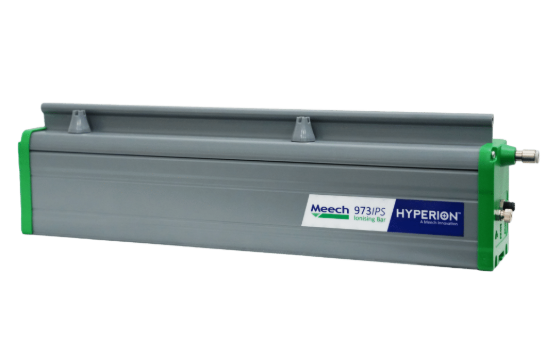
Meech has introduced the Hyperion 973IPS long-range ionising bar for packaging and converting machinery, increasing maximum adjustable output to 35 kV and introducing changes to emitter design, mounting and ionisation coverage. The equipment will be presented at PACK EXPO International in Chicago from 18 to 21 October 2026.
The UK manufacturer’s new unit succeeds the Hyperion 971IPS-30, which has a maximum output of 30 kV. Both are intended to neutralise unwanted electrostatic charge without making contact with moving material, but the 973IPS adds revised titanium emitters, full-length ionisation and a redesigned mounting arrangement. The equipment is CE and UL certified.
Electrical charge can build up as plastic film separates from a reel and passes across rollers, guides and other machine surfaces. The movement brings different materials into contact before separating them again, allowing charge to remain on the film, particularly where its surface has low electrical conductivity.
On packaging lines, the resulting attraction or repulsion can cause film to cling to machine components, make labels difficult to position and draw airborne particles towards the material. At high operating speeds, repeated disturbances can interfere with registration or transfer and result in additional inspection, adjustment or rejected packaging.
Powdered food products introduce a related problem when charged packaging film attracts loose particles towards a sealing area. Contamination between the sealing surfaces can prevent the intended bond from forming. Meech identifies this mechanism in its guidance for vertical form, fill and seal machinery, although that application guidance concerns other static control equipment rather than a documented installation of the new 973IPS.
The 973IPS uses pulsed direct current to generate positive and negative ions around its emitter pins. A charged surface attracts ions of the opposite polarity, reducing its electrostatic charge as it passes through the treatment area. Effective neutralisation depends on the incoming charge, material properties, distance from the bar and the time available for treatment.
Meech specifies an integrated power supply delivering up to ±35 kV, compared with the previous model’s ±30 kV maximum. The new bar’s default output is 30 kV, and the voltage can be adjusted from 6 to 35 kV through the company’s BarMaster Programmer or SmartControl Touch interface. The higher maximum is a product specification, not a measured improvement in charge decay on a particular machine.
The published working distance is 450–1,500 mm, with operation optimised at 1,000–1,500 mm when air assistance is used. Greater separation can help where guards, moving machinery or the route followed by a wide film web prevent close positioning of an ionising device. It also increases the importance of verifying performance under the installation’s actual airflow and material conditions.
Bars are available in physical lengths from 400 to 4,000 mm. Meech says ionisation now extends across the complete length, removing inactive portions that could otherwise limit the width treated by a selected unit. Full-length coverage describes the bar’s active arrangement; it does not establish uniform residual charge across every material width or operating speed.
The emitter pins have been redesigned with a rounded profile and are manufactured from corrosion-resistant titanium. Meech describes them as resistively coupled, replaceable and designed to reduce changes in ion balance during extended service. Their shape and material are intended to improve durability, but the company has not supplied comparative wear or service-life measurements for a named packaging installation.
Ion balance describes the relative positive and negative ion output. If that balance changes, the material can leave the treatment area with a different residual charge even when the bar continues operating. Accumulated deposits and deterioration around emitter pins can affect performance, making cleaning and monitoring relevant to consistent operation.
The new bar retains Meech’s ion current monitoring system, which tracks the ionising equipment’s condition and can issue a cleaning warning or fault indication. Local LEDs display operating, standby and maintenance states, while two PLC-compatible alarm outputs can transmit signals to external controls, lamps or audible warnings.
These alarms provide information about bar condition rather than a direct measurement of electrostatic charge remaining on the film. An operator may therefore still need to assess static levels on the moving material when commissioning a line, changing products or investigating defects that continue despite normal equipment status.
Output voltage, pulse frequency and ion balance can be adjusted using BarMaster or SmartControl Touch. The technical specification gives a default frequency of 1 Hz, adjustable up to 9.5 Hz, and a configurable positive ion balance. Selecting settings involves matching the treatment to the charge polarity, web movement and conditions around the bar, rather than assuming maximum voltage is suitable for every process.
The unit operates from a 24 V DC electrical input and uses a four-pin M8 connection. Its integrated high-voltage supply avoids the need to run a separate high-voltage cable along the machine, while the available outputs allow its status to be incorporated into wider maintenance or monitoring arrangements.
Mechanical revisions include a raised bar profile, a wider T-slot and redesigned sliding mounting components. The housing is specified as flame-retardant ABS, with external dimensions of 64 mm by 110 mm and an IP54 environmental protection rating. The stated operating temperature range is 0–55°C.
IP54 provides limited protection against dust ingress and splashing water; it is not a hygienic washdown rating. Placement near food processing machinery must therefore account for cleaning chemicals, water exposure, enclosure geometry and the need to avoid contamination traps. The unit’s CE and UL certifications should not be interpreted as approval for every hygiene regime or hazardous environment.
Applications involving combustible dust require a separate assessment of ignition risks and equipment suitability. An ionising bar intended to control charges on packaging films cannot be assumed appropriate for installation within a potentially explosive powder atmosphere merely because it is certified for its stated electrical application.
Static neutralisation also differs from removing physical contamination. Ionisation can reduce the attraction of particles to a charged surface, but material already attached to a web may require a cleaning operation. Meech will also demonstrate its CyClean-R non-contact web cleaning system at the exhibition, addressing a different part of packaging surface preparation.
The company’s exhibition line-up includes the 994 IML static pinner, which deliberately uses electrostatic attraction during in-mould labelling. These contrasting applications demonstrate why charge must sometimes be introduced rather than eliminated: the required electrical condition depends on whether the process is holding a label in place or preventing film and debris from sticking.
Meech identifies slitter rewinders, turret rewinders and transit bag machinery among the long-reach applications for the 973IPS. Its relevance to food packaging will depend on the particular web or label operation, the installation position and the measured treatment required. The company has not identified a named food manufacturer using the new model.
No quantified reduction in waste, rejected packs, downtime or residual static has been released for the 973IPS under food packaging conditions. Those results would require comparative testing at defined material speeds and operating distances, with measurements taken before and after treatment and assessed against the defects experienced on the line.
Meech will exhibit the system at stand N-4627 during PACK EXPO International. The new bar provides a higher adjustable voltage ceiling and revised hardware for long-range static control, while effective installation will depend on positioning, settings, cleaning and verification against the packaging process in which it operates.