IN Brief:
- Oakland International has commissioned its eighth pick-by-light system at Redditch.
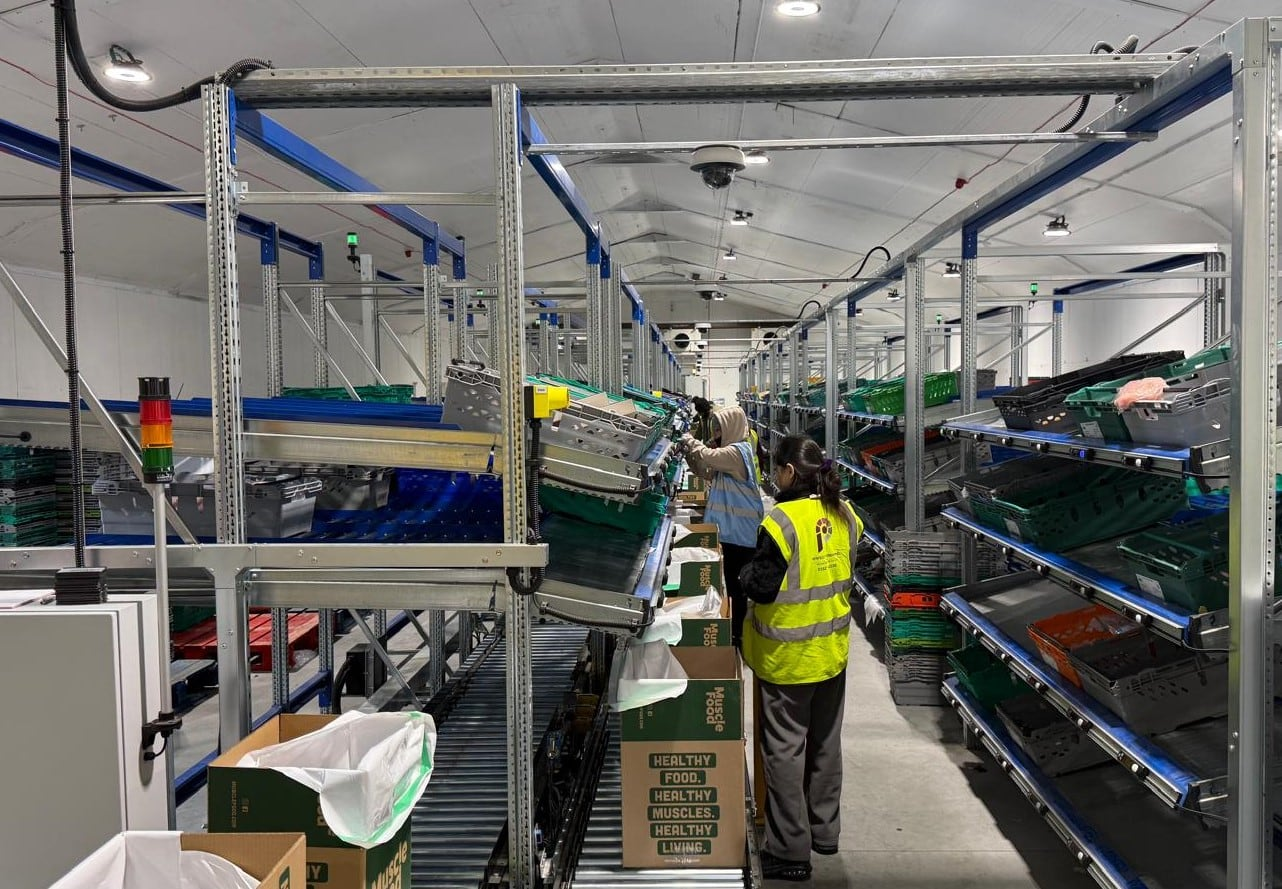
- Illuminated guidance directs operatives through chilled, frozen, and ambient direct-to-consumer and store orders.
- The system is intended to improve picking accuracy, throughput, traceability, and labour productivity without full warehouse automation.
Oakland International has commissioned its eighth pick-by-light system at its Redditch headquarters, extending semi-automated order fulfilment across chilled, frozen, and ambient food products.
The technology supports direct-to-consumer and direct-to-store operations in which employees assemble orders containing multiple stock keeping units, temperature regimes, pack formats, and customer instructions. Illuminated, colour-coded indicators direct each operative to the correct location and required quantity.
Element Logic supplied the latest installation, which joins seven existing systems at the Worcestershire site. Repeating the technology across several operating areas allows Oakland to standardise software, guidance methods, training, and performance measurement while adapting individual layouts to their product mix.
Pick-by-light occupies the middle ground between conventional manual picking and fully automated storage or retrieval. Employees continue to move through the facility and handle products, while the digital system controls sequence, location, and confirmation.
The arrangement retains human flexibility across irregular cases, short-life goods, promotions, changing stock, and mixed orders. At the same time, illuminated instructions reduce reliance on paper lists, handheld-screen navigation, or an operative’s memory of a large and frequently changing product range.
Oakland provides multi-temperature supply chain services across the UK and Ireland. The fulfilment operation handles orders that may require separate picking zones and temperature controls before chilled, frozen, and ambient items are brought together for dispatch.
As food brands expand online and direct-store channels, distribution centres are being asked to process smaller and more varied orders alongside conventional cases and pallets. The growing number of order profiles increases travel, checking, consolidation, and packaging requirements inside the same facility.
Semi-automation suits variable food inventories
Full warehouse automation performs most efficiently where unit dimensions, volumes, and demand patterns are predictable. Food logistics often combines seasonal ranges, promotional peaks, short shelf lives, irregular cases, and rapid changes in product velocity, making a highly fixed system harder to justify.
Guided manual picking allows the layout and workforce to respond more readily when products change. New stock can be assigned to locations within the control system, while operators require less time to learn the complete physical arrangement of the warehouse.
Accuracy carries a direct operational cost. An incorrect item can lead to customer complaints, returns, replacement transport, stock adjustments, repacking, or disposal, while errors involving allergens, dietary requirements, or use-by dates can create a more serious quality issue.
The system still depends on accurate replenishment and master data. A light directing an employee to the wrong location will accelerate an underlying stock or system error rather than prevent it, making barcode control, location discipline, and inventory accuracy essential.
Confirmed picks and timings also create an operational dataset. Managers can identify congested zones, repeated errors, slow-moving lines, lengthy walking routes, and products frequently ordered together, then use that information to change slotting and replenishment practice.
Labour availability remains a major consideration across temperature-controlled logistics. Cold and frozen environments can be difficult to staff, while seasonal peaks require new employees to reach productive output quickly. Guided picking can shorten training without removing the need for product, hygiene, and safety instruction.
Ergonomic design will influence whether performance gains are sustained. Poorly positioned lights, heavy cases, difficult reaches, narrow aisles, and congestion can limit the benefit of accurate digital instructions, particularly during high-volume periods.
Replenishment must also keep pace with faster picking. If stock is not transferred into the correct forward location at the required rate, improved guidance simply brings employees to empty shelves more quickly. Picking and replenishment data need to operate as parts of the same workflow.
Temperature adds another constraint because products cannot remain outside controlled zones indefinitely while a mixed order is assembled. Routing and consolidation rules must reduce exposure while maintaining the sequence required for efficient packing and vehicle loading.
The eighth installation indicates that Oakland has moved beyond a limited trial and adopted the system as a repeatable operating method. Performance can now be compared across zones and customer programmes, providing a stronger basis for further investment.
Order accuracy, throughput, training time, labour use, and handling cost will determine the return. By combining digital guidance with manual adaptability, the system addresses the variable product and order patterns that continue to make fully automated food fulfilment difficult.