IN Brief:
- Oji is showing Kinocloth fresh-food containers at Material Week Tokyo for applications including produce and seafood.
- Functional powders can be incorporated within the air-laid pulp structure to alter odour or moisture management.
- The current examples remain material demonstrations rather than an announced large-scale commercial food packaging deployment.
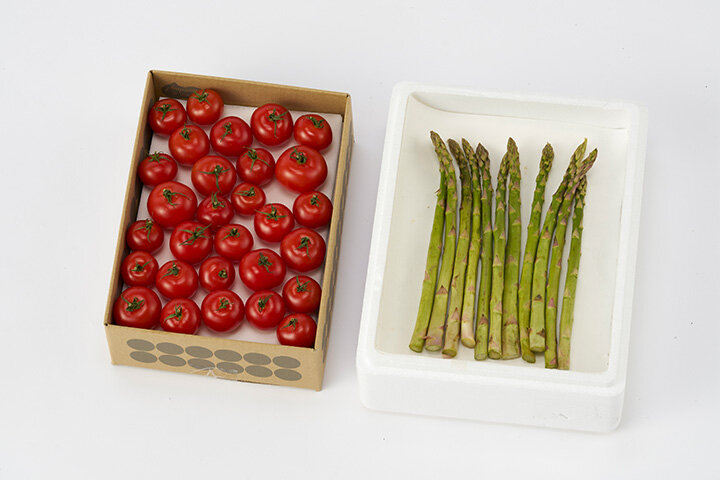
Oji Holdings is demonstrating pulp-based Kinocloth containers for fresh food at Highly-Functional Material Week in Tokyo, using an air-laid fibre structure that can incorporate functional powders within the sheet rather than relying entirely on separate inserts or conventional coated paperboard. Examples shown at the event include packaging for strawberries and seafood, with activated carbon, scallop shell powder, and silica gel used to alter odour or moisture performance.
Air-laid production distributes fibres through air instead of the water-based forming process associated with conventional papermaking, producing a porous nonwoven structure with internal spaces capable of carrying additional materials. Oji Paper manager Vipavan Sae Gang told Packaging Insights that those spaces allow different functional powders to be incorporated into the sheet, giving Kinocloth variants different performance characteristics without changing the basic fibre platform.
Activated carbon and scallop shell powder are being demonstrated for odour control around products including broccoli, seafood, and tomatoes, while silica gel can be incorporated where moisture adsorption and humidity management are required. Fresh food packaging already uses pads, absorbent structures, atmosphere control, coatings, and other components to manage similar conditions, so embedding some of that function within the formed fibre material changes the architecture of the pack rather than creating an entirely new preservation requirement.
Moisture remains one of the harder conditions for fibre packaging because condensation, product purge, or high relative humidity can reduce stiffness and undermine handling performance long before a dry laboratory sample shows any weakness. Incorporating an adsorbent into the material could help manage part of that exposure, although its value will depend on adsorption capacity, distribution through the sheet, contact conditions, pack geometry, and the amount of moisture released by the particular food.
Odour control raises a similar set of questions because adsorption needs to remain effective over the required shelf life without interfering with the product or creating food contact concerns. Activated carbon is already used widely for adsorption, while scallop shell powder gives Oji a route to incorporate a secondary material from seafood processing, but both still have to function predictably once contained within a high-volume packaging structure rather than a controlled exhibition sample.
The current presentation remains a materials demonstration rather than evidence of commercial-scale conversion across food factories, and no large customer deployment or validated shelf-life study has been announced alongside the Tokyo examples. Industrial adoption would require food contact assessment, migration work where applicable, mechanical testing, refrigerated and humid storage trials, packing-line evaluation, transport testing, and a defined end-of-life route for each specific construction.
Fresh produce and seafood create demanding qualification conditions because the packaging may encounter refrigeration, free water, fragile contents, variable respiration, and relatively short but sensitive supply chains. A material that performs well around one product cannot automatically be transferred to another, leaving pack design and validation closely tied to the moisture load, temperature, handling, and shelf-life requirement of the individual application.
Oji is presenting Kinocloth alongside other air-laid materials that show how the same manufacturing platform can be adapted for different packaging functions, including mouldable Kinarito structures for premium packs and biodegradable HyBioth cushioning. The food applications are more directly exposed to process and regulatory constraints because the material sits close to perishable products, so any functional additive has to be assessed alongside hygiene, traceability, line performance, and food contact requirements.
Replacing plastic with fibre also requires a wider material calculation than the visible pack alone, since a heavier or more complex fibre structure can consume additional material while a loss of barrier or product protection can increase food waste. Any environmental advantage therefore depends on the complete system maintaining sufficient product protection while offering a credible recycling or recovery route after use.
Scallop shell powder gives the concept an additional circular-material element, although the secondary raw material itself has to be cleaned, prepared, characterised, and supplied consistently before a converter can rely on it. Variation in particle size or composition that is manageable in a demonstration can become troublesome once sheet production is running continuously, particularly where the additive influences forming behaviour or the mechanical properties of the finished material.
Kinocloth consequently sits at an earlier stage than a commercial pack already running at food-factory volumes, but the Tokyo examples show how fibre packaging developers are extending their attention beyond stiffness and graphics towards active control of the conditions surrounding fresh products. Commercial progress will depend on whether those functions remain repeatable through food contact testing, industrial forming, packing-line trials, distribution, and recycling — the less glamorous sequence that determines whether an exhibition material becomes a routine packaging specification.