IN Brief:
- More than 300 Tunnock’s workers at Uddingston have accepted an improved 21-month pay settlement.
- Basic hourly pay rises from £13 to £13.61 from July 2026, then to £14.25 from April 2027.
- Acceptance of the offer removes the immediate threat of strike action at the company’s Uddingston factory.
More than 300 workers at Tunnock’s Uddingston factory have accepted an improved pay agreement worth 9.6% over 21 months, removing the immediate threat of strike action at the Scottish confectionery manufacturer.
The settlement raises basic hourly pay from £13 to £13.61 with effect from 1 July 2026. A second increase will take the rate to £14.25 from 1 April 2027.
Unite, which represents the workers involved, said members had overwhelmingly backed industrial action before the company returned with an enhanced offer. A majority subsequently accepted the revised terms.
The agreement matters beyond the employment dispute because Uddingston is the manufacturing centre behind products including Caramel Wafers and Teacakes. A prolonged stoppage would have interrupted production at a business whose output is closely associated with one established Scottish factory.
Unite general secretary Sharon Graham described the agreement as a “significant victory for Tunnock’s workers” after employees demonstrated that they were prepared to take strike action.
The settlement does not represent a production expansion, restructuring programme, or change in manufacturing strategy, and there is little value in pretending otherwise. Its industrial consequence is continuity: workers remain on site under an agreed pay structure and the immediate risk of strike-related disruption has been removed.
That matters particularly in food factories where a large proportion of production is concentrated at one location. A multi-site manufacturer can sometimes move selected volumes elsewhere during a local stoppage, although recipes, packaging specifications, equipment, and customer approvals can limit that flexibility. A company centred on one principal production operation has fewer options.
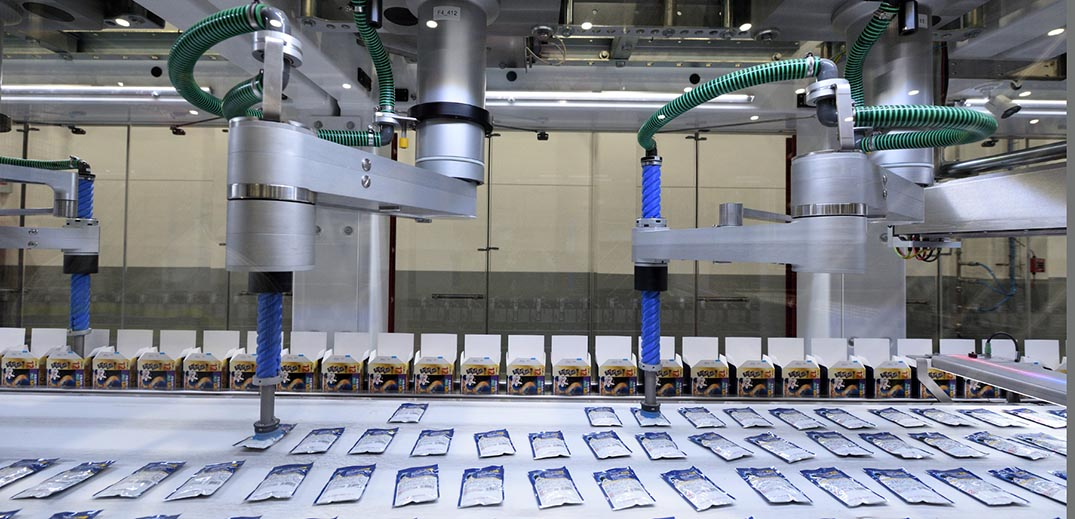
Automation does not remove that exposure. Confectionery factories can contain high-speed forming, enrobing, cooling, wrapping, case-packing, and materials-handling equipment, but those lines still require operators, maintenance teams, quality staff, warehouse employees, cleaners, and engineering support.
A machine capable of running hundreds of packs a minute contributes little if there are not enough trained people to feed it, change formats, clear faults, carry out sanitation, complete quality checks, or move finished product into dispatch.
That is why labour availability remains an operational measure even in highly automated food production. As repetitive handling is reduced, the remaining jobs often become more dependent on product knowledge, process understanding, fault finding, and safe intervention around machinery.
Experienced operators also accumulate knowledge that is difficult to capture fully in a work instruction. They recognise how products behave during temperature changes, how packaging materials respond at speed, when a line is beginning to drift, and which minor intervention can prevent a short stoppage becoming a prolonged one.
The 21-month pay structure gives employees and the company greater visibility than a short annual settlement. The first step adds 61p an hour to the basic rate, followed by another 64p from April 2027.
For Tunnock’s, those increases become part of the manufacturing cost base during a period when confectionery businesses are already managing pressure from ingredients, packaging, energy, and transport. Cocoa markets in particular have created substantial cost volatility for chocolate-coated products, although the current pay agreement is separate from those commodity movements.
Labour costs cannot be considered only as an expense to be reduced. Recruitment, turnover, overtime, absence, training, and industrial disruption also carry costs, and an apparently cheaper labour settlement can become expensive if it leaves a factory unable to staff production reliably.
That calculation becomes more acute where the workforce has already demonstrated willingness to strike. Unite said the enhanced proposal followed members rejecting earlier terms and backing industrial action, meaning the risk of disruption was no longer theoretical when negotiations resumed.
The new agreement removes that immediate uncertainty. Production planners can schedule labour without allowing for announced strike dates, while customers and suppliers avoid the knock-on effects that can arise when factory output is interrupted.
Food manufacturing stoppages can create effects on both sides of a plant. Incoming ingredients and packaging may already be booked for delivery, while finished-goods inventory can run down quickly if customers continue ordering during a prolonged production interruption.
Restarting is not always instantaneous either. Food lines may require cleaning, heating, cooling, product preparation, quality checks, and staged start-up before full output is restored, making a one-day stoppage operationally more complicated than simply losing one day of nominal capacity.
That is why the avoidance of industrial action has a measurable production value even where the dispute itself does not involve machinery or investment. Stability allows factories to use the equipment and capacity they already own rather than spending management time working around an avoidable interruption.
The settlement also arrives against a wider backdrop of labour disputes within UK food manufacturing, where pay, shift arrangements, and the cost of living continue to influence negotiations. Food businesses may be investing heavily in automation, but labour remains sufficiently important that unresolved pay disputes can still stop highly mechanised plants.
Tunnock’s now has agreed basic rates through the spring of 2027 and no immediate strike threat arising from this dispute. That does not resolve every cost pressure facing confectionery manufacturing, but it removes one that could have halted production altogether — which is generally preferable to discovering how automated a factory really is when nobody turns up to run it.