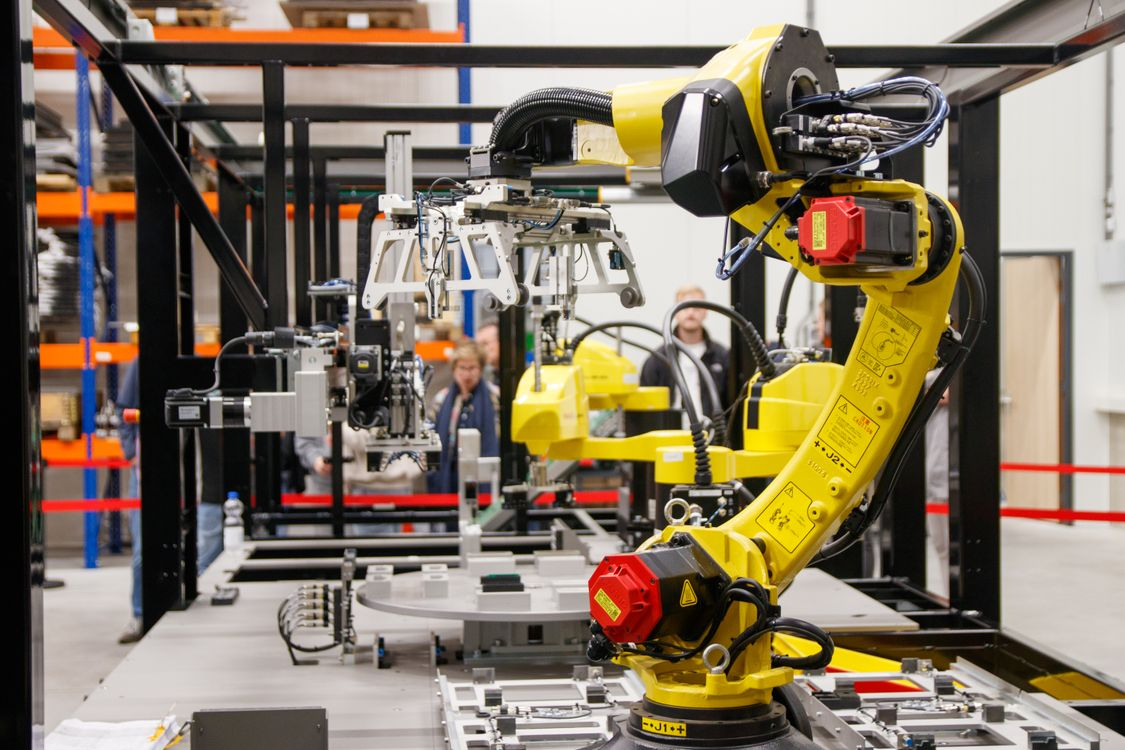
IN Brief:
- Eight robotics adoption hubs are supported through a £40 million UK programme.
- The Lincoln-based HARVEST hub includes food manufacturing among its proposed testbed applications.
- A separate £2.5 million allocation supports robotics skills and training projects.
The UK government has announced £40 million of support for eight robotics adoption hubs, including a Lincoln-based programme intended to help food manufacturers evaluate potential automated processes.
The announcement, made on 9 October 2026, describes a network of facilities intended to connect research with practical use across industry and public services. The funding should not be confused with completed robotic installations or guaranteed productivity gains at food factories.
The HARVEST hub is led by the Lincoln Institute for Agri-Food Technology. Its proposed applications span farming, horticulture and food manufacturing, providing a route for companies to examine technologies before making substantial equipment commitments.
Robotic equipment already handles products at different stages of food production, from loading and inspection to packing and palletising. The difficulty is often less about whether a robot can perform a movement and more about whether the whole process remains reliable across different products and factory conditions.
Products moving along a conveyor may vary in dimensions, position, texture and orientation. A gripping system that works consistently for rigid cartons may be unsuitable for loose produce or fragile baked goods unless the feeding and handling process is adapted.
Computer vision can help a robot identify product position, but cameras and algorithms still depend on suitable lighting, presentation and an appropriate response to unexpected conditions. Integrators must consider how inspection information becomes reliable movement commands.
This is where testing facilities can help. A manufacturer can compare different tools, sensors and handling arrangements against a representative sample of its products rather than relying on an equipment demonstration built for an entirely different application.
The original announcement does not specify a completed commercial installation at HARVEST. Its stated function is to support adoption, experimentation and informed purchasing decisions, so claims of reduced waste or faster factory output would require later measured evidence.
Hygiene requirements also affect the choice of machinery. Equipment operating close to exposed food needs cleaning arrangements suited to its use, with suitable material selection and access to surfaces that could retain residues.
The engineering assessment changes when a robot is positioned after sealed secondary packaging rather than in a primary product-contact zone. A single generic description of food-safe robotics cannot account for those differences.
Factory layout creates another constraint. An automated handling cell needs space for the robot, guarding, conveyors, rejected products, equipment maintenance and safe staff access. A compact robot arm alone does not establish the size of the complete working installation.
Automation should also be assessed at line level. Improving the capacity of one handling station may have limited value if incoming product arrives irregularly or downstream packaging equipment cannot accept the additional flow.
The adoption hubs are intended to help businesses consider these dependencies, including technical integration and the commercial circumstances in which the investment could be justified.
For smaller producers, frequent changes between products can complicate the business case. Cleaning, format changeovers, recipes and different packaging dimensions may reduce the proportion of a shift during which a robot performs its highest-speed task.
Trials can establish whether an automated process is flexible enough for those demands, and whether additional conveyors or control systems would be needed. They can also help identify training requirements before equipment arrives on site.
Safety remains a fundamental design obligation. The presence of robotics does not remove the need for risk assessment, suitable guarding, emergency-stop procedures and controlled access during maintenance or fault recovery.
The government has also announced £2.5 million for 12 robotics-related training projects. The skills allocation is separate from the £40 million adoption-hub support and should not be treated as an additional grant solely for food manufacturing.
Such training matters because machines still require operators and technicians able to recognise faults, restore production and carry out maintenance without compromising safety or product quality.
The government refers to a possible £150 billion economic contribution from robotics and autonomous systems by 2035 in a high-adoption scenario. That estimate is a modelled scenario, not a financial benefit already delivered by the new hubs.
Lincoln Institute founder Professor Simon Pearson has described the need to address technical, commercial, regulatory and workforce obstacles that can prevent businesses from adopting robotic technologies.
The network spans other applications outside food production, including health and wider manufacturing. HARVEST stands out for its role across the agri-food chain, where products can be variable and factories operate to demanding hygiene and production schedules.
The practical measure of the programme will be whether manufacturers can move from demonstrations and feasibility assessments to validated systems operating reliably within their own facilities.
No specific new food factory deployment or independently verified return on investment has yet been established by the 9 October announcement. Those would require separate customer-level evidence after the hubs begin their work.