IN Brief:
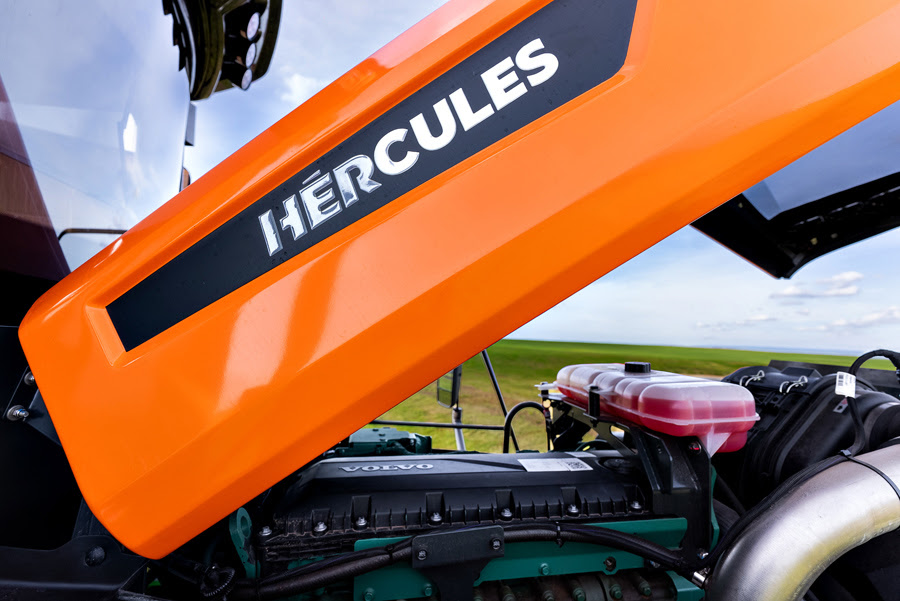
- Stara’s Hércules 9.0 self-propelled spreader uses the Volvo Penta D8 engine.
- Field use has shown working-speed gains of 10–15% and fuel reductions of 15–20%.
- The launch reflects growing demand for efficient, high-capacity machinery in precision agriculture.
Volvo Penta is powering Stara’s new Hércules 9.0 self-propelled spreader with its D8 engine, supporting higher productivity and lower fuel consumption in high-capacity agricultural operations.
The machine, displayed at Agrishow 2026 in Brazil, expands Stara’s Hércules range with a 9-tonne fertiliser hopper. The higher-capacity design is intended to increase productivity and uptime by reducing refill frequency during spreading operations.
Stara delivered 11 pilot Hércules 9.0 units to key customers in Brazil during 2025, with the machines monitored under different field conditions to validate performance and reliability. Serial production has now started, with the first customer units due to arrive this month.
The Volvo Penta D8 engine is designed to deliver high power density and strong torque at low engine speeds. In the Hércules 9.0, that low-RPM torque profile supports consistent working speed and even spreading while helping reduce fuel consumption, vibration, and noise inside the cab.
“Stara customers who have been operating the Hércules 9.0 with the Volvo Penta engine are experiencing clear productivity gains,” said Cristiano Paim Buss, Director of Research and Development at Stara. “Machines equipped with the Volvo Penta D8 are achieving increases of 10–15% in working speed, while reducing fuel consumption by around 15–20%, depending on terrain conditions.”
Fertiliser application is highly time-sensitive, particularly where weather windows, soil conditions, labour availability, and crop-stage requirements constrain fieldwork. Faster operation is valuable only when distribution accuracy is maintained, placing pressure on the relationship between engine output, driveline stability, metering, and application control.
The D8’s low-speed torque profile sits at the centre of the efficiency gains. Lower RPM can reduce fuel use and noise, while torque reserve helps maintain speed and distribution consistency across varied terrain. Hopper weight changes, field gradients, and uneven ground can all affect spreading stability.
“The strong, steady engine torque allows the machine to operate at a consistent speed, enabling an even spread,” said Gabriel Barsalini, Head of Volvo Penta Brazil. “The power density of the proven D8 and the robustness of the Volvo Penta solution have impressed Stara and its customers.”
Engine integration is becoming more strategic in agricultural machinery. Customers are evaluating total cost of ownership rather than headline power alone, especially in markets where fuel cost, uptime, operator comfort, and service access shape machine economics over multiple seasons. A powertrain that cuts fuel consumption while supporting higher work rates can reduce cost per hectare for contractors and larger farming operations.
The launch also aligns with a broader move towards precision agriculture machinery with stronger connectivity, monitoring, and operational control. Stara’s wider 2026 equipment updates include machine monitoring, telemetry, satellite connectivity, and synchronised operation capabilities across planting, spraying, and spreading lines.
Agrishow remains a major platform for agricultural technology in Brazil, where large-scale farming creates demand for machines that can cover ground quickly and reliably. The Hércules 9.0 combines hopper capacity, torque delivery, and lower fuel use in a format built around higher uptime and tighter integration between mechanical power and precision control.