IN Brief:
- Wilson’s Country is using digestate as the main fertiliser input for a commercial Manhattan potato crop.
- The digestate comes from an anaerobic digestion plant using potato peel from the company’s processing operations.
- Harvest results will be compared with potatoes grown under a conventional fertiliser regime.
Wilson’s Country is using digestate from its anaerobic digestion plant as the principal fertiliser source for a commercial potato crop in Northern Ireland.
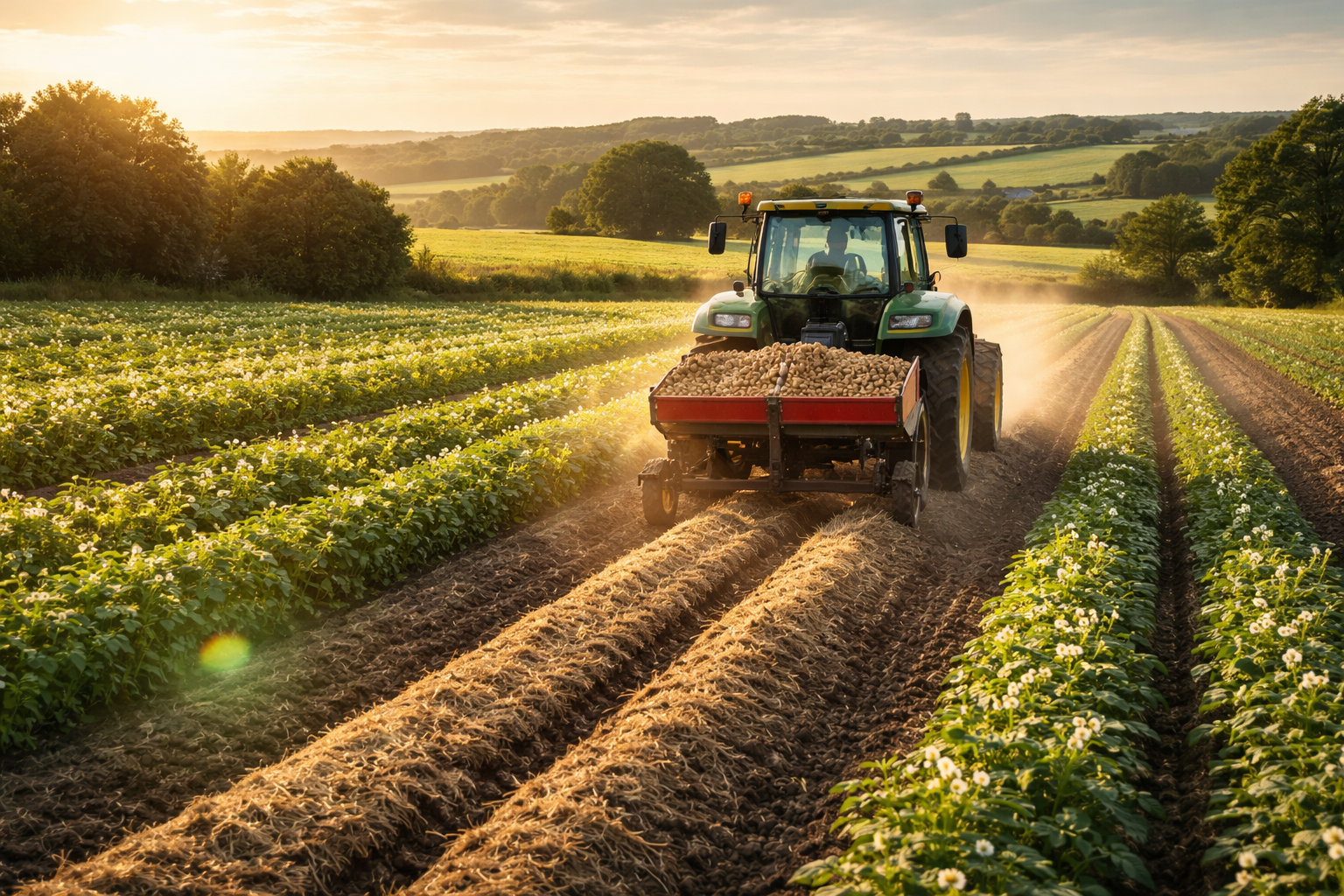
The processor and packer selected the second early Manhattan variety for the project, planting the crop at the end of April on ground with high organic matter. Harvest is expected in mid September, subject to weather conditions.
Digestate was applied before ploughing and planting, replacing the principal conventional fertiliser input. The material comes from Wilson’s anaerobic digestion operation, where waste potato peel forms an important part of the feedstock.
Electricity generated by the digester now supplies almost 60% of the company’s requirement. A solar array has also been installed at its cold store, while much of its product is distributed by McCulla Ireland vehicles using renewable biomethane rather than diesel.
Digestate alone cannot provide all the nitrogen required by the crop, so the trial includes a water soluble mineral catalyst within the fortnightly blight spray programme. The treatment is intended to convert atmospheric nitrogen oxides and nitrous oxide into nitrate that can be absorbed through the leaves.
The agronomy team expects the catalyst to provide as much as 50kg per hectare of plant available nitrogen during the growing season. Following harvest, the crop’s carbon footprint will be compared with Manhattan potatoes produced under a standard fertiliser regime.
Factory residue returns to production
The project connects waste treatment, energy generation, nutrient recovery, crop production, and potato processing within the same commercial chain. Peel leaves the factory, enters digestion, produces electricity, and returns to the field through digestate before the harvested potatoes re-enter packing or processing.
Digestate can displace part of the mineral fertiliser requirement while providing an outlet for nutrients retained after anaerobic digestion. Its performance varies with feedstock, storage, dry matter, nitrogen form, application timing, soil type, and weather.
Accurate analysis is therefore needed before application because digestate is not a standardised fertiliser bag. Nutrient content must be matched to crop demand, existing soil fertility, environmental limits, and the contribution expected from other treatments.
Potatoes respond strongly to nitrogen management. Insufficient supply can restrict canopy development and tuber bulking, while excessive nitrogen may delay maturity, reduce dry matter, impair skin set, and create storage or processing difficulties.
The trial must consequently be judged through marketable yield and quality rather than carbon measurement alone. Tuber size, shape, dry matter, defects, storage stability, and packout will influence whether the approach remains viable after harvest.
Research linking soil management with improved drought resilience has placed field performance alongside environmental measurement. Wilson’s project takes a related step by connecting recovered factory nutrients with a commercial crop specification.
Carbon accounting moves upstream
Processing efficiency, renewable electricity, and lower emission transport can reduce the footprint controlled directly by a factory, although agricultural production remains a large component of potato emissions. Fertiliser manufacture and nitrous oxide released after application are particularly significant.
Moving the programme into the field creates a more demanding data requirement. Wilson’s will need records covering digestate composition, field operations, fuel, spray applications, machinery, yield, waste, storage losses, and transport before the two production systems can be compared fairly.
Differences in marketable output must be included because a lower footprint per hectare can conceal weaker efficiency per tonne of usable potatoes. Waste created through poor size distribution or lower storage performance would transfer environmental cost further along the chain.
Commercial adoption will also require repeatability. A result achieved on high organic matter soil may not transfer directly to lighter ground, another variety, different rainfall, or a crop intended for a different processing use.
Digestate logistics impose their own constraints because the material contains substantial water and is expensive to move over long distances. Storage capacity, spreading equipment, field access, odour, and application windows determine how widely the practice can be used.
The mid September harvest will provide the first full measure of agronomic and carbon performance. A successful result would give Wilson’s a practical route for returning nutrients from processing to agriculture while reducing reliance on purchased fertiliser and preserving the potato quality required by its factory and customers.