IN Brief:
- Yangi is entering the US market with plates, bowls, beverage lids, and takeaway trays for quick-service food packaging.
- The company says Cellera can run 4.3-second cycles, use 1.8 kWh/kg, and cut process-water demand by 90–99% against conventional wet moulding.
- Its first serial Cellera platform is operating at a European converter site ahead of the technology's October Pack Expo launch in Chicago.
Yangi is taking its Cellera dry-forming platform into the US quick-service food packaging market, offering converters a system for producing fibre-based plates, bowls, beverage lids, and takeaway trays without the water-intensive forming process associated with conventional wet moulding.
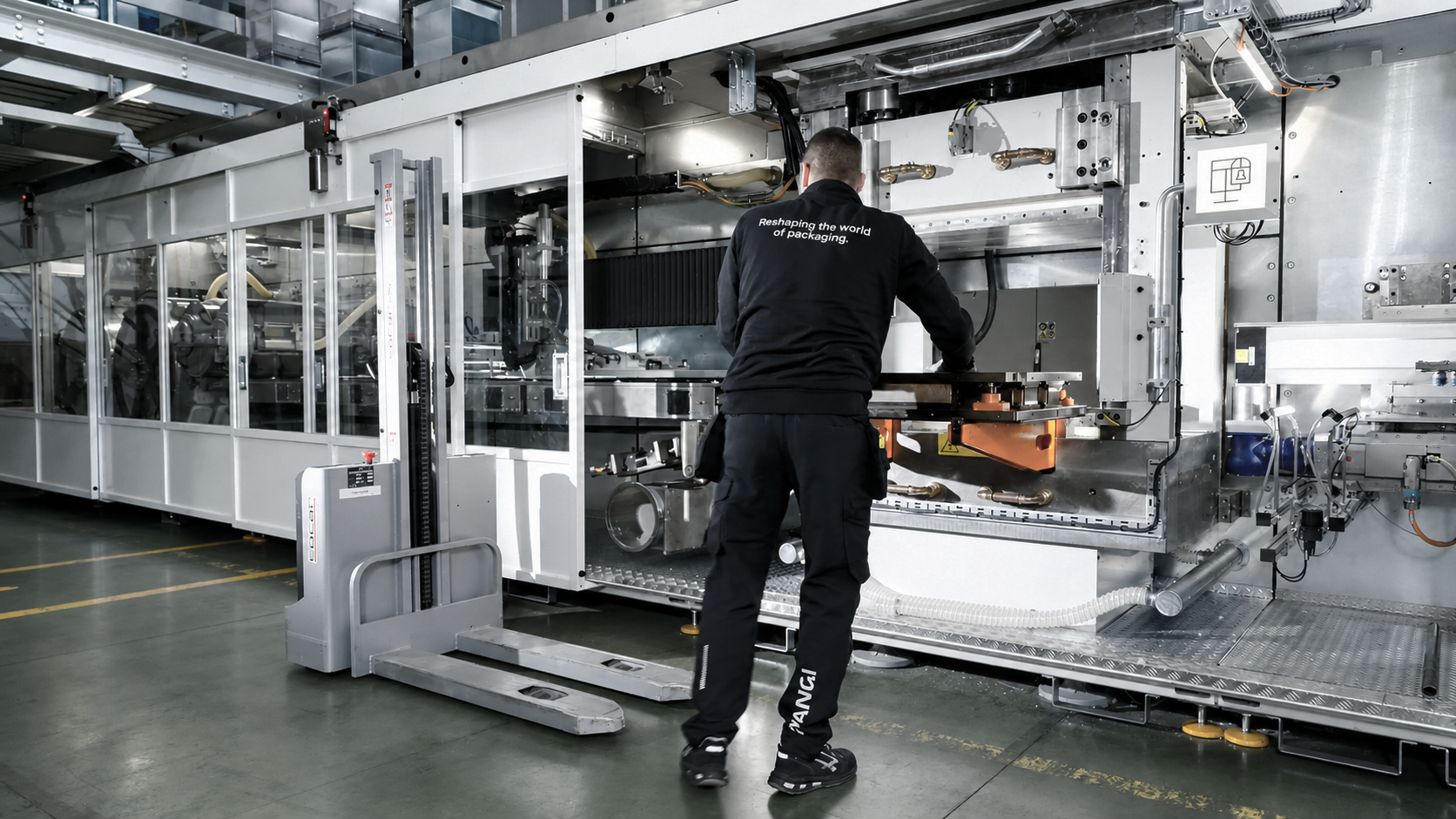
The Swedish developer will present Cellera at Pack Expo International in Chicago from 18 to 21 October, following the commissioning of its first serial platform at a European converter earlier this year. Yangi says feedback from that installation has demonstrated continuous operation, repeatable product quality, high uptime, and fast production cycles under commercial manufacturing conditions.
Cellera combines dry fibre formation with thermoforming, eliminating the water slurry and separate drying stages used in traditional wet-moulded fibre production. Yangi claims cycle times as short as 4.3 seconds, compared with 30 to 60 seconds for conventional wet moulding, while electricity use is stated at 1.8 kWh/kg against 4 to 7 kWh/kg for the conventional process.
The company also claims a 90–99% reduction in process-water demand and electricity savings of 55–75%, with the energy comparison based on a third-party verified life-cycle assessment. Those figures remain manufacturer claims, but they address two of the main operating burdens associated with moulded fibre: drying energy and the infrastructure required to manage large volumes of process water.
Removing those stages changes the production layout as well as utility demand. A dry process can reduce the need for water handling, drying capacity, and associated plant services, while shorter forming cycles potentially bring fibre packaging closer to the throughput expected from established high-volume food packaging processes.
Hanna Rüdel, chief commercial officer at Yangi, said: “Converters and brands are seeking solutions that combine high operational performance with improved resource efficiency.”
The platform uses Yangi’s FiberIQ fibre-formation system to control fibre distribution during forming, with the aim of maintaining material consistency and structural performance across the finished part. Industrialisation has involved GDM, part of Coesia, and Swedish press specialist AP&T, adding established machine-building and forming expertise to the development programme.
That engineering support is important as dry forming moves beyond demonstration equipment. Producing a convincing sample tray is considerably easier than holding dimensions, material distribution, cycle time, and uptime across long production runs, particularly when the same platform is expected to manufacture several geometries and sizes.
Beverage lids, bowls, and takeaway trays also impose different mechanical requirements. Lids need dimensional accuracy and reliable fit, while trays and bowls have to resist deformation during filling, handling, transport, and use. Grease and moisture resistance can add another layer of complexity where the fibre structure has to work with coatings or barrier treatments without undermining recycling performance.
Yangi says its US offer uses renewable, FSC-certified fibre and is PFAS-free, while the finished formats are intended to work within established paper recycling streams. Those attributes will still have to be assessed against the barrier, sealing, contamination, and shelf-life requirements of individual food applications rather than treated as universal characteristics of every possible pack.
The company’s initial US emphasis is quick-service food packaging, a market in which high volumes make relatively small differences in cycle time, material consumption, or utilities significant at plant level. Yangi also argues that tariffs and anti-dumping measures affecting imported moulded-fibre products are strengthening the case for domestic converting capacity, although the scale of that opportunity will depend on individual converter economics and customer demand.
Before the US launch, Yangi tested dry-formed takeaway trays in a live foodservice environment with Swedish catering operator Flavor Boss. The trays were manufactured on the company’s industrial demonstration line in Varberg and used through a full day of festival service, giving the developer handling and performance feedback outside laboratory conditions.
Its technical centre is also being used to validate pack formats and materials at industrially relevant volumes before customers commit to serial production. That intermediate step allows fibre distribution, geometry, tooling, cycle settings, and downstream handling to be adjusted before a converter has to absorb those variables on a commercial line.
Speed remains one of the more significant claims around Cellera. Conventional wet moulding has long been established for fibre foodservice packaging, but slower forming and drying cycles can make it difficult to compete with mature plastic-conversion processes on throughput alone. A 4.3-second cycle, if sustained across serial production and different pack formats, would narrow that gap substantially.
Utility consumption will be tested just as closely. Water and energy savings have direct operating consequences, particularly where converters face constrained utilities, high energy prices, or limited space for drying and water-treatment infrastructure. The value of a lower-consumption process will ultimately depend on total line output, maintenance, tooling, fibre costs, waste rates, and product quality rather than any single headline metric.
Cellera therefore reaches the US with more evidence behind it than a laboratory-scale concept but still with a limited commercial installation base. The first serial system is operating in Europe, and Pack Expo will put the technology in front of North American converters looking at domestic fibre capacity.
The next measure is straightforward: repeated production on customer sites. Cycle time, uptime, pack consistency, and utility consumption will determine whether dry forming can establish itself as a practical high-volume alternative rather than another promising fibre process that performs better in demonstrations than it does on a factory floor.