IN Brief:
- A 202-hectare commercial-scale site in North Yorkshire will start potato production in 2026.
- The farm will pilot a circular nutrient system using pig manure, alongside controlled-traffic farming and year-round soil cover.
- McCain says results will feed into its network of 4,400 growers, supporting its 2030 regenerative acreage target.
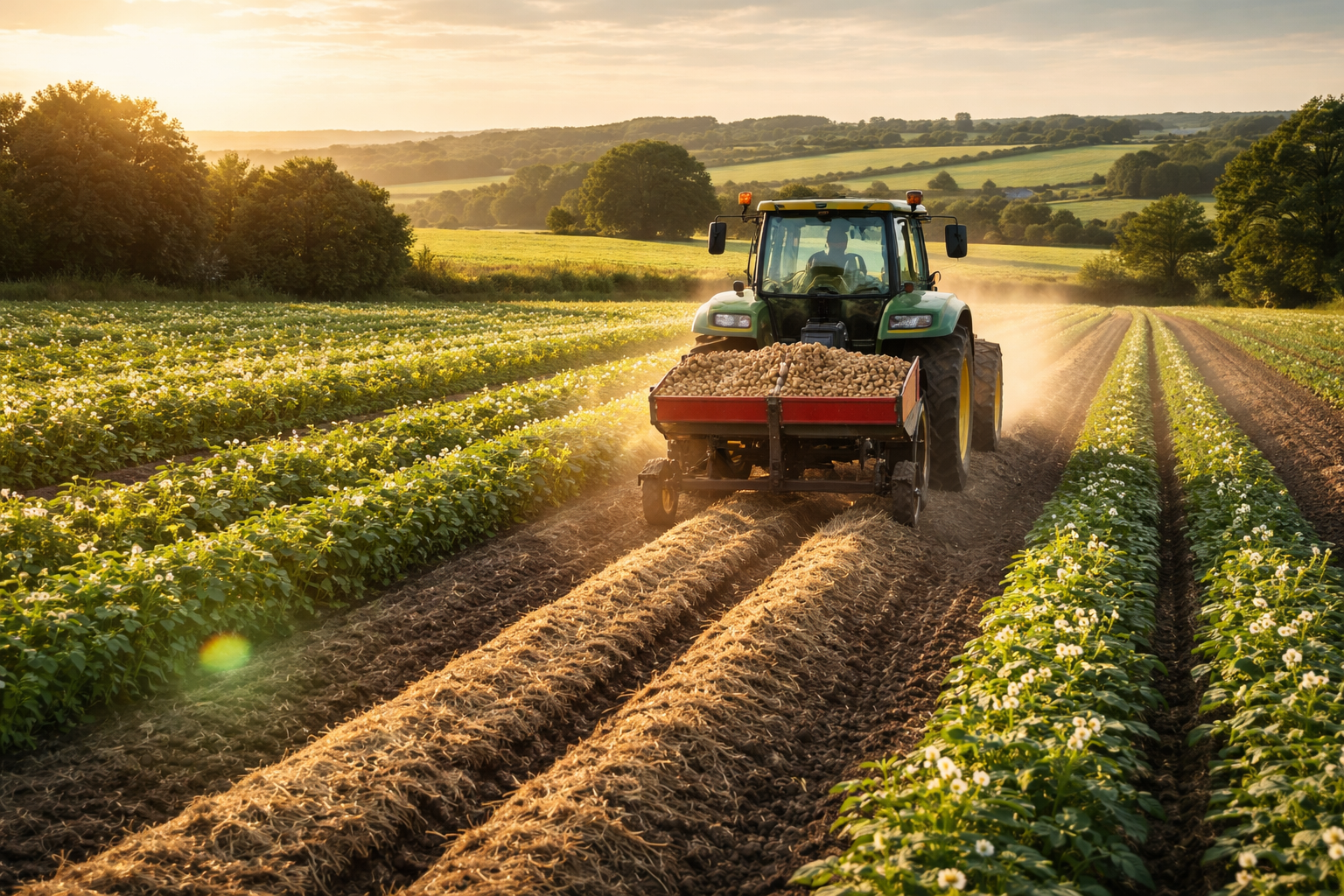
McCain Foods is establishing a new Farm of the Future in North Yorkshire, positioning the 202-hectare site as a working testbed for regenerative practices in a British potato supply chain facing tighter agronomy margins and more volatile weather.
The farm, due to begin potato production in 2026, will be run in partnership with the University of Leeds and is intended to generate publishable, field-scale data rather than small-plot evidence. McCain said it will use the site to trial controlled-traffic farming, year-round soil cover, and biodiversity-building approaches, with independent validation across soil health, biodiversity, and greenhouse gas emissions.
One of the more practical interventions is a circular nutrient system, developed with the University of Leeds’ adjacent National Pig Centre, using pig manure to enrich soils and reduce reliance on synthetic inputs. The aim is to quantify whether mixed farming inputs can lift soil function and biodiversity while lowering emissions intensity, without relying on idealised trial conditions that do not survive a wet autumn or a tight planting window.
McCain said its internal “Farmdex” research shows 77% of British farmers agree sustainable practices are essential, and it is framing the new farm as a de-risking mechanism for growers and processors trying to maintain yield stability and tuber quality with fewer inputs. The site also expands the company’s “Farms of the Future” footprint beyond existing operations in Florenceville, New Brunswick, and Lichtenburg, South Africa, with McCain stating learnings will be shared across its global network of 4,400 farmers.
Max Koeune, President and CEO at McCain Foods, said: “McCain Farm of the Future UK marks an important step in how we are scaling regenerative agriculture across our global Farms of the Future. Each site helps us test real solutions with farmers, understand what works, and share that knowledge across our network. This is how we strengthen the resilience of our farms, support our partners, and build a more sustainable food system for the long term.”
The University of Leeds is treating the collaboration as a long-horizon research platform. Professor Stefan Kepinski, Head of the School of Biology at the University of Leeds, said: “Growing potatoes more sustainably requires innovation and the optimisation of every component of the arable rotation, from reducing inputs and emissions, building soil health and biodiversity to alternative energy, robotics, AI and digital agriculture.”
Beyond agronomy, McCain and the University cited autonomous vehicles and alternative fuels for farm equipment as part of the programme scope — a nod to the reality that field operations, not just fertiliser, can dominate emissions in certain production profiles.
McCain is tying the farm launch to its broader regenerative roadmap. The company states it is committed to implementing regenerative agriculture practices across 100% of its global potato acreage by the end of 2030. In Great Britain, McCain reported that 86% of its potato acreage is “Engaged” or higher within its Regenerative Agriculture Framework, alongside a 25% reduction in Scope 1 and 2 emissions and a 19% reduction in water intensity since 2017.
For potato processors, the value is not the branding — it is whether the data holds up across seasons, varieties, and contract structures, and whether a “blueprint” can translate into measurable improvements in storage losses, disease pressure, and input risk.