IN Brief:
- ITI Group will design and implement the MES for Fazer’s new confectionery plant in Lahti.
- The deployment covers recipe control, material handling, performance monitoring, and traceability.
- Large food factories are being built with digital execution at the centre of plant operations.
ITI Group has been selected to design and implement the manufacturing execution system for Fazer’s new confectionery factory in Lahti, Finland, extending its role in a project that has already become one of the most prominent food manufacturing investments in northern Europe. The MES deployment will support a plant designed around high automation, energy efficiency, and expanded production capacity for Fazer’s confectionery business.
ITI Group had already been involved in the programme through the early design and consulting stages, helping to define business and technical requirements before this implementation phase. That continuity should give the project a more coherent digital foundation, particularly in a factory where equipment integration, process control, and production data will need to work together from the start.
The system will be built on Parsec Automation’s TrakSYS platform and is intended to cover the full facility. The scope includes recipe and material handling, real-time performance monitoring, quality management, product genealogy, and track-and-trace functions, alongside integration with SAP for supplier-chain and invoicing processes. In confectionery production, those disciplines are tightly linked. Recipe control, ingredient movement, batch integrity, and equipment performance all feed directly into product consistency and plant efficiency.
That is particularly true in a large, newly built operation where multiple production assets and digital systems must be commissioned in parallel. A confectionery plant can be highly automated and still struggle if recipe governance is weak, line data is fragmented, or material handling is not aligned with the pace of production. MES sits in the middle of those risks. It connects operational events on the floor with the production rules, quality checks, and reporting structures that keep the plant stable.
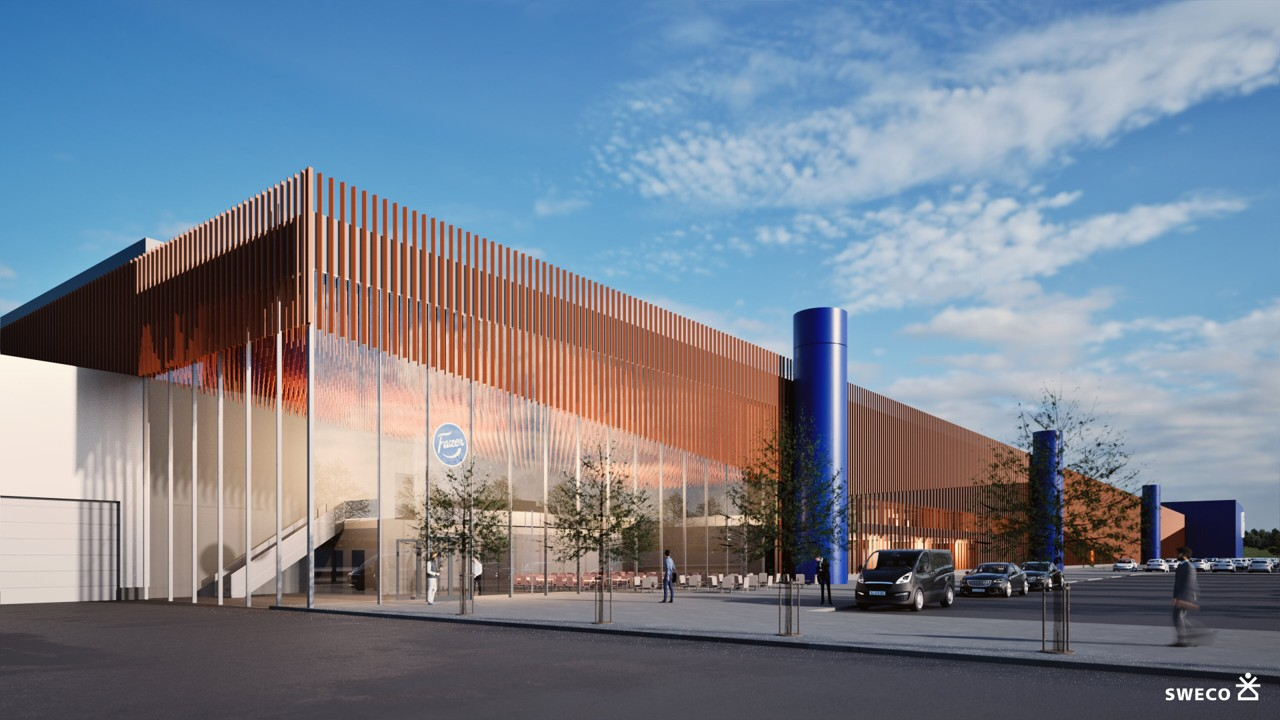
Fazer’s Lahti project is substantial in both industrial and commercial terms. Construction on the 33,300 square metre factory began in 2025, with operations expected to start in 2027 and full capacity to follow in 2028. The company has described the site as a key platform for international growth, particularly in exports and travel retail. It has also said the factory will use comprehensive energy recycling and operate without CO2 emissions. The digital layer selected for the plant will therefore shape not only internal control, but also how quickly the site can scale and how effectively it can prove performance.
For the food sector more broadly, the project reflects how factory design is changing. MES used to be treated in some businesses as an additional software layer justified mainly by traceability or reporting. In major new food plants, it is increasingly part of the core architecture. Manufacturers want recipe execution, operator workflow, asset monitoring, genealogy, and data integration designed into the plant rather than added later as corrective projects.
That is becoming harder to avoid in complex categories such as confectionery. Plants are expected to manage recipe precision, allergen control, packaging coordination, batch accountability, and supplier integration without losing speed or flexibility. Those expectations make a fragmented digital environment increasingly difficult to live with. A unified execution layer offers tighter control, faster root-cause analysis, and a clearer path to standardisation across shifts and product lines.
The MES market has benefited from that change in thinking. Food manufacturers are looking beyond simple dashboards and asking for systems that can govern production in a more structured way, particularly where greenfield sites are concerned. The strongest projects now tend to begin with questions about process discipline and data architecture rather than with software features alone. Integration partners that understand both manufacturing reality and system design are in a stronger position in that environment.
The Lahti project will still be judged on delivery. Large factory programmes rarely move from commissioning to steady-state operation without friction, and software layers are often tested hardest when live production starts to expose the exceptions that no design phase can fully predict. Even so, Fazer’s decision to place MES at the centre of the new factory is a clear sign of where food manufacturing investment is heading. Digital execution is no longer a modernisation extra. In major new plants, it is part of the infrastructure.